Clear Sky Science · en
Kinematic and aerodynamic modeling of flexible wings with wing root adjustment for flapping wing micro aerial vehicles
Why tiny flapping robots matter
Imagine a palm-sized flying robot that can hover like a hummingbird, slip through rubble after an earthquake, or inspect the inside of a machine where larger drones cannot go. To make such insect-inspired micro air vehicles practical, engineers must understand how their paper-thin wings flex, twist, and push against the air. This paper tackles a key missing piece: how to predict the forces and tipping moments produced when the roots of flexible wings are actively twisted to steer a tailless, hovering robot.

How insect-like robots steer without tails
Many small flapping robots copy insects by using two wings and no tail. Steering them is surprisingly hard. Simply flapping faster or harder can change direction, but this couples up-and-down force with turning, making control clumsy. The design explored here uses a more elegant approach: the wing roots themselves can twist. By twisting both roots the same way, the robot pitches forward or backward; by twisting them together sideways, it rolls; by twisting them in opposite directions, it yaws. All of this depends on how the flexible wing surface deforms in response to that twist, changing the angle at which different parts of the wing meet the oncoming air.
Breaking wing motion into simple building blocks
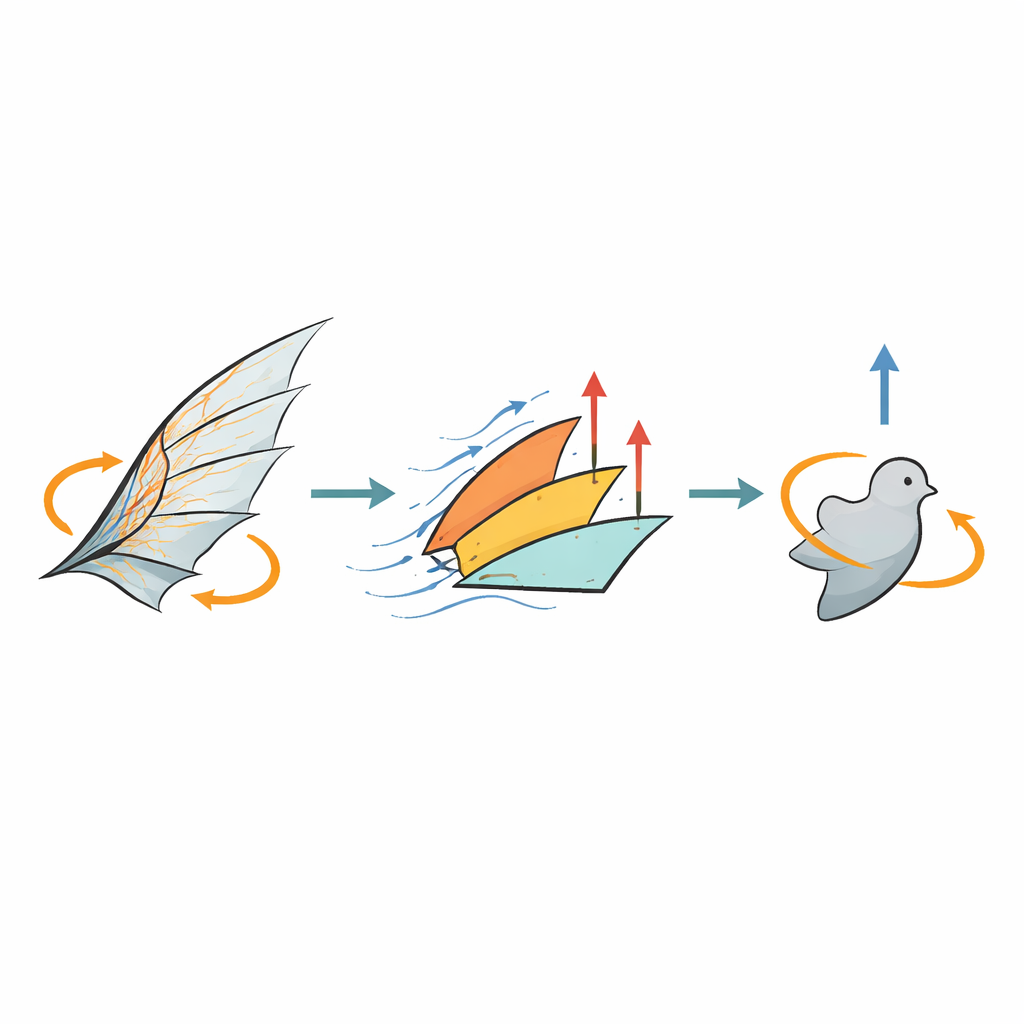
The authors first build a detailed mathematical description of how the wings move. Rather than treating a wing as a rigid plate, they recognize that the wing spar and its main veins do not flap in perfect lockstep. Instead, there is a small phase delay, called the relaxation phase angle, that captures how the membrane lags behind the driving structure. The team represents the flapping motion as a combination of a straight-line (triangular) sweep and a smooth sinusoidal curve, which together mimic real trajectories recorded by high-speed cameras. They then relate the phase differences between spar and veins to how much the wing root is twisted, for both pitch and roll commands, so the model can predict the three-dimensional shape and timing of a flexible wing during every part of a wingbeat.
Turning bending wings into manageable pieces of airflow
Modeling the air around a fully flexible wing in fine detail would normally require heavy-duty fluid simulation, far too slow for design studies or onboard control. To avoid this, the authors introduce a clever shortcut. They slice the deforming wing surface into a small number of rigid planar patches based on the natural vein network: three main panels that tilt and sweep during the flap. For each panel, they use a standard “blade element” approach, computing the lift and drag produced by many tiny strips along the span, while accounting for both sweeping motion and wing rotation. Adding the contributions of all panels gives an estimate of the total force and the twisting moment acting on the robot, with much less computation than full-blown fluid–structure simulations.
From equations to forces and moments in the lab
To test their framework, the researchers built a prototype flapping-wing robot with rope-driven wings and adjustable wing roots. Using high-speed cameras and a six-axis force sensor, they measured actual wing shapes, flapping amplitudes, lift, and control moments over a range of frequencies and root twists. The same conditions were then fed into two models: a traditional single-plane approximation and the new multi-plane method. While the simple model tended to overestimate lift—because it used one fixed attack angle for the whole wing—the multi-plane method, with its panel-based attack angles, matched experiments much more closely. Across a practical range of flapping frequencies, its lift predictions stayed within about 20 percent of measured values, and it accurately captured how pitch and roll commands reduce lift slightly while producing control moments that grow almost perfectly linearly with command strength.
What this means for future tiny flyers
For non-specialists, the key takeaway is that the authors have provided a fast, reasonably accurate way to predict how flexible wings respond when you twist their roots to steer a tiny flying robot. By combining a realistic yet compact description of wing motion with a panel-based airflow model, they show that designers can estimate lift, drag, and control moments without expensive simulations or endless trial-and-error. This gives engineers a practical toolkit for tuning wing geometry, flapping frequency, and control strategies so that insect-like micro air vehicles can hover steadily and respond crisply to steering commands, bringing agile, bug-sized robots a step closer to everyday use.
Citation: Liu, Z., Zhang, X., Wang, Z. et al. Kinematic and aerodynamic modeling of flexible wings with wing root adjustment for flapping wing micro aerial vehicles. Sci Rep 16, 9827 (2026). https://doi.org/10.1038/s41598-026-40582-8
Keywords: flapping wing micro air vehicle, flexible wings, wing root control, aerodynamic modeling, bioinspired robotics