Clear Sky Science · en
Frequency domain analysis of torsional vibration of single pile in orthotropic viscoelastic layered foundation
Why twisting foundations matter
When we picture earthquakes, storms, or waves battering a structure, we often think of buildings swaying back and forth. But many foundations are also shaken in a twisting, or torsional, way. For tall or slender structures such as wind turbines, offshore platforms, and high-rise buildings, this twisting can concentrate stress in the piles that anchor them to the ground. The paper summarized here develops a new mathematical framework to better predict how a single pile twists when it is embedded in complex, layered soils that both absorb energy and behave differently in horizontal and vertical directions.
How a single pile talks to layered ground
Modern foundations commonly rely on long concrete piles driven deep into the earth, passing through several soil layers with very different stiffness and density. In reality, these soils are not uniform: natural sediments often resist shear forces more strongly in one direction than another, and they also behave like a mixture of elastic solid and thick fluid, slowly relaxing and dissipating energy. The authors model a single cylindrical pile surrounded by multiple horizontal soil layers, each with its own stiffness, density, and energy-loss properties. They focus on torsional loading—twisting at the pile head—such as might be caused by the rotating machinery and wind forces in an offshore wind turbine. 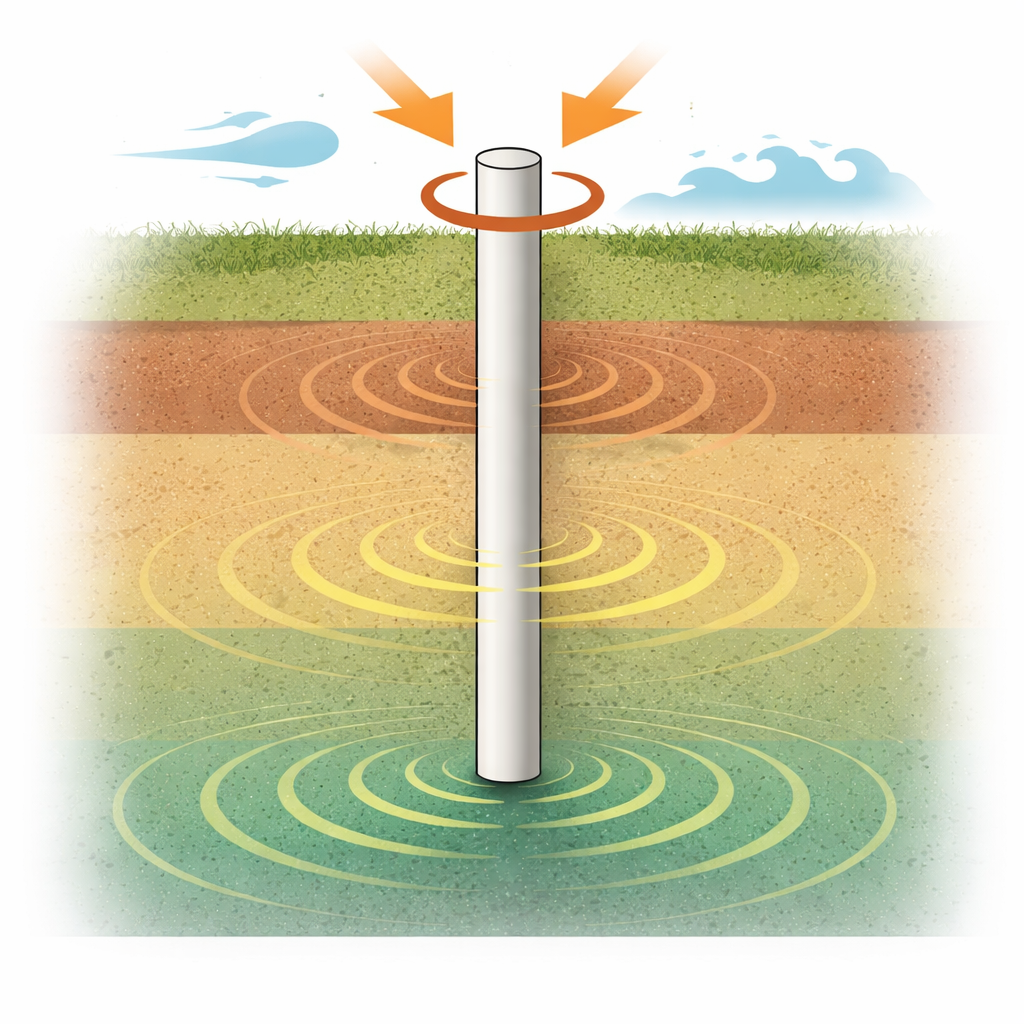
A smarter way to describe how soil gives and recovers
To capture the subtle time-dependent behavior of real soils, the study adopts a three-parameter "standard linear solid" model. In simple terms, this treats the soil like a combination of springs and dashpots: one spring responds instantly, another spring responds more slowly, and a viscous element represents the gradual loss of energy as heat. This arrangement allows the soil to creep under steady load and to relax stress when deformation is held fixed, matching laboratory observations more closely than traditional models. The authors embed this viscoelastic description into a stiffness matrix that distinguishes horizontal from vertical directions, thereby representing layered ground that is stiffer sideways than it is vertically. Tests against experimental data show this three-parameter model reproduces instantaneous stiffness, delayed stiffness, and relaxation time with far smaller errors than classic Kelvin or Maxwell models.
Peeling back the math to see waves and energy flow
Although the underlying problem is three-dimensional, the authors use a mathematical tool called a Hankel transform to reduce the soil motion to a simpler, axisymmetric form. This lets them write the behavior of each soil layer using ordinary differential equations with depth, then connect layers using a transfer-matrix approach. The result is an explicit formula for the complex torsional stiffness of the pile head as a function of frequency. The "real" part of this stiffness measures how strongly the pile resists twisting, while the "imaginary" part reflects damping—how efficiently the system dissipates vibrational energy. By varying soil parameters in the model, they systematically explore how anisotropy, viscosity, layer thicknesses, and imperfect contact between pile and soil shape the frequency response. 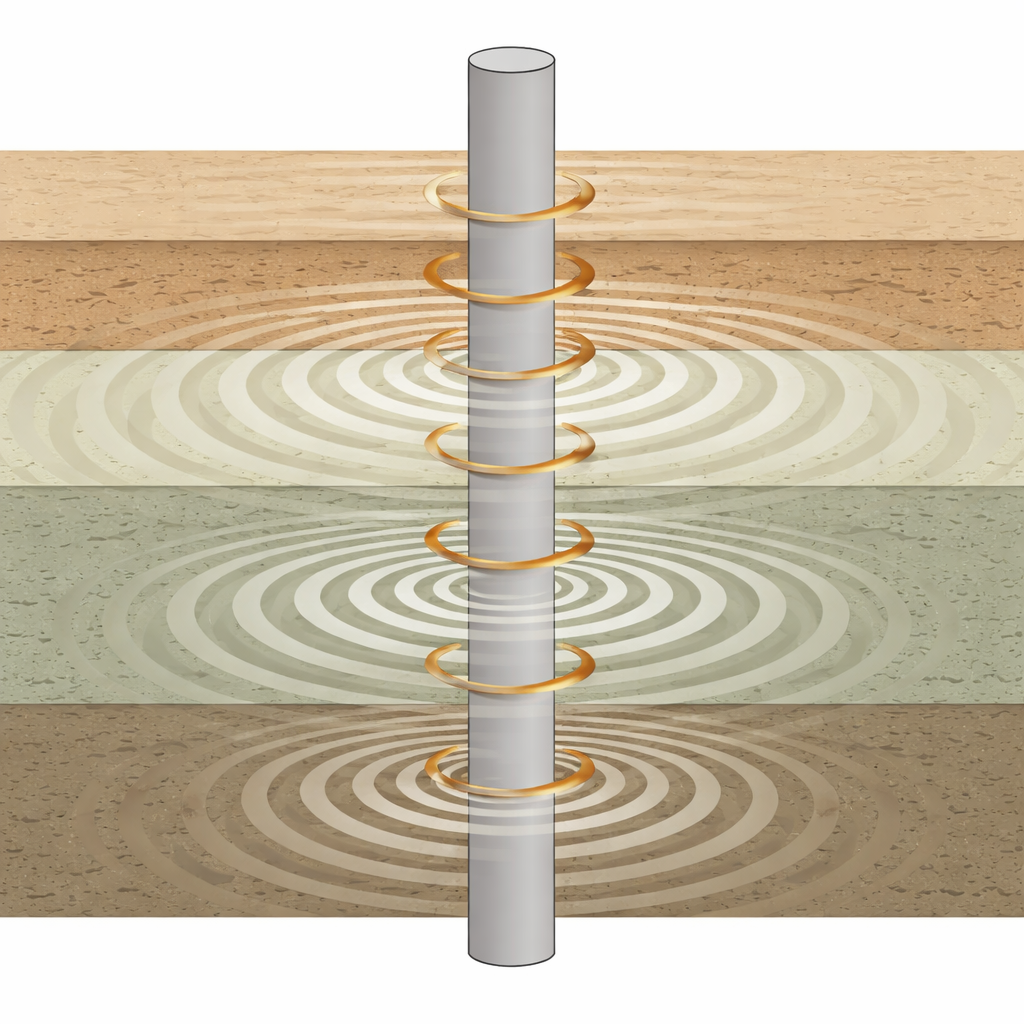
What controls twisting risk in real projects
The simulations reveal several practical trends. First, when the soil is much stiffer in the horizontal direction than in the vertical, the pile becomes harder to twist and its natural torsional frequency shifts upward. That can improve low-frequency stiffness but risks pushing resonance into the range excited by machinery or waves. Second, increasing the soil’s viscous component greatly reduces the height of resonance peaks and broadens them, spreading energy over a wider frequency band and helping to damp vibrations. Third, how the soil layers are stacked matters: a "hard–soft–hard" sandwich can boost low-frequency capacity and filter out certain high-frequency components. Finally, if the pile and soil can slip against each other, the system loses high-frequency torque transfer but also redistributes energy, further broadening the response. The authors condense these insights into simple design formulas for choosing anisotropy and damping targets and for arranging soil improvement around piles.
From theory to safer foundations
To test the engineering relevance of their framework, the authors apply it to an offshore wind turbine supported by a single large-diameter pile. By adjusting soil properties around the pile—reducing directional imbalance, increasing damping via additives, and reconfiguring the effective stiffness profile—they show that the mismatch between predicted and observed resonance frequencies can be reduced dramatically, while the ultimate torque capacity of the foundation can be raised by nearly one-third. In everyday terms, the work shows that by carefully characterizing and, where possible, tailoring the surrounding ground, engineers can design pile foundations that twist less, absorb damaging vibrations more effectively, and offer larger safety margins under extreme dynamic loading.
Citation: Lian, Z., Zhu, Y. & Jiu, Y. Frequency domain analysis of torsional vibration of single pile in orthotropic viscoelastic layered foundation. Sci Rep 16, 11895 (2026). https://doi.org/10.1038/s41598-026-39773-0
Keywords: pile foundation dynamics, torsional vibration, viscoelastic soil, layered anisotropic ground, offshore wind turbines