Clear Sky Science · en
Integrating Lyapunov based backstepping and neuro fuzzy logic with sliding mode control for precise trajectory tracking of differential drive robots
Robots That Stay on Track
From warehouse pickers to planetary rovers, many robots move on two driven wheels like a powered wheelchair. Making these machines follow a path with centimeter-level precision is harder than it looks: floors are uneven, wheels slip, motors saturate, and the robot’s own mechanics are tricky. This paper introduces a new brain for such robots—a control scheme called the Fixed Ultra‑Hybrid Adaptive Controller (FUHAC)—designed to keep a two‑wheeled robot glued to its planned route, even when the world around it is messy and changing.
Why Guiding Two Wheels Is So Hard
Differential‑drive mobile robots steer by spinning their left and right wheels at different speeds. This simple layout hides difficult physics. The robot cannot move sideways, its center of mass may be off‑center, and friction, bumps, and unknown loads constantly nudge it off course. Classic controllers like PID or even more advanced single‑method schemes work well only in narrow conditions: they may track smoothly on gentle curves but struggle with sharp turns, sudden pushes, or imperfect models. Researchers have tried adding learning modules, fuzzy logic, or robust control layers, yet these hybrids usually glue pieces together in an ad hoc way, without a solid guarantee that the whole stack will remain stable.
Blending Several Brains Into One
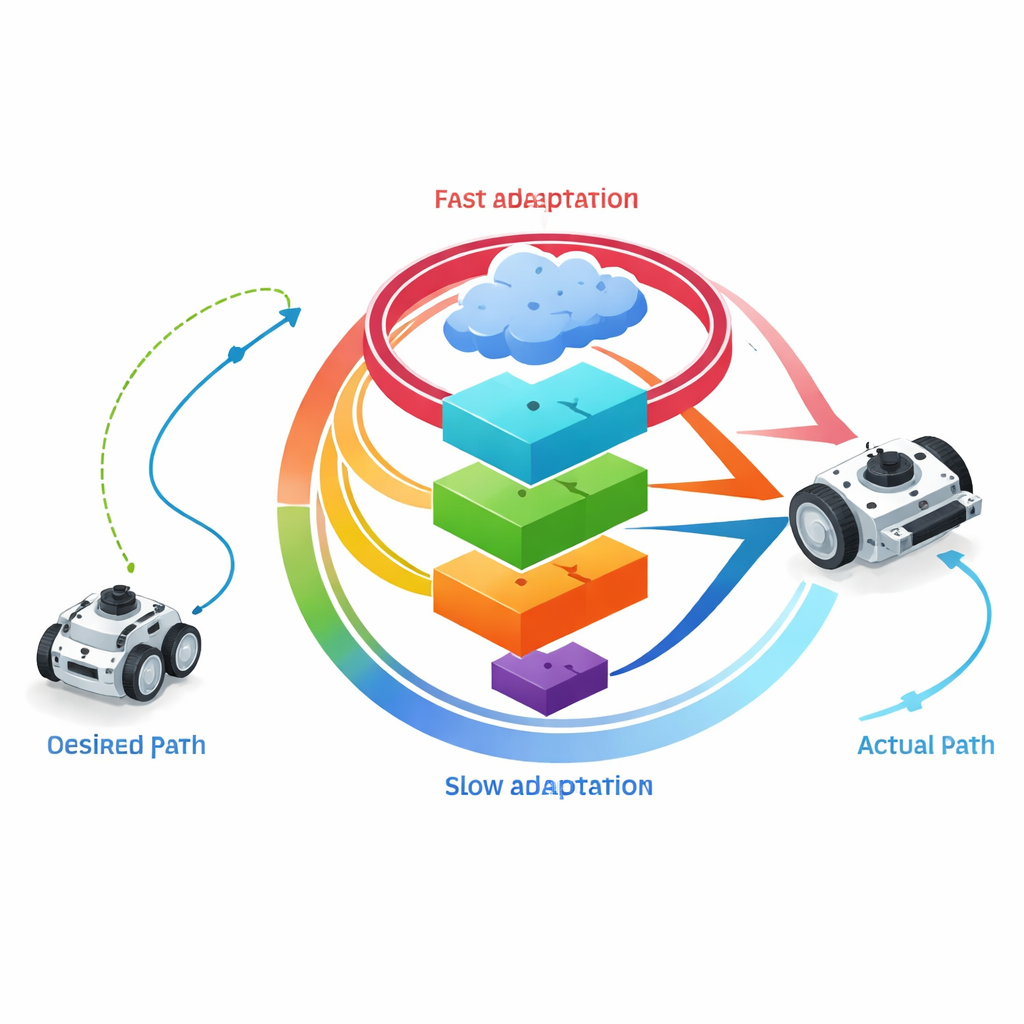
The authors propose FUHAC as a unified architecture that deliberately combines four different control ideas, each handling a different part of the problem. A backstepping core provides smooth, model‑based steering that, in theory, brings the robot toward the desired path. A neuro‑fuzzy module sits on top of this baseline and learns to cancel out unknown effects—such as unmodeled friction or small mechanical quirks—by observing how the robot’s tracking error evolves. A sliding‑mode layer adds a tough, protective shell that reacts quickly to larger disturbances and guarantees that bounded pushes and gusts can be rejected in finite time. Finally, a disturbance observer watches the robot’s motion and infers the external forces acting on it, so the controller can proactively counter them rather than merely reacting afterward. Instead of mixing these elements with fixed weights, FUHAC uses a performance‑based blending factor that shifts influence among them in real time, depending on how large and how oscillatory the tracking error is.
Fast Reactions, Slow Learning
A key innovation in FUHAC is the way it separates rapid reflexes from slower, strategic adjustments. The controller runs two adaptation clocks: a fast loop, updated every 30 milliseconds, that tweaks gains to quench sudden deviations and oscillations, and a slower loop, updated every 150 milliseconds, that gradually tunes parameters for long‑term accuracy and energy efficiency. This dual‑rate scheme is chosen so that the robot feels the slow parameters as almost fixed while it deals with fast motion, a principle inspired by time‑scale separation in control theory. To keep everything mathematically in check, the authors construct a single energy‑like function (a Lyapunov function) that captures tracking errors, learning errors, sliding behavior, and disturbance‑observer errors all at once. They then show that, under reasonable assumptions, this energy can only decrease or level off, which means the robot’s deviation from the path remains bounded and, if approximation errors and disturbances fade, even vanishes over time.
Putting the Controller to the Test
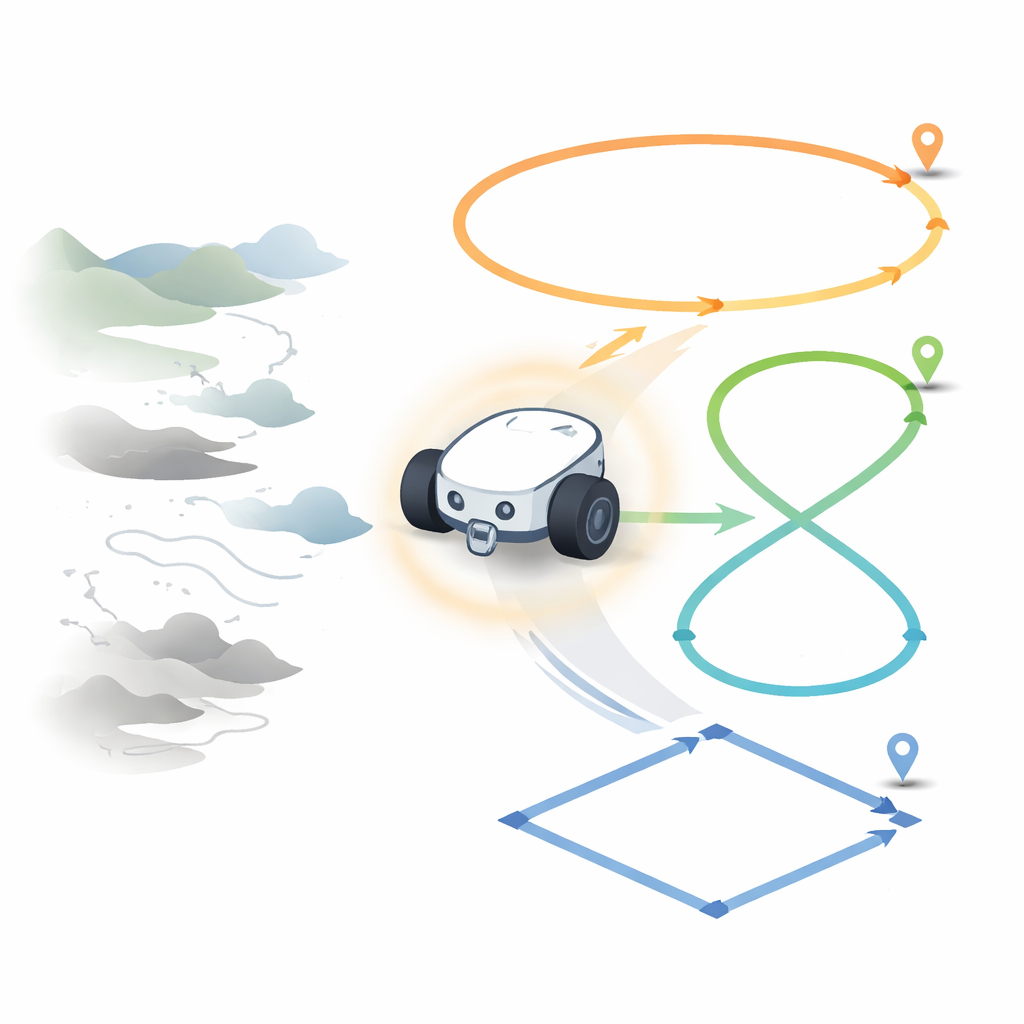
To see how FUHAC behaves, the team ran simulations on three benchmark paths: a figure‑eight, a circle, and a sharp‑cornered diamond. These curves stress different aspects of motion: continuous curvature, curvature reversal, and abrupt direction changes. In all cases the final position error stayed below 4 centimeters, with small cumulative error indices and modest average motor torque under 10 newton‑meters. The controller settled to near‑steady tracking in about 12.7 seconds, while keeping oscillations within a narrow band; its adaptive sliding gain increased just enough to maintain robustness without wasting energy. When compared with standard PID, pure backstepping, and pure sliding‑mode approaches, FUHAC matched or beat their accuracy while dramatically reducing the high‑frequency "chatter" that can wear out actuators. The authors also tried the method on recorded data from a real Pioneer robot. Here, unmodeled effects like wheel slip and motor saturation produced larger errors—on the order of meters rather than centimeters—but the closed loop remained stable and recovered after aggressive maneuvers, underscoring the framework’s robustness.
What This Means for Everyday Robots
FUHAC shows that carefully orchestrated "many‑brain" control can give wheeled robots both precision and resilience. By unifying smooth model‑based steering, learning‑based compensation, robust protection, and disturbance estimation under a single stability proof, the method moves beyond trial‑and‑error hybrids toward principled design. In practice, this could help floor robots, assistive wheelchairs, and inspection platforms follow tight paths with sub‑decimeter accuracy while consuming moderate energy and tolerating bumps, noise, and changing loads. Although tuning its many parameters is more complex than for a simple PID, the controller stays computationally light enough for modern embedded processors. The authors see FUHAC as a foundation for future systems that merge such control with vision, mapping, and even deep reinforcement learning, paving the way for more reliable, intelligent mobile robots navigating real‑world environments.
Citation: Xu, P., Maghsoudniazi, M. & Maghsoudniazi, Y. Integrating Lyapunov based backstepping and neuro fuzzy logic with sliding mode control for precise trajectory tracking of differential drive robots. Sci Rep 16, 11961 (2026). https://doi.org/10.1038/s41598-026-39667-1
Keywords: mobile robot control, trajectory tracking, adaptive hybrid controller, differential drive robots, disturbance rejection