Clear Sky Science · en
MeCP2 gene dosage-dependent neurodevelopmentally restricted defects arise by aberrant activation of cell fate-determining bivalent genes
Why this gene matters for brain health
The MECP2 gene is famous because too little of its protein causes Rett syndrome, while too much leads to MECP2 duplication syndrome. Both conditions bring serious problems such as intellectual disability, seizures, and movement issues. This study asks a deceptively simple question with big implications for future gene therapies: is extra MeCP2 always dangerous, or does the timing and cell type in which it appears determine whether the brain is harmed or spared?
When extra MeCP2 shows up too early
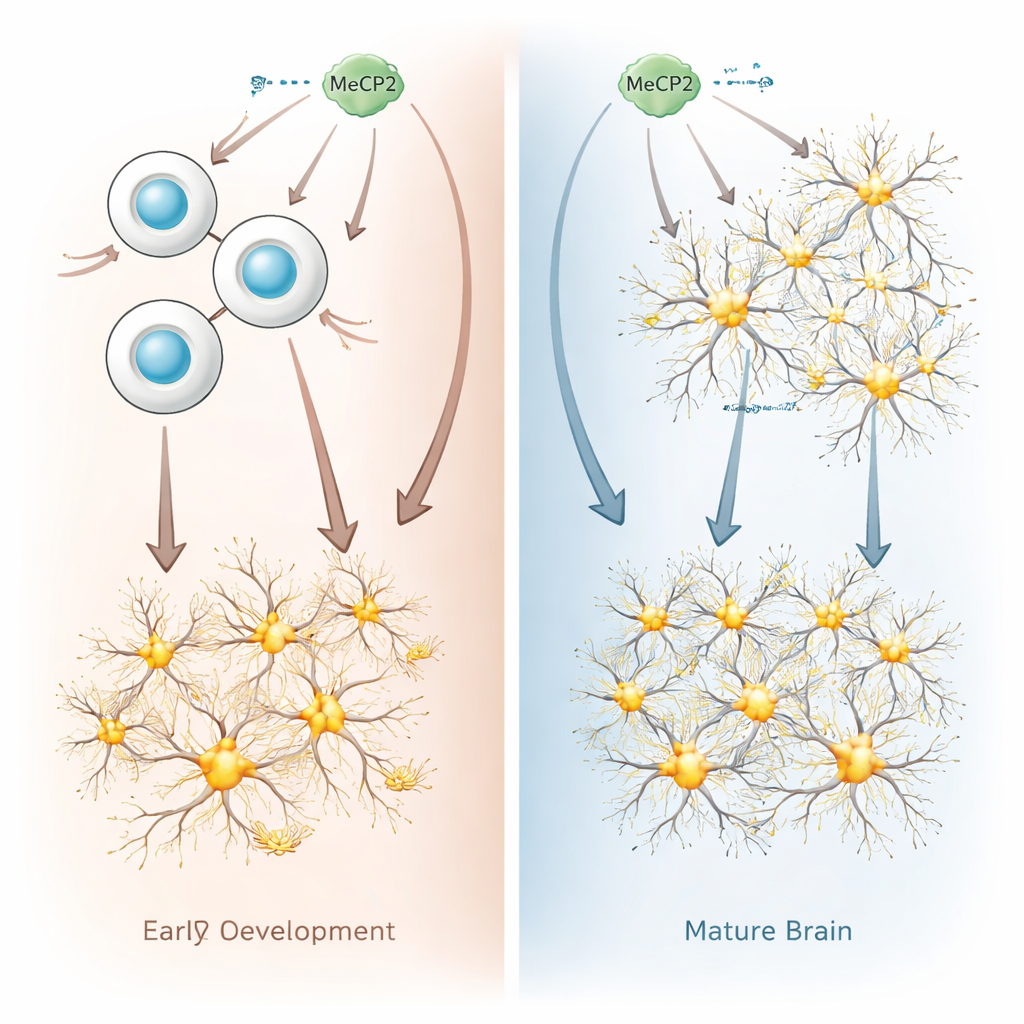
The researchers compared what happens when MeCP2 is overproduced in immature “neural progenitor” cells versus in fully formed neurons, using both mouse and human cells. Neural progenitors are the dividing cells in the developing brain that will later give rise to neurons. When the team boosted MeCP2 in these progenitors, the cells’ genetic activity changed dramatically: thousands of genes became more or less active, with a strong bias toward turning on genes that push cells to become neurons. In dishes and in developing mouse brains, progenitors with excess MeCP2 stopped dividing as much and converted into neurons earlier and more rapidly than normal, shifting the pace of brain development.
Why mature neurons shrug off extra MeCP2
In sharp contrast, when the same amount of MeCP2 was added to mature neurons, the effects were surprisingly mild. Only a few hundred genes changed their activity, and most of those changes were small. The researchers also found little evidence that the overall packaging of DNA in these neurons was altered. In living mice, boosting MeCP2 in embryonic progenitors produced adult neurons with stronger excitatory electrical signals, echoing what is seen in duplication syndrome models. But boosting MeCP2 directly in the adult brain did not change the neurons’ electrical behavior. Together, these results show that mature neurons are much more tolerant of increased MeCP2 than developing progenitors.
How MeCP2 chooses its spots on DNA
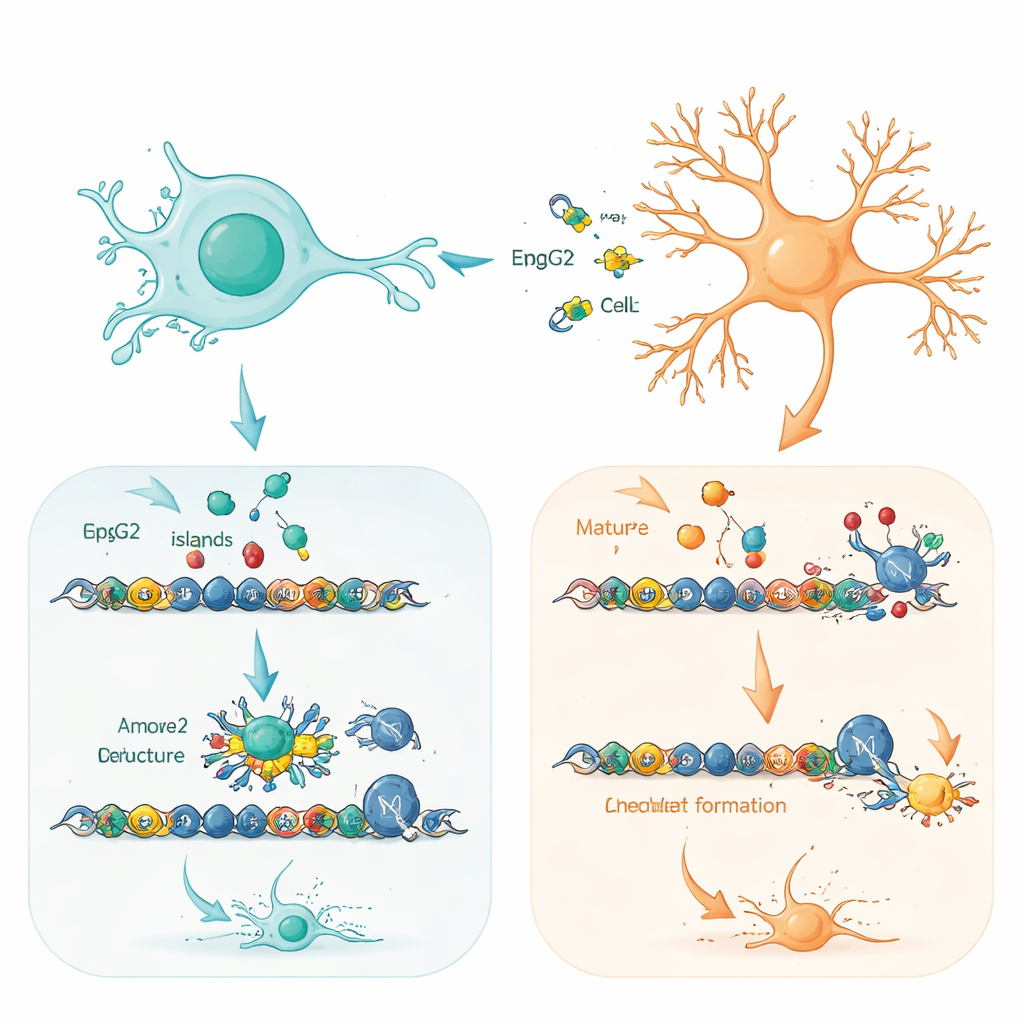
To understand why cell type matters so much, the team mapped exactly where both normal and extra MeCP2 molecules sit on DNA. In both progenitors and neurons, MeCP2 homed in on stretches of DNA rich in “CpG islands” near gene start sites—regions that help control whether genes are on or off. The normal and extra protein chose essentially the same set of targets, especially genes involved in building and refining neural circuits. The key difference was how heavily those sites were occupied. In neurons, where MeCP2 is already naturally abundant, these spots were almost saturated, leaving little room for the extra protein, which bound weakly and was degraded more quickly. In progenitors, where MeCP2 levels are normally low, added protein could bind much more strongly and widely across these regulatory regions.
Priming fate‑deciding genes in young brain cells
A particularly striking finding was that many of the genes most affected in progenitors sit in a “poised” state: they carry both activating and silencing chemical marks on their regulatory regions and are ready to flip on as development proceeds. These bivalent genes often control key decisions about what types of neurons are made and when. The authors show that excess MeCP2 helps recruit a powerful DNA-packaging machine, the SWI/SNF complex, to these poised sites. This partnership tips the balance toward activation, unlocking entire programs of neuronal differentiation earlier than they should be. Subtle shifts in the broader DNA-packing landscape backed up this picture: regions linked to cell-cycle control and neuronal maturation became slightly more open in progenitors with excess MeCP2.
What this means for gene therapy and brain disorders
For families and clinicians worried that MeCP2-based gene therapies might overshoot and harm the brain, this work offers cautious reassurance. The study suggests that moderate increases of MeCP2 in mature neurons—even three- to fourfold—are surprisingly well tolerated, because binding sites are already occupied and surplus protein is rapidly cleared. The real danger appears when MeCP2 is elevated early in development, in progenitor cells whose fate-deciding genes are still poised and highly sensitive. In that setting, extra MeCP2 can prematurely activate developmental programs, alter how and when neurons are produced, and ultimately change brain wiring in ways that may contribute to epilepsy and other symptoms seen in MECP2 duplication syndrome. More broadly, the findings highlight a principle likely shared by many chromatin regulators: gene dosage is not inherently toxic, but its impact depends crucially on when in development, and in which cell type, the imbalance occurs.
Citation: Luoni, M., Kubacki, M., Giannelli, S.G. et al. MeCP2 gene dosage-dependent neurodevelopmentally restricted defects arise by aberrant activation of cell fate-determining bivalent genes. Nat Commun 17, 3225 (2026). https://doi.org/10.1038/s41467-026-71432-w
Keywords: MeCP2, neurodevelopment, gene dosage, epigenetics, gene therapy