Clear Sky Science · en
Despotism promotes dyadic cooperation through enhanced interdependencies in non-human primate societies
Why strict monkey hierarchies matter to us
From offices to online communities, we often assume that fair, easygoing groups are best at working together. This study turns that idea on its head by looking at macaque monkeys, many of which live in rigid, sometimes aggressive hierarchies. By tracking how individuals in six macaque species cooperate to get food, the researchers show that even in harsh, top‑down societies, close partners can become highly cooperative. Their work offers a new way to think about how friendship, dependence, and power shape cooperation—both in other primates and, by analogy, in our own groups.
Different monkey societies along a fairness scale
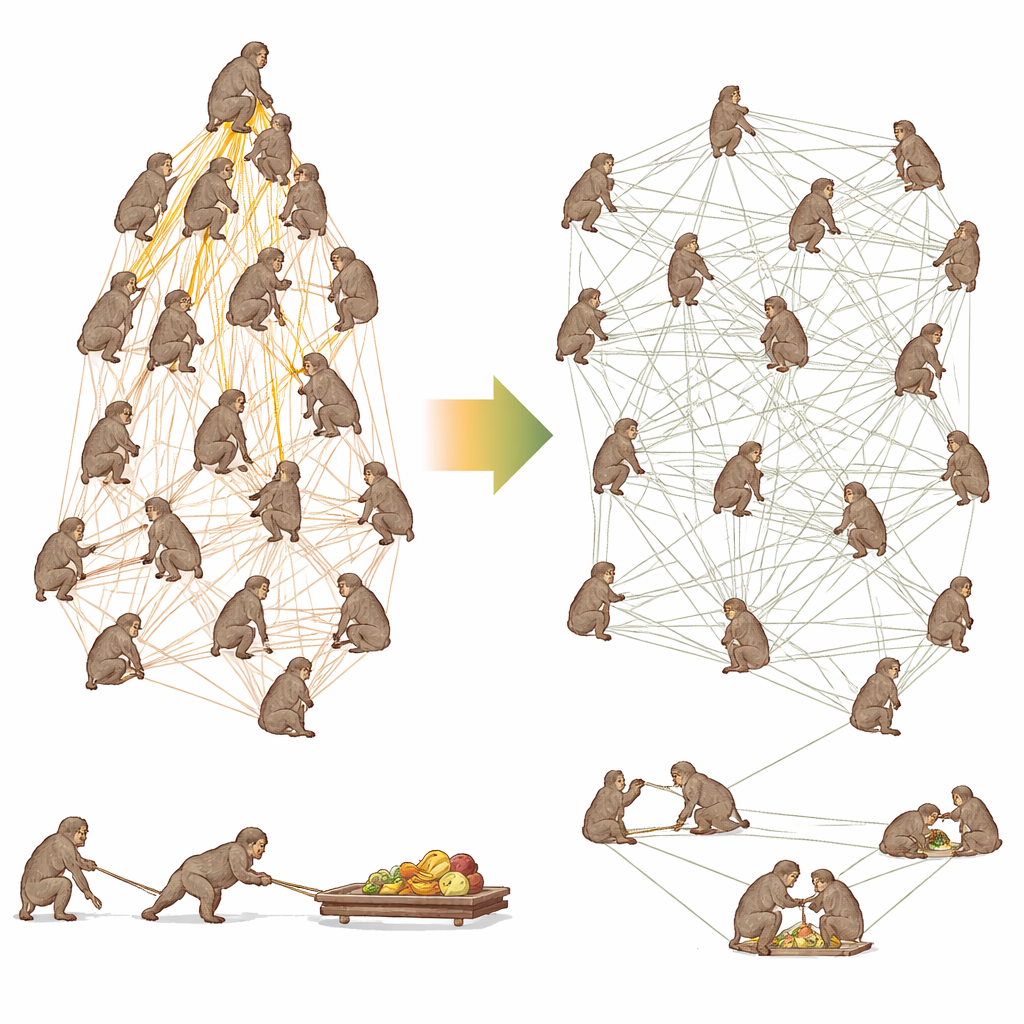
Macaques are a diverse group of monkeys that all live in social groups but differ sharply in how rigid and conflict‑prone their societies are. Some species, labeled “despotic,” have steep hierarchies, frequent aggression, and strong favoritism toward relatives. Others are more “egalitarian,” with flatter rank differences and broader patterns of grooming and tolerance. The authors took advantage of this natural variation, studying 13 groups from six species that span this gradient. They observed behavior for thousands of minutes and then brought specially designed cooperation and food‑sharing devices into the monkeys’ normal living spaces, so that individuals could choose freely whether and with whom to interact.
How the monkeys were asked to work together
To measure cooperation, the team used a “loose‑string” setup where two monkeys had to pull opposite ends of the same rope at the same time to move a platform loaded with treats. If only one pulled, the rope slipped and no food arrived, so success depended on coordinated effort. Separate tests measured how willing monkeys were to provide food to others, and how calmly they could feed side‑by‑side at a food‑rich “peanut plot,” which served as a yardstick for group‑level tolerance. Together, these experiments allowed the researchers to link who cooperated with whom to factors such as kinship, friendliness, and how comfortable they were with each other at close quarters.
Surprising strength of cooperation in tough societies
Contrary to the common assumption that tolerant, easygoing groups should cooperate more, pairs of monkeys in the most despotic species actually showed the highest cooperation success in the rope‑pulling task. The catch was that this success was concentrated in a relatively small number of pairs. In despotic societies, most possible pairings never cooperated at all, while a few select partners worked together repeatedly and very effectively. In more egalitarian groups, many more pairs tried and managed to cooperate, but their success was spread more evenly and typically at lower levels per pair. Statistical analyses showed that cooperation was most strongly predicted by how tolerant two individuals were of feeding near each other, whether at least one of them had a tendency to help others, and whether they were related.
How tight bonds grow in strict hierarchies
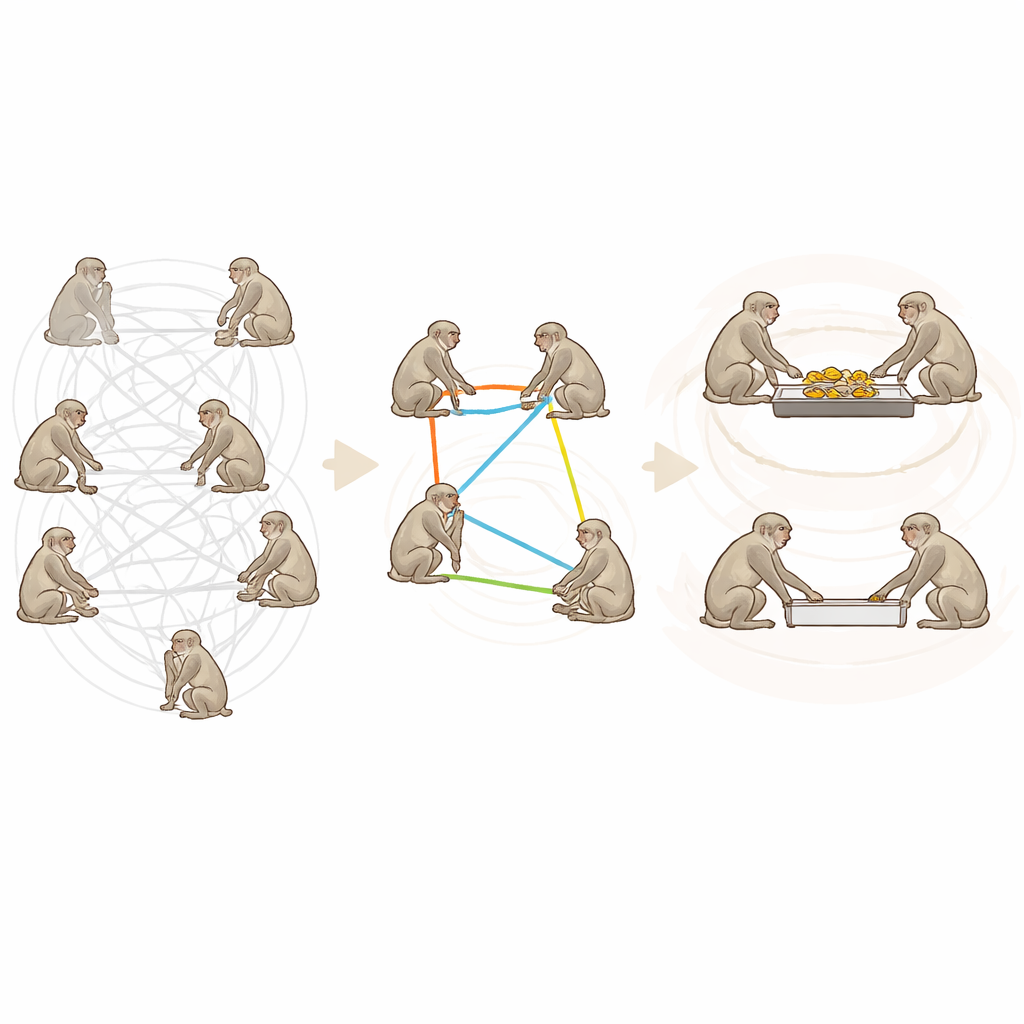
To understand how these selective partnerships arise, the researchers built computer models that mimicked macaque social life. In the model, “agents” groom one another, remember past interactions and slowly form likes and dislikes for specific partners. When the simulated dominance hierarchy was steep—representing a despotic society—only a few strong bonds emerged, mainly between individuals close in rank, and these ties stayed stable over time. In more egalitarian simulations, many more bonds formed and shifted, but they were less exclusive and less stable. Real‑world grooming data matched this pattern: despotic groups had more tightly clustered grooming networks, while egalitarian groups showed more even, reciprocal grooming spread across many partners.
What this means for the evolution of teamwork
The study suggests that strong, selective dependence between specific partners can fuel cooperation even in harsh social climates. In despotic macaque societies, individuals cannot rely on broad groupwide goodwill; instead, they invest in a small number of trusted relationships—often relatives or long‑term allies—that bring mutual benefits during feeding, conflict, and rank struggles. These “high‑stakes” bonds boost tolerance between the partners and make them reliable teammates in tasks like the rope‑pulling challenge. For humans, the findings hint that inequality and hierarchy do not automatically prevent cooperation. Rather, cooperation can take different shapes: broad and diffuse in more equal groups, or narrow but intense in more hierarchical ones, with interdependence between close partners playing a central role in keeping teamwork alive.
Citation: Bhattacharjee, D., Zijlstra, T.W., Roth, T.S. et al. Despotism promotes dyadic cooperation through enhanced interdependencies in non-human primate societies. Nat Commun 17, 3513 (2026). https://doi.org/10.1038/s41467-026-71168-7
Keywords: primate cooperation, social hierarchy, macaque societies, dyadic interdependence, social tolerance