Clear Sky Science · en
Global blue carbon losses from salt marshes exceed restoration gains
Why coastal mud matters for the climate
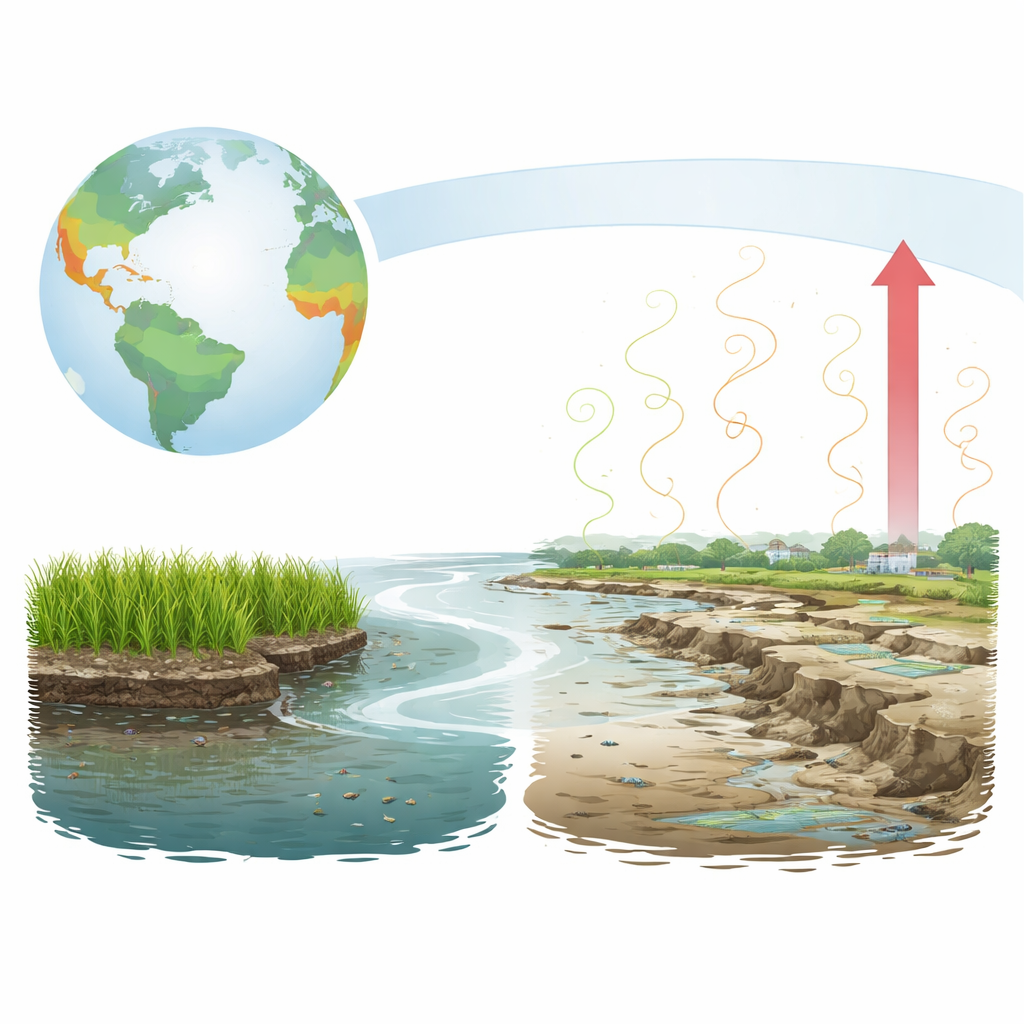
Along the world’s shorelines, grassy salt marshes quietly lock away huge amounts of carbon in their muddy soils, helping to slow climate change and shield coasts from storms. This study asks a simple but crucial question: as we restore damaged marshes in some places while losing them in others, are we gaining or losing this hidden “blue carbon” overall? By tracking global changes in marsh area and soil carbon from 2002 to 2019 with satellites and field data, the authors uncover a worrying answer: our restoration efforts are not yet keeping pace with ongoing damage.
The hidden vault beneath coastal grasses
Salt marshes are among the planet’s most powerful natural carbon vaults. Thanks to fast plant growth, steady mud deposition, and low-oxygen soils that slow decay, they can bury carbon at rates far higher than most forests, even though they cover a much smaller area. Much of this “blue carbon” sits in the upper 20 centimeters of soil, where new material is added and lost most rapidly. When marsh plants colonize bare coasts or restoration projects succeed, this surface layer gradually thickens with organic matter. But when marshes are drained, eroded, or paved over, this same carbon-rich topsoil is disturbed first, and its contents can leak to the atmosphere or wash into the sea. Understanding how this surface store is changing globally is key to judging whether coastal conservation is actually helping the climate.
Reading the planet’s marshes from space
To build a global picture, the researchers combined a high-resolution map of tidal wetlands with long-term Landsat satellite imagery and thousands of soil samples from marshes around the world. Machine-learning models were trained to link subtle differences in surface color and moisture seen from space with measured soil organic carbon in the top 20 centimeters. They then followed every pixel where marshes appeared or disappeared between 2002 and 2019, estimating how much carbon per square meter those soils held and how total stocks changed as land cover shifted. This allowed them to distinguish between two intertwined influences: the expansion or shrinkage of marsh area, and changes in how carbon-dense those soils were.
Where the world is losing and gaining blue carbon
The global tally reveals a net loss of about 0.52 million tonnes of surface soil carbon from salt marshes over the study period, even though some regions saw gains. North America and Oceania were the main sources of loss, with the United States alone responsible for roughly 60 percent of the global decline. In the U.S., particularly along the Atlantic and Gulf coasts, major hurricanes and ongoing human pressures converted mature marshes into mudflats, open water, or aquaculture ponds, stripping away thick, carbon-rich soils. By contrast, Asia and South America showed net gains: new or restored marshes along coasts in China, Bangladesh, Brazil, Uruguay, and Argentina accumulated fresh carbon as plants colonized former aquaculture ponds, farmland, and mudflats. Europe and Africa told a mixed story, with periods of both gain and loss that roughly balanced out over time.
Why old marshes matter more than new ones
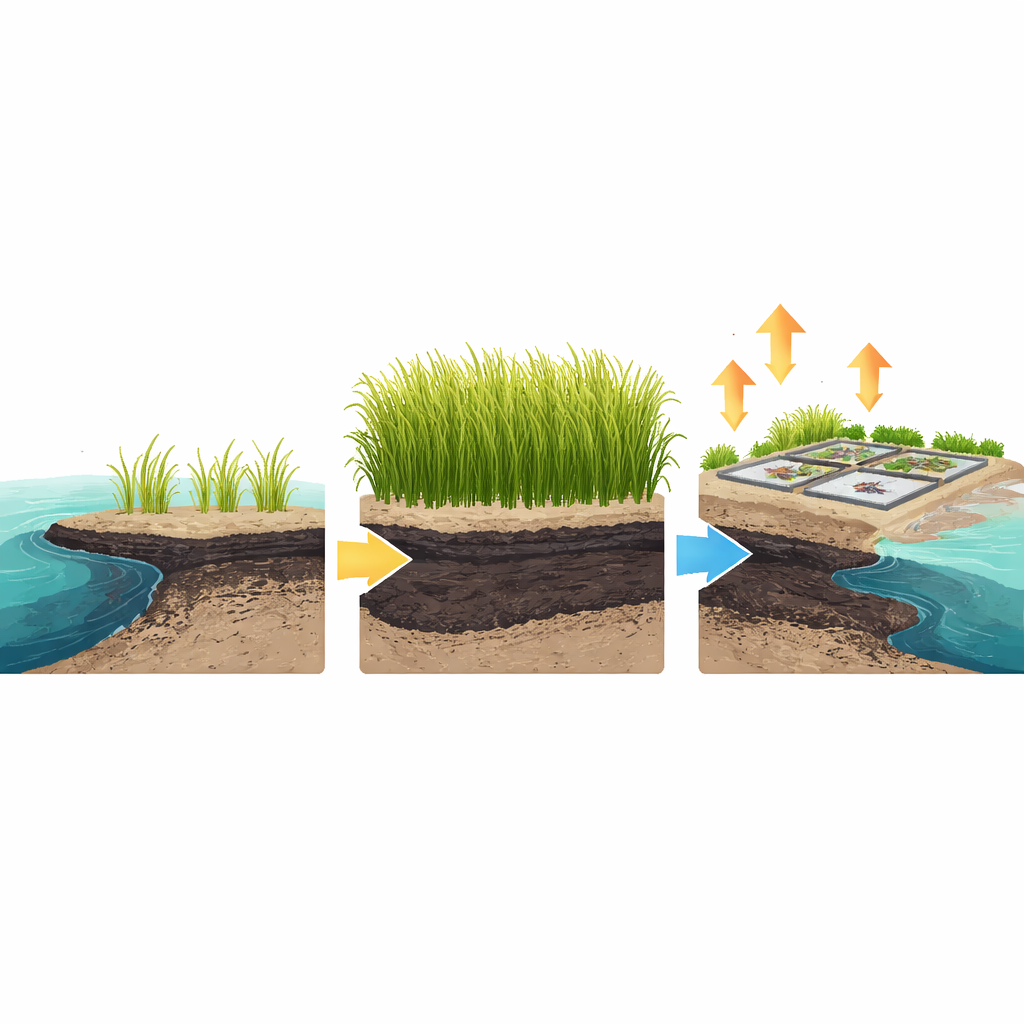
A key insight is that not all marsh hectares are equal. Mature marshes, which have been accumulating mud and roots for decades to centuries, store far more carbon per square meter than young marshes do. The study found that many of the losses occurred in these high-density “old-growth” marshes, especially in North America and high-latitude coasts such as Canada and eastern Russia. New marshes, whether created by natural expansion or human-led restoration, tended to have much thinner carbon layers. Even though Asia added substantial marsh area, the relatively low carbon density of these young soils meant that global gains could not fully offset losses from older, richer sites. Land-use changes were central: converting marshes into mudflats, aquaculture ponds, or croplands consistently led to large carbon losses, while turning aquaculture areas back into marshes was one of the few pathways that produced strong gains.
What this means for climate and coastal policy
For non-specialists, the main message is stark but actionable: planting new marshes is not enough if we continue to damage the oldest, most carbon-packed ones. Because it can take many decades for restored marsh soils to rebuild their full carbon stocks, today’s destruction of mature marshes creates a long-lasting deficit that young marshes cannot quickly erase. The authors argue that climate strategies should treat these carbon-rich coastal wetlands much like old-growth forests: as irreplaceable natural infrastructure. Protecting existing marshes in places such as the United States, Canada, and Australia, guiding aquaculture and development away from high-carbon shorelines in Asia, and designing restoration projects to favor long-term soil buildup could turn salt marshes back into a net ally in the fight against climate change.
Citation: Zheng, Y., Jiang, Q., He, Q. et al. Global blue carbon losses from salt marshes exceed restoration gains. Nat Commun 17, 3744 (2026). https://doi.org/10.1038/s41467-026-70158-z
Keywords: salt marshes, blue carbon, coastal wetlands, soil organic carbon, ecosystem restoration