Clear Sky Science · en
Balancing land use for conservation, agriculture, and renewable energy
Why How We Use Land Matters to Everyone
Every meal we eat, every light we switch on, and every natural place we treasure depends on how we use land. As the world races to feed more people and replace fossil fuels with clean energy, farms and solar or wind projects are spreading into new areas. At the same time, we need to protect forests, wildlife, and the many ways nature supports human well-being, from clean water to storm protection. This article explores a global plan for juggling these competing needs so that food, energy, and nature can all have space to thrive on a warming planet.
Three Different Ways to Share the Planet
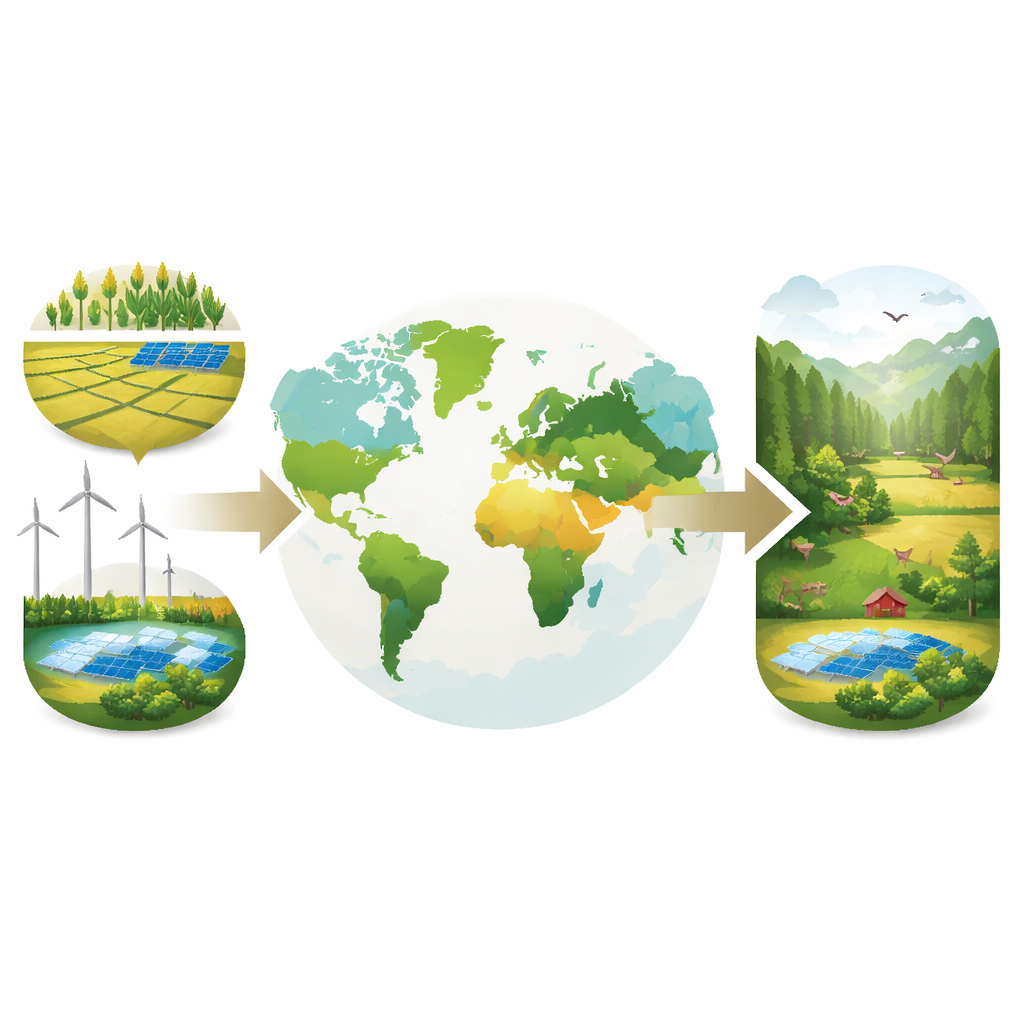
The researchers compare three simple planning styles for deciding how land gets used for farming, renewable energy, and conservation. In a “Production-First” world, land that can best produce food or energy is developed first, and whatever is left is set aside for nature. In a “Nature-First” world, high-value lands for wildlife, carbon storage, and benefits like clean water are protected first, and development is pushed into the remaining space. A third, “Multi-Sector” approach plans for nature, food, and energy all at once, searching for arrangements that work reasonably well for every goal instead of maximizing just one. They run these three strategies for every country on Earth using future projections for 2050 that assume strong climate action and more sustainable lifestyles.
How the Study Simulates the Future
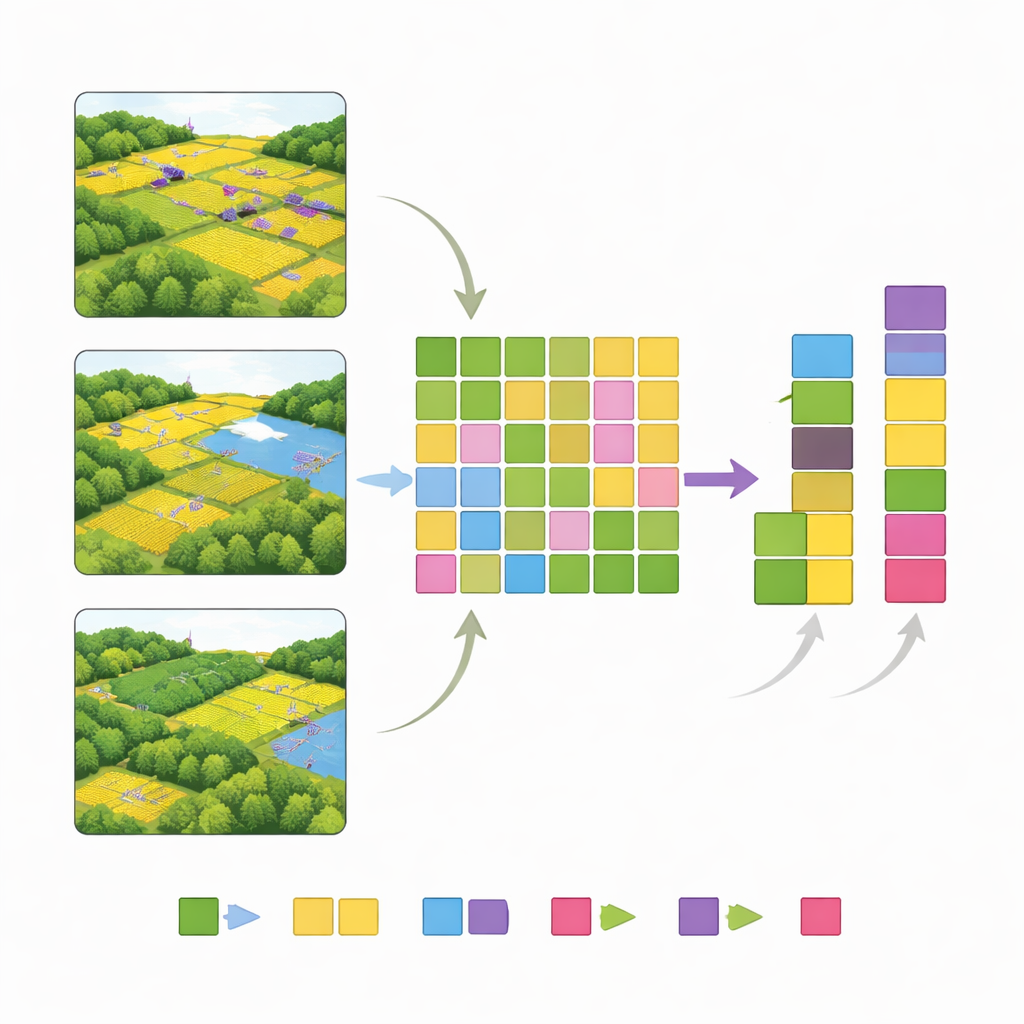
To test these land-sharing choices, the team builds global maps at a fine scale and assigns each grid cell to one main use: conservation, food crops, bioenergy crops, solar power, wind power, or hydropower. They rely on a mathematical approach that sifts through millions of possible arrangements to find those that best meet targets for each sector. Conservation targets focus on thousands of threatened land animals, stores of vulnerable carbon that would be hard to replace if lost, and key “nature’s contributions to people” such as areas that filter water, shield coasts from storms, support pollinators, or give people access to natural spaces. Development targets come from widely used climate and energy scenarios describing how much food and renewable power the world is likely to need by mid-century.
What Happens When We Ignore Nature
When the models prioritize production, they do a good job of meeting demand for food and energy but at a steep environmental cost. Many high-yield farming and energy sites overlap with places that are also rich in species and carbon. Under this Production-First approach, hundreds more already threatened species lose significant portions of their remaining habitat, and far more carbon stored in ecosystems lies in the path of new development. Hydropower, which must follow rivers and steep terrain, is especially difficult to place without clashing with important natural areas. The analysis also shows that if we rely only on clearing new land and do not stack uses together—for example by placing wind turbines over cropland—it becomes impossible to fully meet both development and conservation goals.
Why Planning Together Changes the Outcome
By contrast, the Nature-First strategy does a much better job of shielding wildlife, carbon, and nature’s benefits, but it struggles to supply all of the projected food and energy. The Multi-Sector approach, which balances the needs of nature and development at the same time, lands in the middle: it sacrifices some production efficiency compared with Production-First, yet it greatly reduces the number of species and the amount of carbon exposed to new projects. The study also reveals global “hotspots of conflict,” especially in parts of Asia, Europe, and North Africa, where prime locations for farms or wind and solar facilities sit on top of the very areas most important for future conservation. These are the places where careful planning and innovative designs—such as co-locating certain energy projects with existing croplands—could yield the greatest benefits.
How Much Land Nature Really Needs
The popular goal of protecting 30 percent of the planet by 2030 has become a rallying cry in global agreements. But this study finds that, when climate change and the full range of nature’s services are taken seriously, many countries would need to conserve well over 30 percent of their land to safeguard threatened species, carbon, and key benefits to people. Globally, more than half of all land would ideally remain in some form of conservation or low-impact use to meet these objectives. This does not mean walling off half the Earth from human use; rather, it highlights the importance of improving yields on current farmland, cutting waste, shifting diets, and expanding solar and wind in places that are already altered, such as rooftops, degraded lands, and compatible agricultural landscapes.
What This Means for Our Shared Future
For a general reader, the main message is that there is no free lunch when it comes to land. Feeding people and powering society with clean energy will demand space, but where and how we choose to develop matters enormously for the survival of species, the stability of the climate, and human well-being. The authors show that treating land-use decisions as a joint puzzle—rather than a tug-of-war between conservation, agriculture, and energy—can dramatically cut the damage to nature without giving up on climate or food goals. Their framework offers a roadmap for governments, planners, and communities to spot future trouble zones early and design smarter landscapes where thriving farms, effective clean power, and living ecosystems can coexist.
Citation: Brock, C., Roehrdanz, P.R., Beringer, T. et al. Balancing land use for conservation, agriculture, and renewable energy. Nat Commun 17, 3623 (2026). https://doi.org/10.1038/s41467-026-69952-6
Keywords: land-use planning, biodiversity conservation, renewable energy, sustainable agriculture, spatial optimization