Clear Sky Science · en
Promoting genetic and genomic practices among allied healthcare professionals and nurses: a systematic review
Why this matters for everyday care
Genetic testing is no longer rare or futuristic; it is quietly shaping diagnoses, treatments, and health advice in many clinics. This review article asks a simple but important question: how can nurses and allied health professionals, who see patients every day, be better supported to talk about and use genetic information in their work? The authors sifted through recent research to find out which practical strategies are being tried, which are only being suggested, and where the biggest gaps remain.
Frontline staff in a changing health system
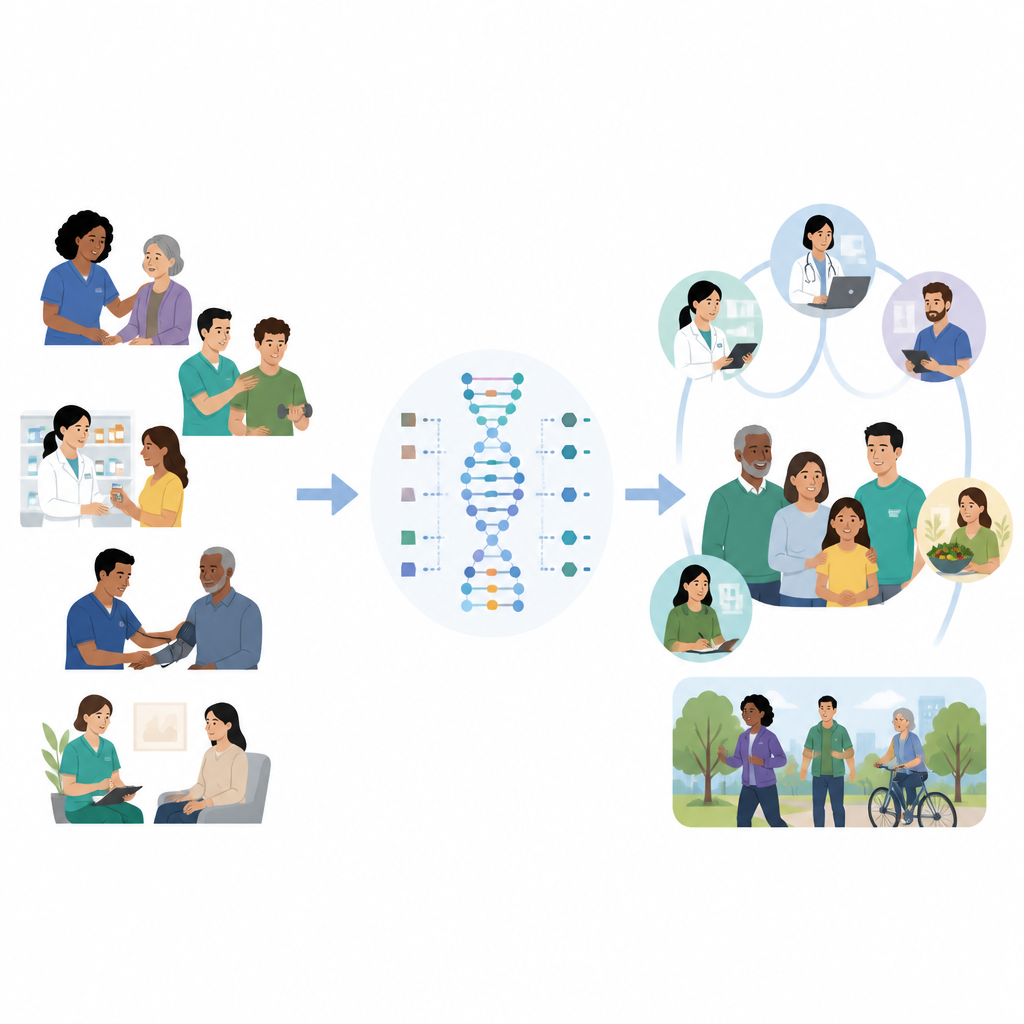
Nurses and allied health professionals such as speech pathologists, physiotherapists, occupational therapists, audiologists, and optometrists are often the first to spot signs of inherited conditions or to care for people who already have a genetic diagnosis. Yet many report that they do not feel confident discussing genetics, are unsure of their role, or lack access to clear guidance and expert support. At the same time, demand for genetic services is growing faster than the supply of specialist geneticists and counsellors. As more genetic tests become affordable and routine, these non-specialist clinicians are expected to help patients understand results and navigate follow up care.
What the researchers set out to find
The authors conducted a systematic review, meaning they used a structured, transparent method to search several large medical databases for studies published since 2020. They included 28 articles that described either real-world strategies that had been tested or thoughtful proposals for how to bring genetics into everyday practice. These strategies focused on nurses and allied health professionals, rather than doctors, and covered a range of study types from surveys and trials to qualitative interviews. The team then grouped the strategies and linked them to a widely used behaviour framework that explains what helps or hinders people when they try to change how they work.
What is already being tried in practice
Many of the tested strategies centred on education. Workshops, online courses, case-based learning, and formal undergraduate or postgraduate teaching were used to build basic genetic understanding and practical skills. Several studies reported that such programs improved knowledge, boosted confidence, and increased interest in using genetics in care or teaching. Some interventions also drew on leaders and senior staff to champion genetic topics, created online toolkits and web platforms, or used reminders and structured programs to help keep new knowledge in use. However, even when knowledge and attitudes improved, actual changes in day-to-day decisions, such as ordering tests or making referrals, were often modest and not always measured carefully.

Good ideas waiting to be tested
Alongside these tested approaches, the review uncovered many proposed strategies that have not yet been fully evaluated. These include building genetics into national nursing and allied health curricula, developing stand alone or integrated courses, using international partnerships, and creating dedicated genetic champions within teams. Other suggestions involve co designing educational materials, offering supervised clinical experience with genetic cases, and creating tools to track how ready different services are to use genomics. Policy ideas such as aligning with national genomic plans, adjusting accreditation standards, and securing targeted funding also featured strongly, suggesting that system level support is seen as vital.
Looking beyond knowledge alone
By mapping all of these ideas and interventions onto a behaviour framework, the authors show that most efforts so far have focused on building knowledge and clarifying professional roles, often supported by social influences such as mentors and peers. Much less attention has been paid to emotions, motivation, goals, or rewards, even though fear, anxiety, or low optimism about using genetics could quietly hold people back. Time pressures, limited resources, and competing clinical tasks were also noted as real-world barriers that simple training sessions cannot solve. The review concludes that future work should both test the many untried strategies and deliberately address emotional and motivational factors, so that nurses and allied health professionals are not only informed about genetics but also supported to use it confidently and consistently in patient care.
Citation: Anandam, T., Peters, S., Lauretta, M. et al. Promoting genetic and genomic practices among allied healthcare professionals and nurses: a systematic review. Eur J Hum Genet 34, 583–596 (2026). https://doi.org/10.1038/s41431-026-02038-5
Keywords: genetic literacy, nursing education, allied health, genomic integration, implementation strategies