Clear Sky Science · en
Multi-session CBM-I for social anxiety: examining psychopathology, cognitive, neural, and psychophysiological effects in a randomized controlled trial
Why everyday worries in social situations matter
Many people know the sinking feeling that comes with speaking up in a group or meeting someone new. For those with strong social anxiety, everyday interactions can be colored by the belief that others are judging them harshly. This study explores whether a brief, fully online training program can help people learn to see social situations in a less threatening light, and what changes inside the mind and body when they do.
Training the mind to finish the story differently
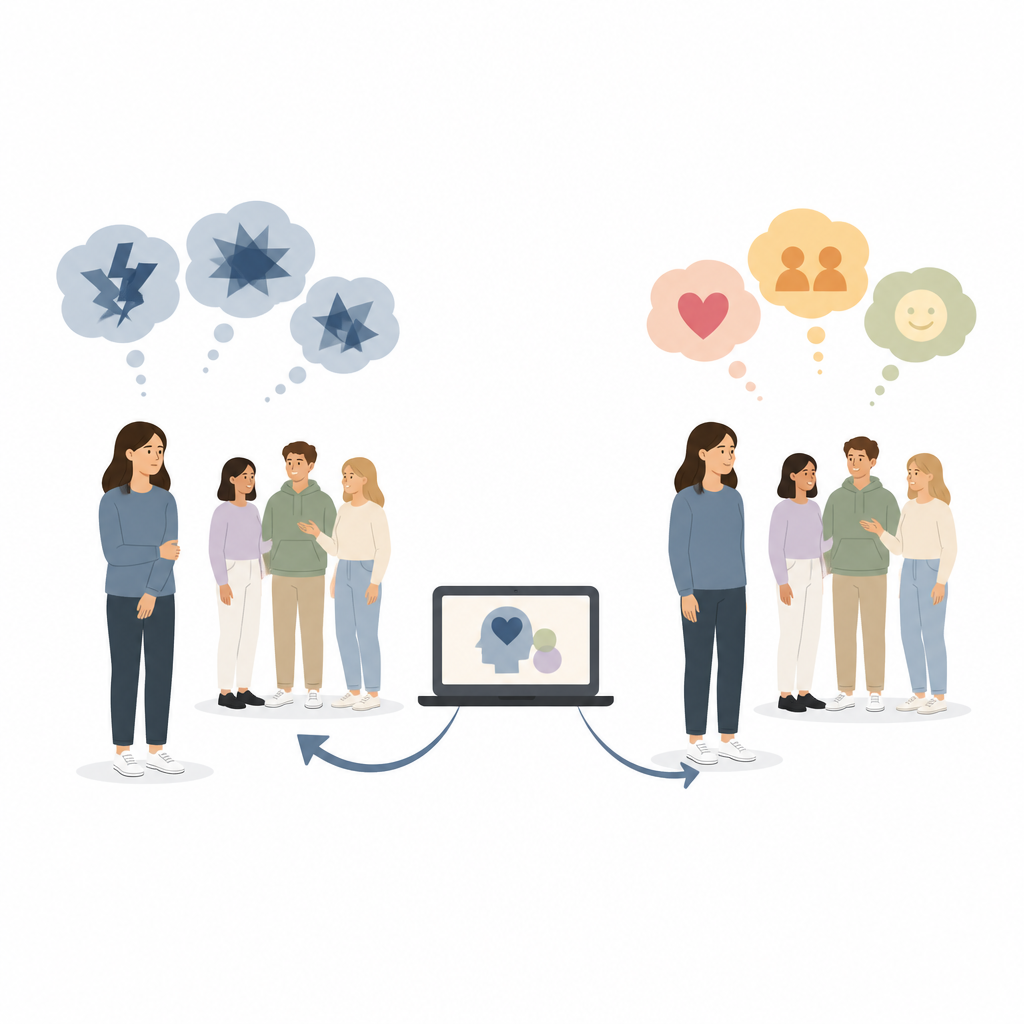
At the heart of social anxiety lies a habit of reading unclear social moments in the worst possible way. If your boss calls you into the office, do you assume praise or trouble? The researchers tested a digital exercise called Cognitive Bias Modification for Interpretation, or CBM-I, which repeatedly asks people to complete short, everyday stories. For half of the participants, socially themed stories always ended well, gently nudging them to expect kinder reactions from others. The other half completed neutral, non-social stories that did not target anxious thinking.
How the study followed thoughts, feelings, and body signals
Eighty-eight adults with high social anxiety completed two lab visits and six daily online training sessions in between, then an online follow-up. At each stage, they filled out questionnaires on social fears, mood, and stress, and worked through tasks that measured how they interpreted ambiguous stories. In the lab, sensors recorded brain activity, heart rate, and heart rate variability while they listened to spoken sentences and completed a stressful anagram task designed to mimic being judged on performance. Saliva samples tracked hormones and enzymes linked to stress.
Shifting from worst-case to kinder expectations
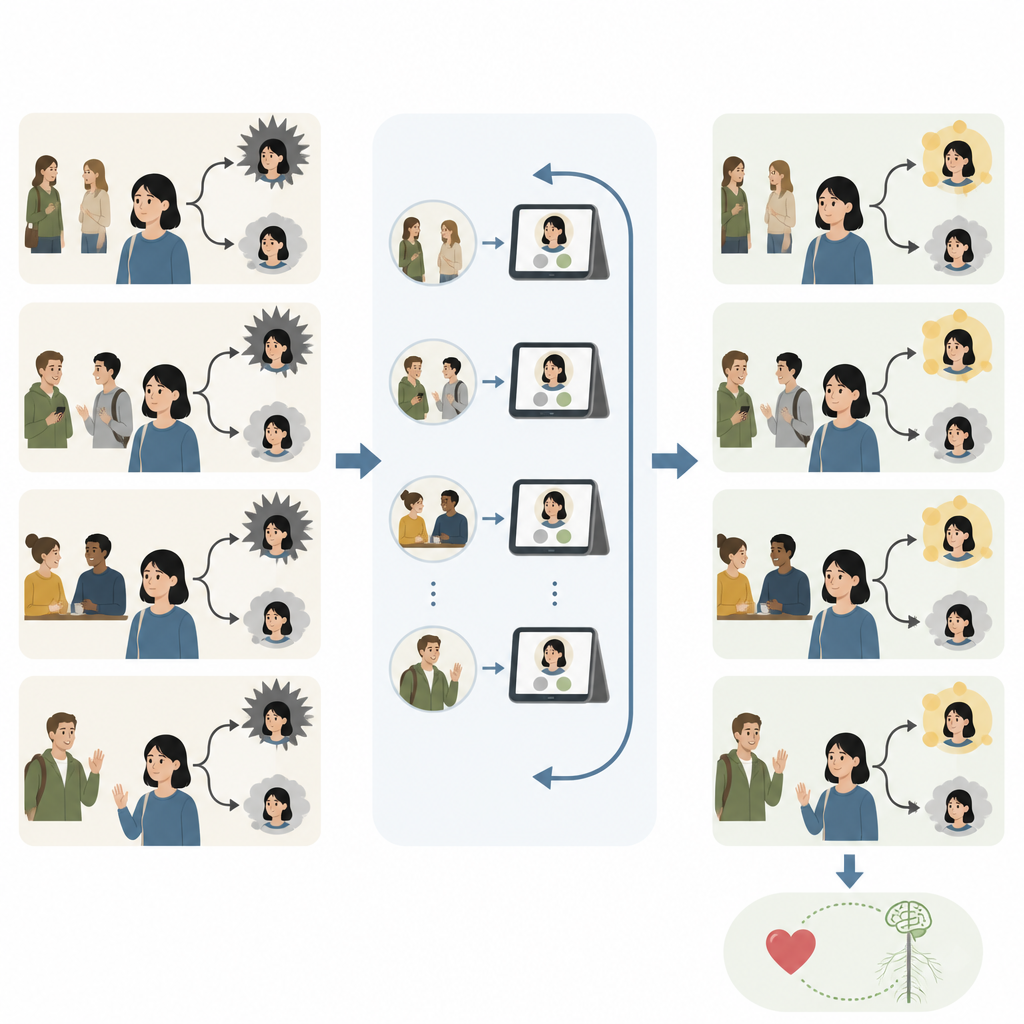
Across a week, both groups reported some drop in social anxiety scores, suggesting that simply taking part and reflecting on feelings may offer a small benefit. However, only those who practiced positive social stories through CBM-I showed a clear drop in fear of being negatively judged by others. On detailed interpretation tasks, this training group became more likely to endorse positive endings and less likely to endorse negative ones, while the control group changed little. A statistical model showed that people who reduced their negative readings of social situations after training went on to have lower social anxiety a week later, hinting that changing how we interpret social cues is one pathway to feeling safer around others.
What the brain and body revealed
Brain-wave patterns showed that participants strongly distinguished between clearly expected and clearly unexpected neutral sentences, but their responses to emotionally charged social sentences were more mixed. This suggests that what the brain finds "expected" in social life is shaped not only by logic but also by feelings. Heart rate and related measures confirmed that the anagram task was stressful, with the heart speeding up and calming again afterward. Yet these body-based responses did not differ between the training and control groups, and hormone levels in saliva changed mainly with time of day rather than with the task itself.
What this means for help with social anxiety
For people who struggle with social fears, the findings underline that the stories we tell ourselves about others’ reactions are not fixed. A short, structured online exercise made people less likely to jump to harsh conclusions and eased their fear of negative judgment, even though overall social anxiety scores shifted only modestly in the brief study window. This suggests that interpretation habits are a changeable piece of the puzzle, and that simple digital tools might one day complement therapy by helping people practice kinder, more balanced readings of everyday social life.
Citation: Abado, E., Kunna, M., Würtz, F. et al. Multi-session CBM-I for social anxiety: examining psychopathology, cognitive, neural, and psychophysiological effects in a randomized controlled trial. Transl Psychiatry 16, 279 (2026). https://doi.org/10.1038/s41398-026-04122-2
Keywords: social anxiety, interpretation bias, online training, cognitive bias modification, stress reactivity