Clear Sky Science · en
Sex-dependent developmental changes in behavior, brain structure, functional connectivity, and sensory perception following exposure to psilocybin during adolescence
Why teen brain changes from psychedelics matter
Psilocybin, the active ingredient in many “magic mushrooms,” is being tested as a treatment for depression and anxiety in adults. At the same time, its use is rising among teenagers, whose brains are still under construction. This study used mice to ask a difficult question that cannot be easily tested in people: what happens to the developing brain when it is repeatedly exposed to psilocybin during adolescence, long after the drug has left the body?
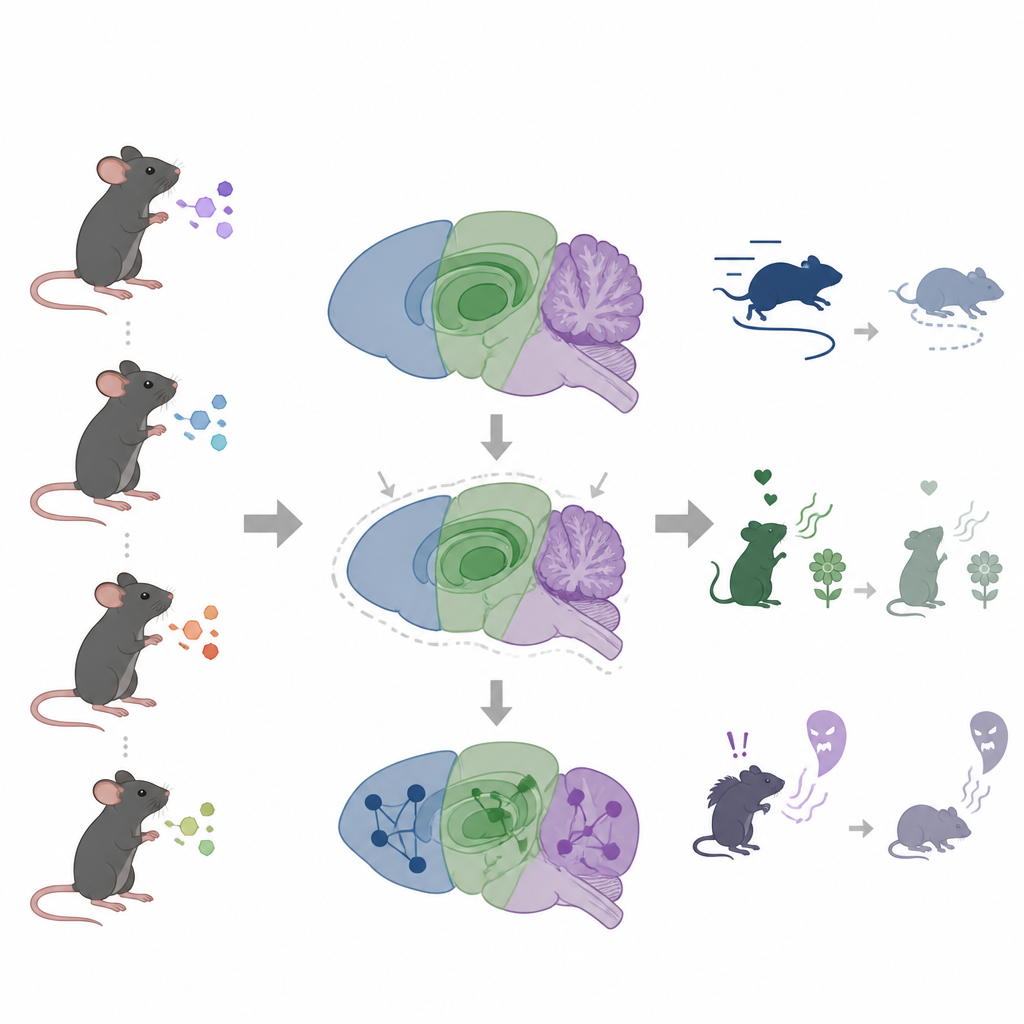
Testing a teenage-like window in mice
The researchers gave male and female adolescent mice several doses of psilocybin over about 10 days, a period that roughly matches mid to late teenage development in humans. After the animals reached adulthood, the team measured their activity in simple behavior tests, scanned their brains with high-resolution MRI, and exposed them to pleasant and scary smells while tracking brain activity. They also examined key brain proteins linked to plasticity, the process that allows neural circuits to change with experience. This combination of behavior, imaging and molecular biology let the scientists see both what the mice did and how their brains were wired beneath the surface.
Subtle behavior shifts but wide brain remodeling
On the surface, the mice did not appear dramatically changed. Both psilocybin and control animals behaved similarly in a standard light–dark box test of anxiety. However, female mice that had received psilocybin were less active and exploratory in an open field than untreated females, suggesting that adolescent exposure blunted a normally higher tendency to move around. Under the scanner, the story grew more complex. Both male and female mice showed small but widespread reductions in overall brain volume, with different regions affected in each sex. Measures of how water diffuses through tissue, which reflect microscopic structure, indicated that many brain areas became more directionally organized yet also less dense, consistent with a large-scale reshaping of neural wiring rather than simple damage.
Networks talk more while senses react less
MRI scans taken while the mice were resting revealed that brain regions communicated with one another more strongly after adolescent psilocybin exposure. This heightened connectivity was especially clear in circuits linking the front of the brain to deeper structures that help regulate emotion, motivation and bodily states. Yet when the researchers introduced a sweet almond-like odor, which animals normally find rewarding, psilocybin-exposed mice showed weaker positive responses across many brain areas. When they later smelled a fox odor that usually triggers fear, these mice again showed altered activity patterns, with signals suggesting dampened responses to threat. Together, the results hint that while brain networks became more tightly knit, their reactions to important sensory cues, both pleasant and scary, were muted.
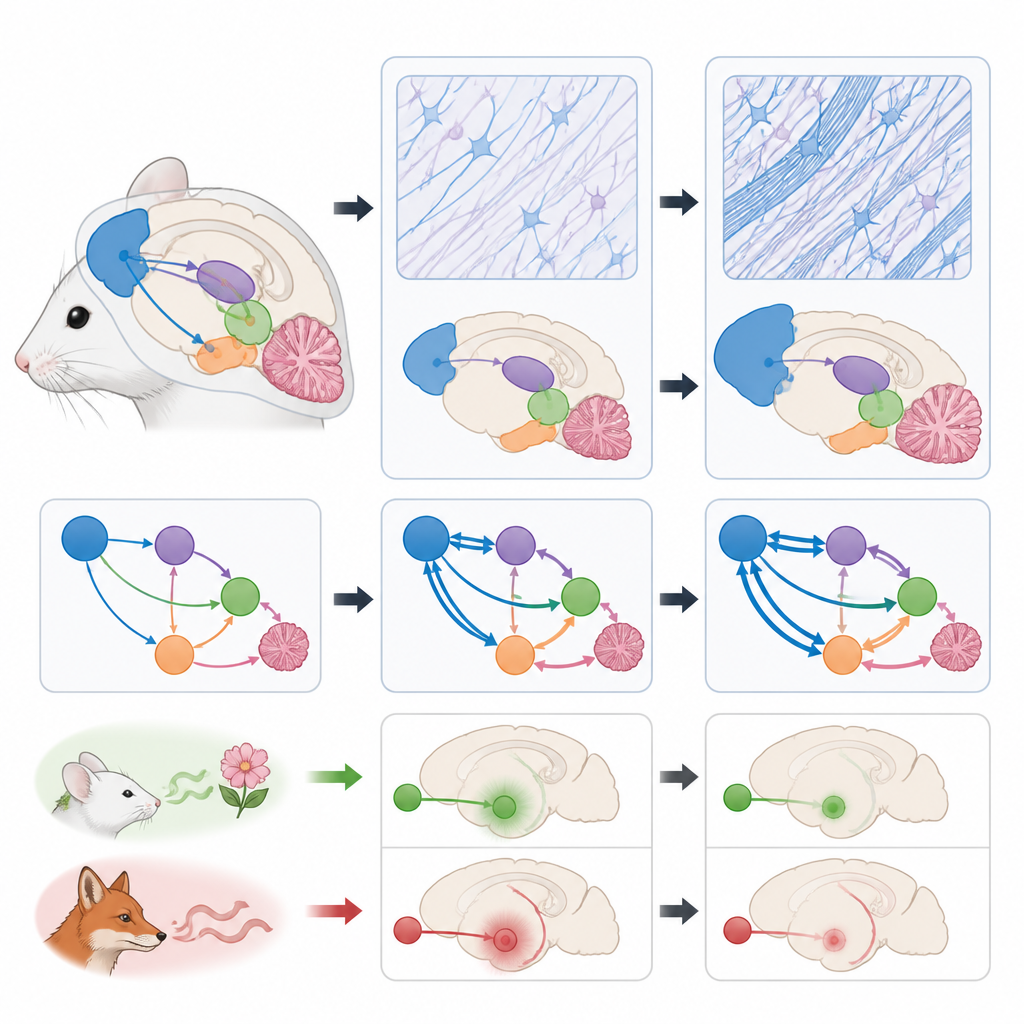
Male brains show deeper molecular shifts
To peek inside the machinery of plasticity, the team analyzed proteins in the prefrontal cortex, a region that continues to mature during adolescence. In males, but not females, psilocybin exposure lowered levels of several proteins that control how genes are switched on and off, as well as markers related to supporting cells and overall gene regulation. These changes point to long-lasting adjustments in the brain’s epigenetic landscape, the chemical tags that help lock in patterns of gene activity. The fact that male and female brains showed different combinations of structural, functional and molecular changes underscores that biological sex strongly shapes how the adolescent brain responds to psychedelic exposure.
What this means for teen psychedelic use
This work does not claim that psilocybin is unsafe when carefully used by adults in clinical settings. Instead, it shows that when exposure occurs during a sensitive developmental window, the brain’s long-term wiring, chemistry and sensory responses can be altered in lasting and sex-dependent ways, even when everyday behavior looks mostly normal. For a lay reader, the key takeaway is that the teenage brain is unusually plastic and therefore unusually impressionable. Introducing powerful mind-altering substances during this time may steer its maturation onto a different path, with consequences that might only become apparent much later in life.
Citation: Sahoo, I., Masadi, S., Maheswari, A. et al. Sex-dependent developmental changes in behavior, brain structure, functional connectivity, and sensory perception following exposure to psilocybin during adolescence. Neuropsychopharmacol. 51, 1310–1324 (2026). https://doi.org/10.1038/s41386-026-02356-8
Keywords: psilocybin, adolescent brain, neuroplasticity, functional connectivity, mouse study