Clear Sky Science · en
Over fifteen centuries of weathering: mineralogical identification and decay assessment of the Tāq-e Bostān Sasanian rock reliefs
Ancient carvings facing modern decay
Tāq‑e Bostān, a cliff-side ensemble of royal rock carvings in western Iran, has watched over a spring-fed pool and mountain pass for more than fifteen centuries. These Sasanian reliefs are masterpieces of political theater in stone, but visitors today often see blurred shapes under colored crusts instead of crisp royal hunts and coronations. This study asks a deceptively simple question with big consequences for heritage sites worldwide: what, exactly, is happening to the stone, and how can we slow the damage without doing harm?
A royal stage carved into living rock
The monuments of Tāq‑e Bostān consist of two arched grottoes, known as the Great Arch and Small Arch, and an open-air panel, all carved directly into a massive limestone cliff in the Zagros Mountains. Their scenes show kings hunting, being crowned, and standing with divine figures above fallen enemies, blending royal propaganda with religious symbolism. The cliff itself is part of a fractured karst landscape riddled with springs and underground water pathways. A reflecting pool and nearby springs add to the drama of the setting—but also ensure that water, one of stone’s most persistent enemies, is never far away.
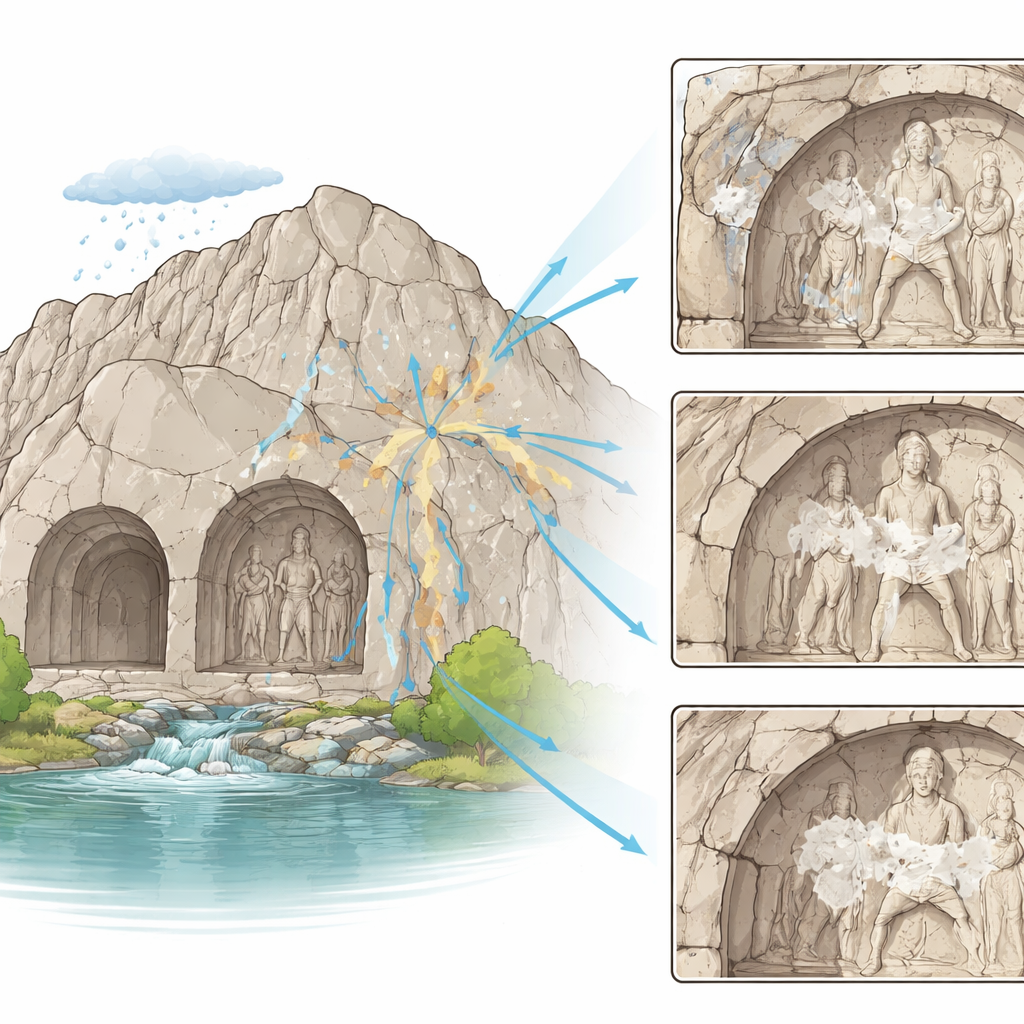
How stone, water, and old repairs interact
To understand why the carvings are deteriorating, the researchers combined several microscope and laboratory techniques to look from the grain scale up. They found that the cliff is made of very pure, fine-grained limestone with few pores but many tiny fractures and veins filled with secondary calcite. These internal features control how moisture moves through the rock, guiding water along cracks and stylolite seams. Over the twentieth century, conservators tried to stabilize these weaknesses by filling fractures and missing pieces with cement- and gypsum–lime-based mortars. The new study shows that, rather than simply acting as inert plugs, these materials have become active sources of salts and new crusts on the carved surfaces.
Unmasking good and bad surface films
The team sampled and analyzed eight types of crusts with colors ranging from white and khaki to orange and dark brown, as well as salt blooms and repair mortars. Many of the thick, dingy or brown layers turned out to be rich in gypsum—a calcium sulfate mineral—that has crystallized in successive sheets laden with dust, clay, and soot particles likely from local barbecue smoke and vehicles. Microscopic images reveal needle-like and rosette-shaped sulfate crystals growing in pores, along layer boundaries, and near mortar–stone contacts. In contrast, the bright orange films coating some faces and figures are dominated by calcium oxalate, a mineral commonly formed by lichens and other microorganisms. These “oxalate patinas” bond strongly to the limestone and, despite their color, behave as relatively stable, thin skins rather than aggressive decay agents.
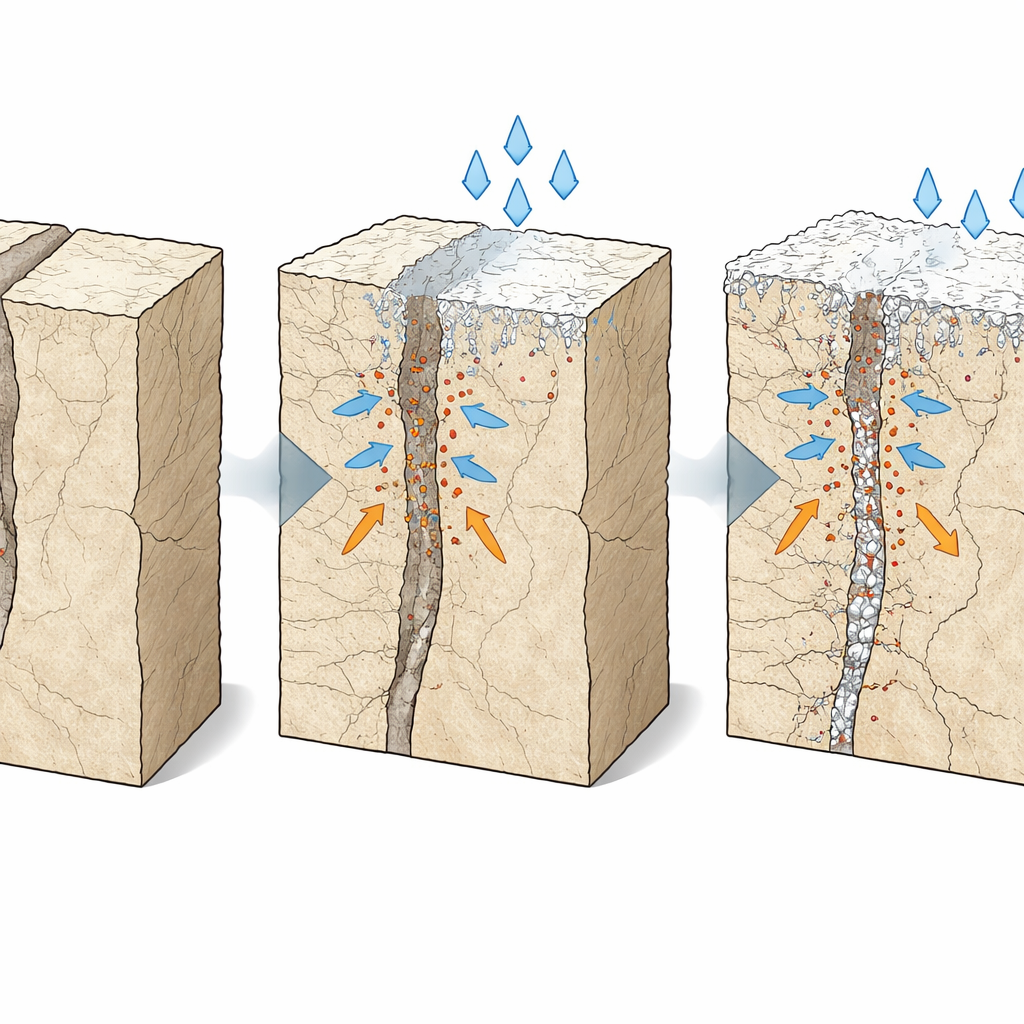
Climate stress and hidden salt cycles
Kermanshah’s climate amplifies these chemical processes. Wet winters bring heavy rainfall, high humidity, and frequent freeze–thaw cycles, driving water into cracks and pores and promoting both frost damage and salt movement. Summers are hot and dry, encouraging evaporation and repeated crystallization of dissolved minerals. The study links the thickest gypsum-rich crusts and salt efflorescences to this cycling of water and ions, especially where incompatible mortars supply extra calcium and sulfate. While regional air pollution was once suspected as the main culprit, the mineral signatures here point instead to water percolating through past repairs as the dominant source of damaging salts, with airborne soot mainly darkening existing crusts.
Rethinking how we “fix” ancient stone
The authors conclude that the carvings are threatened less by the natural karst environment than by the legacy of well-meant but incompatible restorations interacting with local climate. Their findings support a shift toward minimal, evidence-based care. Stable oxalate patinas should generally be left in place and monitored, as stripping them risks losing already fragile details. In contrast, gypsum-rich, soot-darkened crusts that trap moisture, generate crystallization pressures, and obscure carving should be selectively thinned or removed. Just as crucial is the careful extraction of old cementitious and gypsum–lime mortars and their replacement with breathable, lime-based materials tailored to the original limestone. Coupled with discreet drainage improvements to guide water away from vulnerable joints, such measures offer the best chance of keeping these finely carved royal scenes legible and structurally sound for future generations.
Citation: Shekofteh, A., Bahadori, S., Charesaz, M. et al. Over fifteen centuries of weathering: mineralogical identification and decay assessment of the Tāq-e Bostān Sasanian rock reliefs. npj Herit. Sci. 14, 293 (2026). https://doi.org/10.1038/s40494-026-02593-6
Keywords: stone conservation, rock-cut heritage, gypsum crusts, Sasanian archaeology, salt weathering