Clear Sky Science · en
Beyond pedagogy: American abstinence-only until marriage sexual education as fundamentalist practice in secular disguise
Why School Sex Lessons Matter to All of Us
What children and teenagers learn about sex in school quietly shapes their futures—how they see their bodies, make decisions about relationships, and understand other people’s lives. In the United States, most public money for sex education has gone to programs that insist young people should avoid sex entirely until they are married. This article argues that these lessons are not just one neutral teaching style among many. Instead, they are a modern form of religious fundamentalism, packaged in secular language and delivered through public schools.
How We Got to “Abstinence Only”
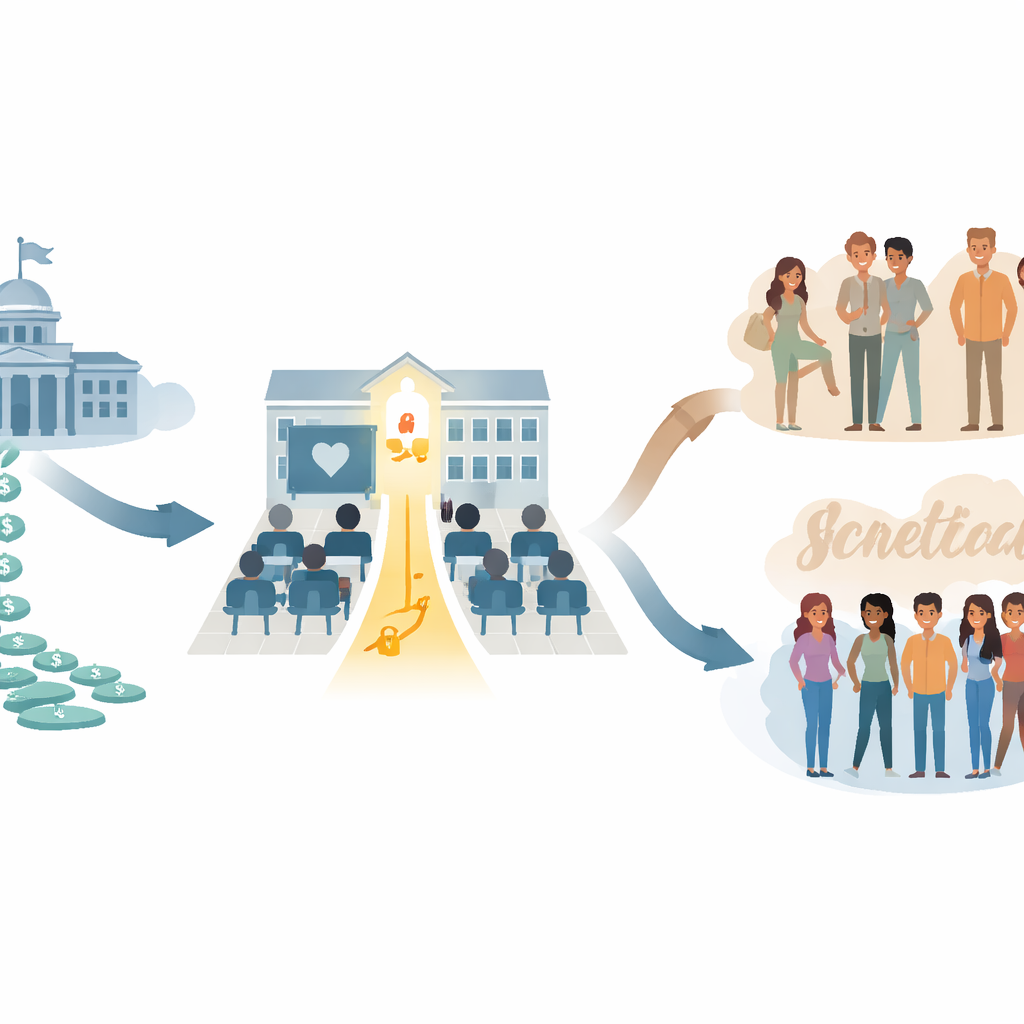
Unlike many countries, the U.S. has no national rulebook for sex education. States and school districts decide what to teach, but since 1981 federal dollars have overwhelmingly supported “Abstinence-Only Until Marriage” (AOUM) programs. To qualify for this funding, curricula must present abstaining from sex as the only fully acceptable and safe choice, describe sex outside marriage as harmful, and portray marriage as the expected norm for everyone. In practice, this squeezes out fuller discussions of contraception, sexual orientation, consent, and diverse family structures, even though surveys show most parents actually favor broader, more informative sex education.
What Counts as Fundamentalism Here
The article widens the idea of “fundamentalism” beyond one Christian group to include a family of religiously rooted, socially conservative movements that seek certainty, fixed roles, and strict moral boundaries. A key feature is the refusal to admit that there can be more than one legitimate moral framework. Applied to sex education, this means students are taught that there is only one proper way to organize intimate life: heterosexual sex confined to marriage, leading to childbearing in a traditional family. By silencing competing visions—such as the idea that sex can be ethical, caring, and responsible outside marriage when practiced safely—AOUM presents a single cultural script as if it were just common sense.
History That Gets Conveniently Forgotten
To many Americans today, sex education looks like a tug-of-war between religious moralists and secular liberals. The historical record is messier. Early efforts in the 20th century often involved alliances between religious leaders, reformers, and scientists who wanted young people to understand both the risks and the positive meaning of sexuality. Over time, however, conservative religious activists worked to recast sex education as a threat to family values, linking sexual freedom to fears about communism, social decay, and the loss of “purity.” By the 1980s, these groups successfully steered federal funding toward AOUM programs that matched their own doctrines, while still claiming to defend neutral “family values” rather than particular religious views.
What These Lessons Actually Do
Research over several decades shows that AOUM programs do not delay sexual activity or reduce the number of partners more effectively than comprehensive programs. What they do reliably produce is silence around contraception, LGBTQ+ identities, and the realities of sexual violence. Girls and young people who can become pregnant are often cast as gatekeepers responsible for preventing sex and protecting boys’ morality. Those who are already sexually active, pregnant, parenting, or queer are stigmatized. In this way, the classroom becomes a place where one narrow moral order is enforced, and other ways of living are framed as disorder, danger, or moral failure—hallmarks of a fundamentalist project operating through public policy.

Why Calling It What It Is Matters
The author argues that as long as AOUM is treated as a simple teaching preference rather than a fundamentalist practice, courts, policymakers, and the public will keep missing what is really at stake. Public schools are supposed to respect religious freedom by not endorsing any one faith’s doctrine, and to help students develop the capacity to think and choose for themselves. When tax-funded curricula quietly advance a specific religious moral script while pretending to be neutral, they risk violating both aims. Recognizing AOUM as openly fundamentalist is not about attacking religion; it is about being honest that these programs carry a particular religiously charged worldview, so communities can debate—on constitutional and ethical grounds—whether that belongs at the center of public education.
Citation: Robinson, Z.S. Beyond pedagogy: American abstinence-only until marriage sexual education as fundamentalist practice in secular disguise. Humanit Soc Sci Commun 13, 520 (2026). https://doi.org/10.1057/s41599-026-06858-0
Keywords: sex education, abstinence-only, fundamentalism, public schools, religion and law