Clear Sky Science · en
Linking industries, sustaining villages: endogenous development in China’s ancient road villages
Why Mountain Villages Matter to All of Us
Across the world, mountain villages guard clean water, ancient cultures, and green landscapes, yet they often struggle to create lasting jobs and income. This article follows twelve historic “ancient road” villages in the mountains near Hangzhou, China, to ask a simple question with global relevance: instead of relying mainly on government aid or outside investors, can villages themselves weave their small farms, homestays, and tourist spots into a living local economy that keeps young people from leaving and traditions from fading?
From Outside Help to Inner Strength
For years, China has poured resources into rural areas through major campaigns against poverty and new programs for “rural revitalization.” These efforts have built roads, opened scenic areas, and drawn visitors, especially to mountain regions with striking views and rich history. Yet many villages still depend on temporary projects or distant markets. When a policy changes or a tourism fad passes, income can drop quickly. The authors argue that the missing ingredient is “endogenous” development—growth powered by local people, local resources, and local cooperation rather than by short-lived outside pushes.
Following Twelve Villages Over Time
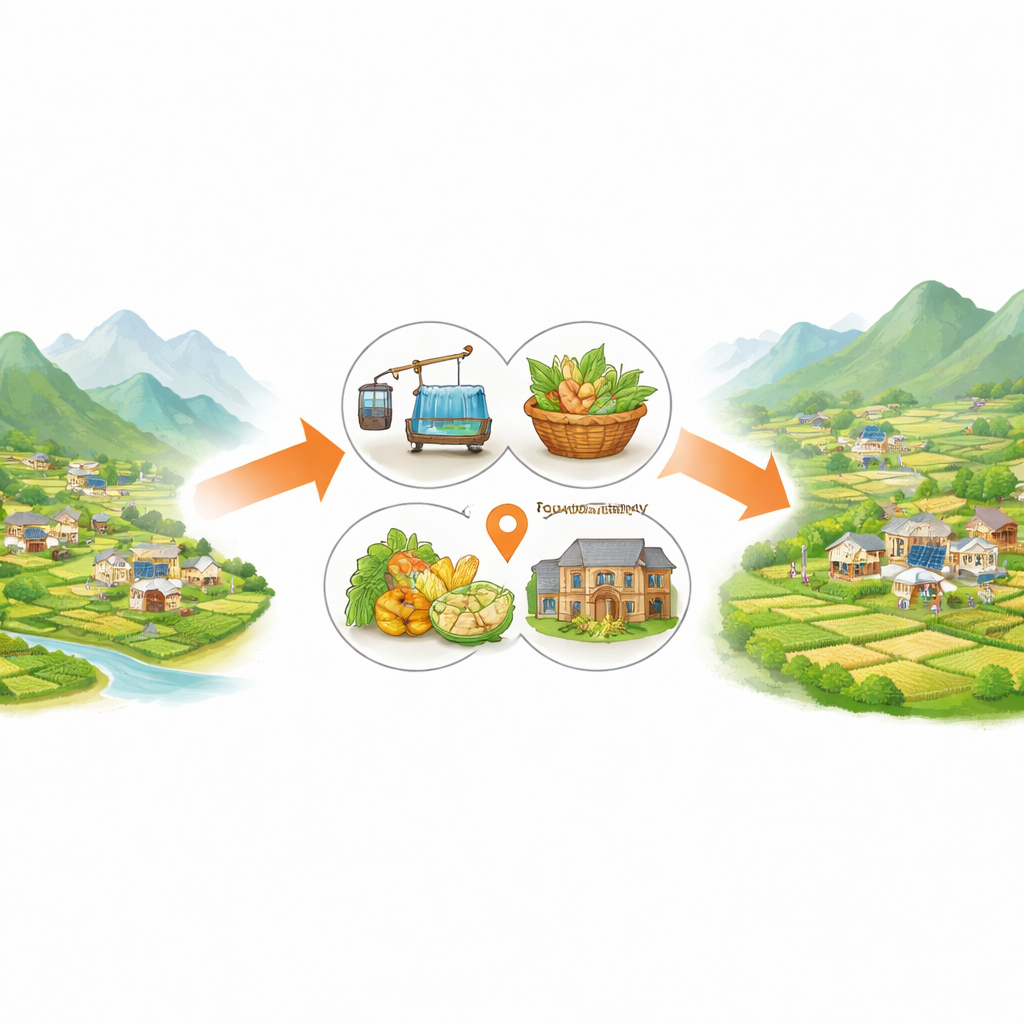
To see how such inner strength might be built, the researchers spent three years visiting twelve ancient road villages in Fuyang District, talking with officials, business owners, residents, and tourists, and tracking the earnings of key enterprises. Some villages lie along mountain paths and lean toward hiking, wellness retreats, and cultural tourism. Others sit by rivers and focus on rafting, swimming, and lakeside homestays. Almost all combine these services with small-scale ecological farming. The team also gathered detailed holiday revenue data from 17 established and 9 newer businesses, since peak travel periods reveal which combinations of activities really work.
What Is Working—and What Is Not
The study finds that many ventures are tiny, family-run operations, especially homestays and eco-farms. These are easy to start but hard to stabilize. Most businesses work alone: a rafting company sells tickets by itself, while nearby guesthouses market only their rooms. Where firms did team up—by bundling rafting with lodging, farm visits, or cultural events—holiday income often rose sharply, especially after the pandemic eased and the Hangzhou Asian Games drew new visitors. Still, only about one-third of the tracked enterprises tried such joint packages, and many local policies encouraging cooperation remained on paper, reaching big attractions more than small household businesses.
Three Ways Villages Try to Grow
Looking across dozens of sites, the authors identify three main development patterns. Some communities build around their landscape, creating scenic hubs where mountains, rivers, food, and homestays cluster, but they risk heavy investment and seasonal crowds without a strong local brand. Others bet on eco-planting—fruits, vegetables, and pick-your-own orchards—that raise incomes but remain scattered and loosely organized. A third path turns deep cultural roots into attractions: historic towns, ancestral halls, crafts, and village festivals that can anchor sports, dining, and creative industries. Each model shows promise, yet all are held back by weak links between sectors, limited marketing reach, and the continuing outflow of younger residents seeking better-paying city jobs.
Weaving Local Ties into a Stronger Fabric
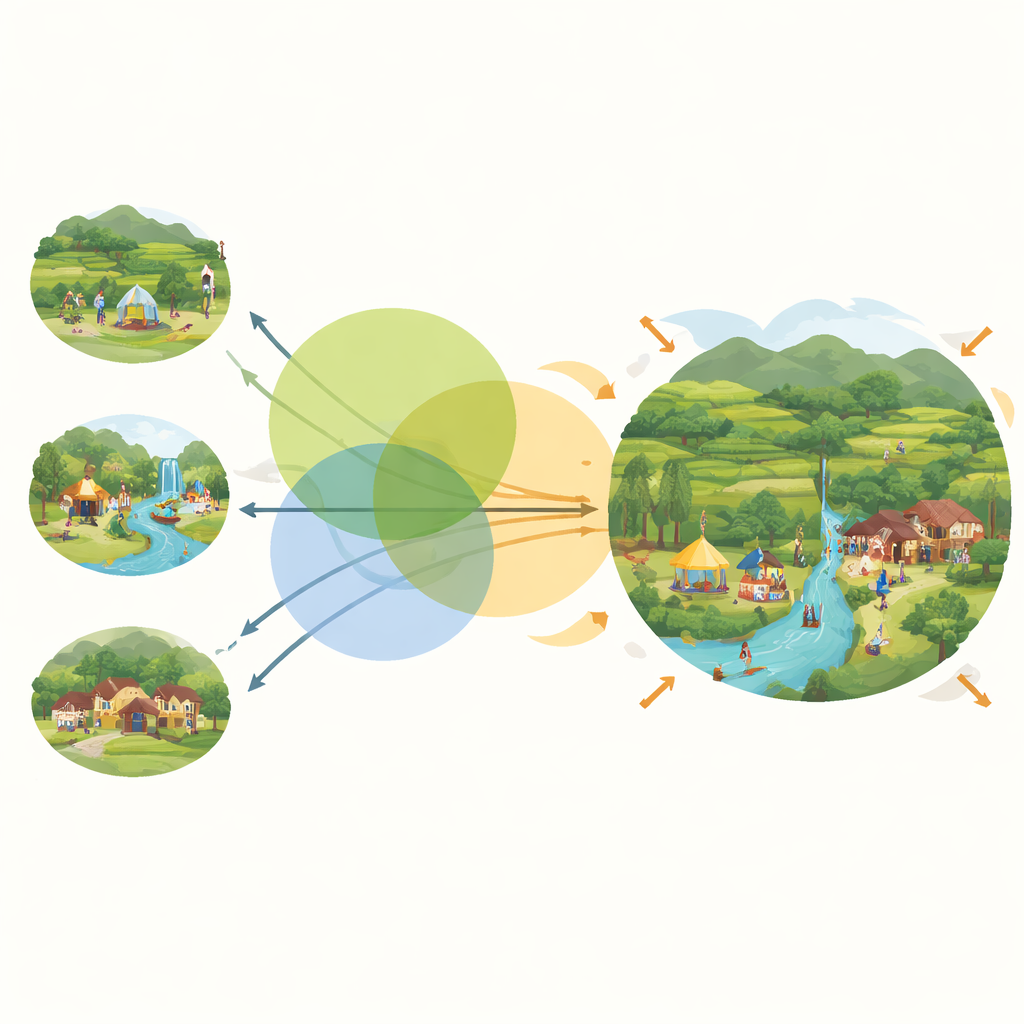
Drawing on ideas from “Theory of Change” and “industrial clusters,” the authors propose a practical roadmap for mountain regions. In the short term, villages should focus on simple steps that connect people and activities: joint holiday packages, shared promotion, and basic resource sharing across neighboring villages. In the medium term, these ties can mature into an industrial linkage system, where core industries such as key tourist sites pull in related services like food, lodging, farm visits, sports, and cultural workshops. Over the long run, this network becomes a true cluster: information, skills, and customers circulate locally, new side businesses emerge, and villages rely less on one-off government pushes or outside investors.
What This Means for Mountain Futures
To a lay reader, the message is clear: the future of mountain villages does not lie only in more subsidies or a single “star attraction.” It depends on whether local farmers, homestay hosts, craft makers, and officials can cooperate across village boundaries and across sectors, turning scattered efforts into a mutually reinforcing web. When tourism, agriculture, and culture are linked rather than isolated, small businesses gain stability, young people see reasons to stay, and heritage landscapes can support themselves instead of being mined for quick profit. The article concludes that such homegrown linkage models, though demanding in terms of trust and coordination, offer one of the most promising paths for sustainable, self-sustaining life in the world’s mountain regions.
Citation: Zhang, Y., Li, H. Linking industries, sustaining villages: endogenous development in China’s ancient road villages. Humanit Soc Sci Commun 13, 541 (2026). https://doi.org/10.1057/s41599-026-06538-z
Keywords: mountain villages, rural development, industrial clusters, rural tourism, China