Clear Sky Science · en
Patterns of media and social media consumption associated with suicidal ideation in Spanish children
Why this matters for families today
In recent years Spain has seen a worrying rise in suicide among children, even though such deaths remain rare. At the same time, young people are growing up surrounded by screens, from television talent shows to social networks on their phones. Parents and educators often sense that media might affect children’s moods, but it is hard to know which kinds of content are most concerning. This study looks closely at how different patterns of media and social media use are linked to suicidal thoughts among Spanish children aged 10 to 15, aiming to help adults focus their attention where it is most needed.

The challenge behind the screens
The authors begin by setting out the broader context: child suicide is a serious public health issue, with a sharp increase observed in Spain during the first years of the COVID-19 pandemic. Suicidal ideation—recurrent thoughts about wanting to die—is highlighted as a key warning sign, even though most children who have such thoughts will never attempt suicide. Earlier research has already shown that feeling excluded, being bullied, facing family violence, and living with depression or anxiety can all raise the risk of suicidal ideation. More recently, attention has turned to how media coverage of suicide and the always-on world of social networks might either fuel or help prevent these thoughts.
How the study was carried out
To explore these questions, the researchers surveyed 804 children in Spain between the ages of 10 and 15. The questionnaire combined a standard psychological scale that measures suicidal thoughts and past attempts with a set of questions about everyday media habits. Children reported how often they watched different TV genres, such as action shows, reality competitions, or programs that promote reasons to live, and how often they searched online for information about suicide. They also described their behavior on social media: reading posts, clicking “like,” posting photos, and interacting with people they only know online. All responses were anonymous, and special care was taken to obtain consent and provide information about mental health resources.
What children are watching and doing online
The data show that most children rarely seek out suicide-related material. Only a small minority said they frequently searched the internet or social networks for information or videos about suicide. Much more common were routine activities such as reading posts, liking content, and browsing friends’ or relatives’ profiles from a smartphone. On traditional media, programs that promote social support and regular news were more popular than violent films or shows depicting suicide. Still, a notable share of children watched action series or movies with violent scenes, and nearly one in three reported watching contests or reality shows at least frequently, which often center on emotional conflict and public humiliation.
Links between media habits and suicidal thoughts
When the researchers compared media habits with levels of suicidal ideation, a clear pattern emerged. Children who often searched online for information about suicide were more likely to report medium to high levels of suicidal thoughts. Some ways of using social media—such as very frequent commenting, liking, exploring profiles, or posting status updates—also tended to go hand in hand with higher suicidal ideation, suggesting that how children engage may matter more than simply how long they spend online. Among traditional media, frequent viewing of action shows with violent content, news about violent deaths, and especially reality or competition programs showed a positive association with suicidal ideation. However, these are statistical links rather than proof that the media directly cause suicidal thoughts; underlying vulnerabilities, such as existing mental health problems, likely play a key role.
The three riskiest patterns of use
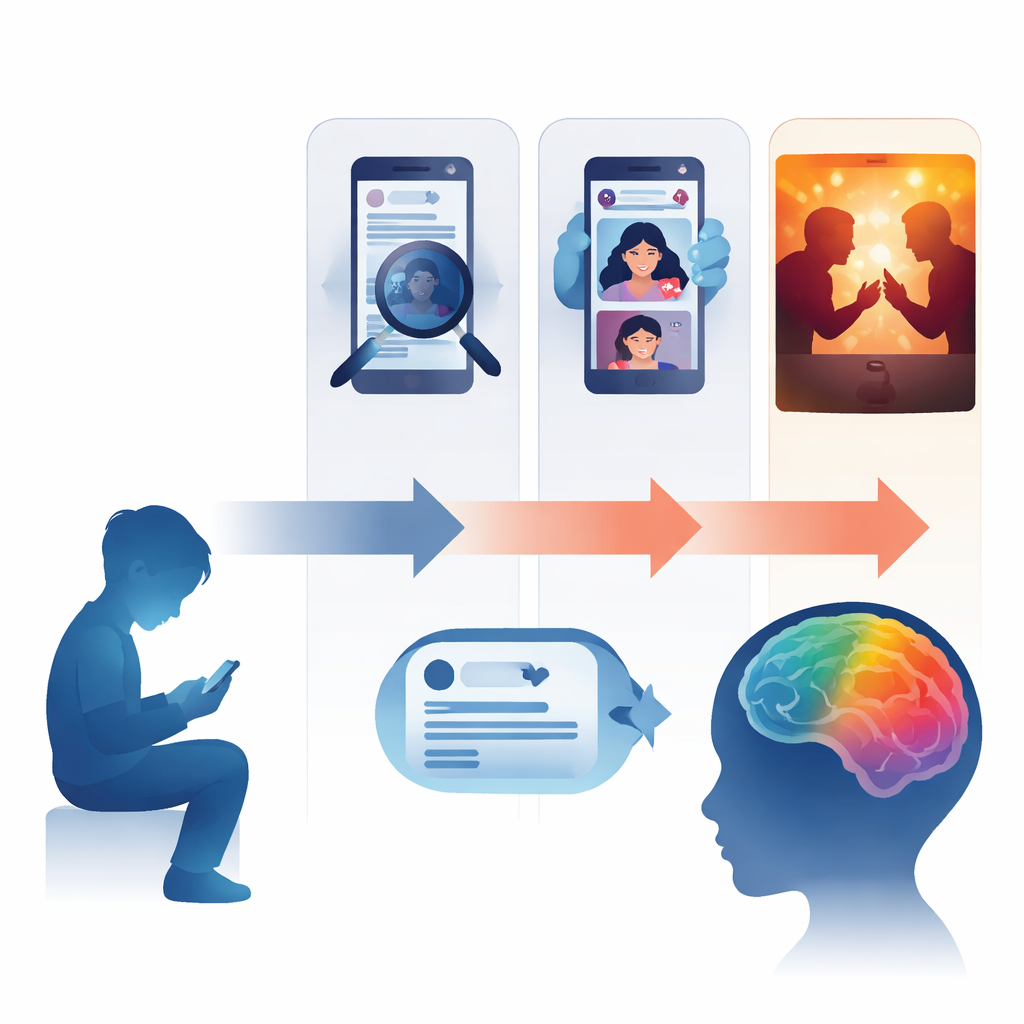
Using more advanced analysis, the authors identified three specific behaviors that stood out as most strongly tied to elevated suicidal ideation. First, frequently searching the internet for information about suicide appears to signal a particularly high-risk profile, in which personal distress interacts with recommendation algorithms that can quickly serve more disturbing content. Second, regularly posting photos from one’s private life on social media may expose children to relentless social comparison, pressure to gain approval, and potential cyberbullying, amplifying feelings of isolation or inadequacy. Third, often watching contests or reality shows—formats that thrive on emotional confrontations and may ignore public health guidelines for talking about mental suffering—was also linked to higher suicidal ideation. Together, these patterns sketch a digital environment where vulnerable children can be nudged toward greater distress.
What this means for parents, schools, and platforms
The authors conclude that media and social media are neither purely harmful nor purely helpful, but they can become dangerous when combined with existing vulnerabilities and designs that maximize attention at any cost. Their findings call for stronger safeguards around suicide-related content, including human oversight in moderation, as well as clearer guidelines to help journalists, producers, parents, and teachers handle sensitive topics responsibly. For families, the core message is not to panic about every minute spent online but to pay close attention to what children search for, how they present themselves on social networks, and the emotionally charged programs they watch. Talking openly about these habits and providing supportive alternatives may help reduce the likelihood that troubling media experiences deepen a child’s darkest thoughts.
Citation: Barredo-Ibáñez, D., Garcés-Prettel, M., Caro-Castaño, L. et al. Patterns of media and social media consumption associated with suicidal ideation in Spanish children. Humanit Soc Sci Commun 13, 378 (2026). https://doi.org/10.1057/s41599-026-06529-0
Keywords: child mental health, social media use, suicidal ideation, youth and screens, media influence