Clear Sky Science · en
Diverse built environment pathways for bridging global ambitions with local initiatives in sustainable transportation transitions
Why Neighborhood Design Matters for Travel and Climate
As cities grow and more people buy cars, it can feel inevitable that traffic jams and rising emissions will follow. This study shows that is not a fixed destiny. By carefully designing everyday places where people live, work, shop, and catch the bus, China could cut car travel almost as much as in the most climate‑friendly global scenarios, even if its economy and population follow a more typical path. The research connects big climate models with the fine-grained details of city blocks, highlighting how local choices about streets and buildings can add up to national progress on carbon goals. 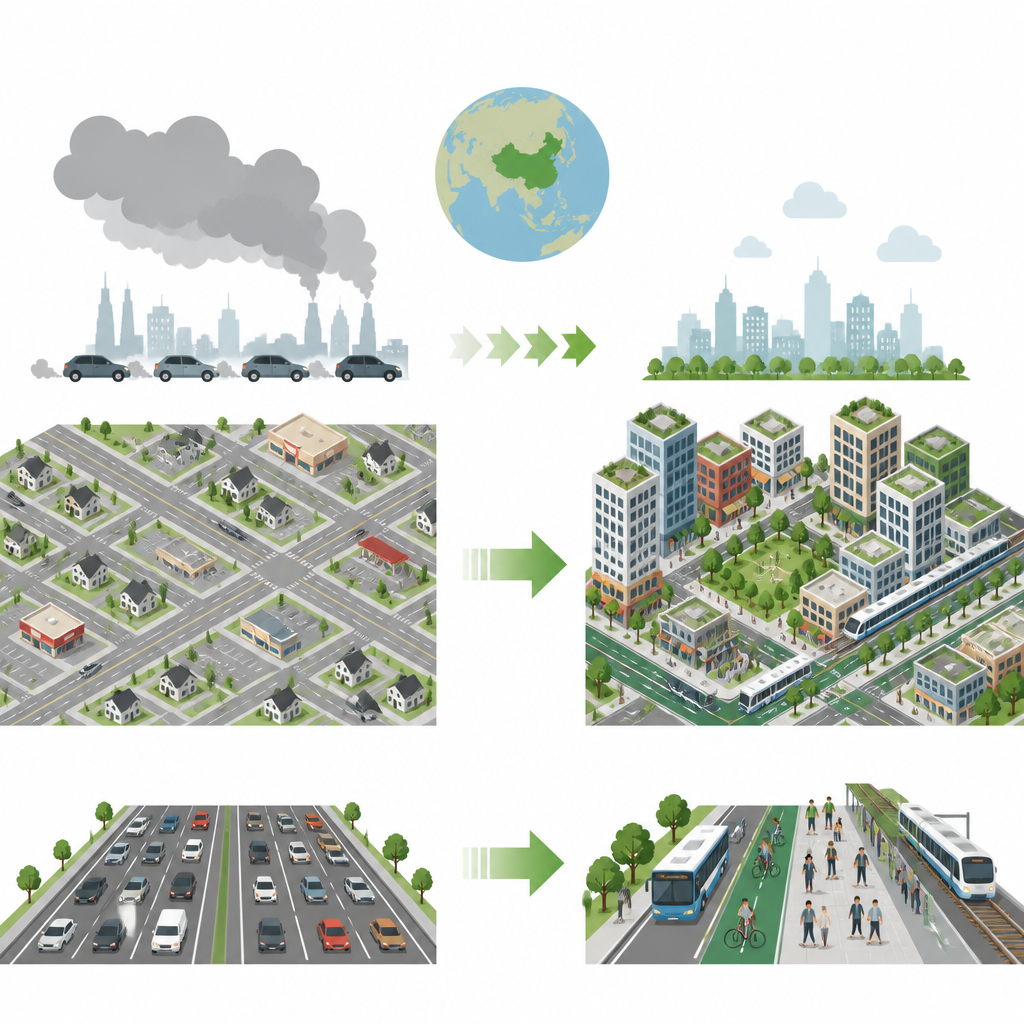
From Global Climate Goals to Local Streets
Transportation produces nearly a quarter of energy‑related carbon dioxide worldwide, and many plans to clean it up focus on new technologies like electric cars. Yet places such as Copenhagen and Amsterdam show that how cities are laid out matters just as much: compact, walkable neighborhoods with good public transport can keep car use low even in wealthy societies. This paper asks two questions in the context of China’s fast‑changing cities. First, how far can small‑scale urban design changes push the country toward a low‑carbon transport future? Second, how do those possibilities differ between provinces and between dense cities and the countryside, given varied economies, policies, and landscapes?
Linking National Models with a One‑Kilometer Grid
The authors build a bridge between large climate‑energy models and the realities of individual neighborhoods. They use the Global Change Analysis Model to project how much passenger travel in four‑wheeled light‑duty vehicles China might see from 2015 to 2060 under different global development storylines. Then they zoom in, dividing mainland China into more than nine million one‑kilometer squares and describing each square using five features often called the “5Ds”: how many people live there, how mixed the land uses are, how dense and connected the roads are, how close it is to a city center, and how many public transport stops are nearby. By combining earlier research on how these features affect travel with machine learning, they estimate how car travel potential in each grid cell changes over time as the built environment improves.
How Much Car Travel Can Design Avoid?
The results are striking. If China continues recent trends in making neighborhoods denser, more mixed, better connected, and better served by buses and trains, national demand for car travel in 2060 could be about 21 percent lower than in 2015, even as the country grows richer. That level, the study finds, is close to what the most climate‑ambitious global pathway (known as SSP1) would require, and much lower than a business‑as‑usual pathway with the same population and economic growth. In other words, street networks, transit stops, and land‑use patterns can deliver demand cuts comparable to aggressive technological and economic shifts in global models. At the same time, the study confirms that even wide adoption of electric vehicles slightly lowers overall travel demand in the models, but not nearly as much as improving neighborhood form.
Different Places, Different Paths
Looking across provinces and between city and countryside reveals important differences. By 2060, gaps in car travel between provinces are driven less by income and more by how and where people live. Cities hold about three‑quarters of total car travel, but each rural grid square tends to generate slightly more car use than an urban one because homes and services are far apart and transit options are limited. Within cities, older pedestrian‑oriented cores, built before private cars were common, already show lower car travel than newer outer districts shaped around driving. Machine‑learning analysis suggests that keeping these historic centers dense, diverse, and economically vibrant helps them stay low‑car, while redesigning car‑oriented districts around better street layouts, closer destinations, and stronger transit links can steadily reduce their car dependence. 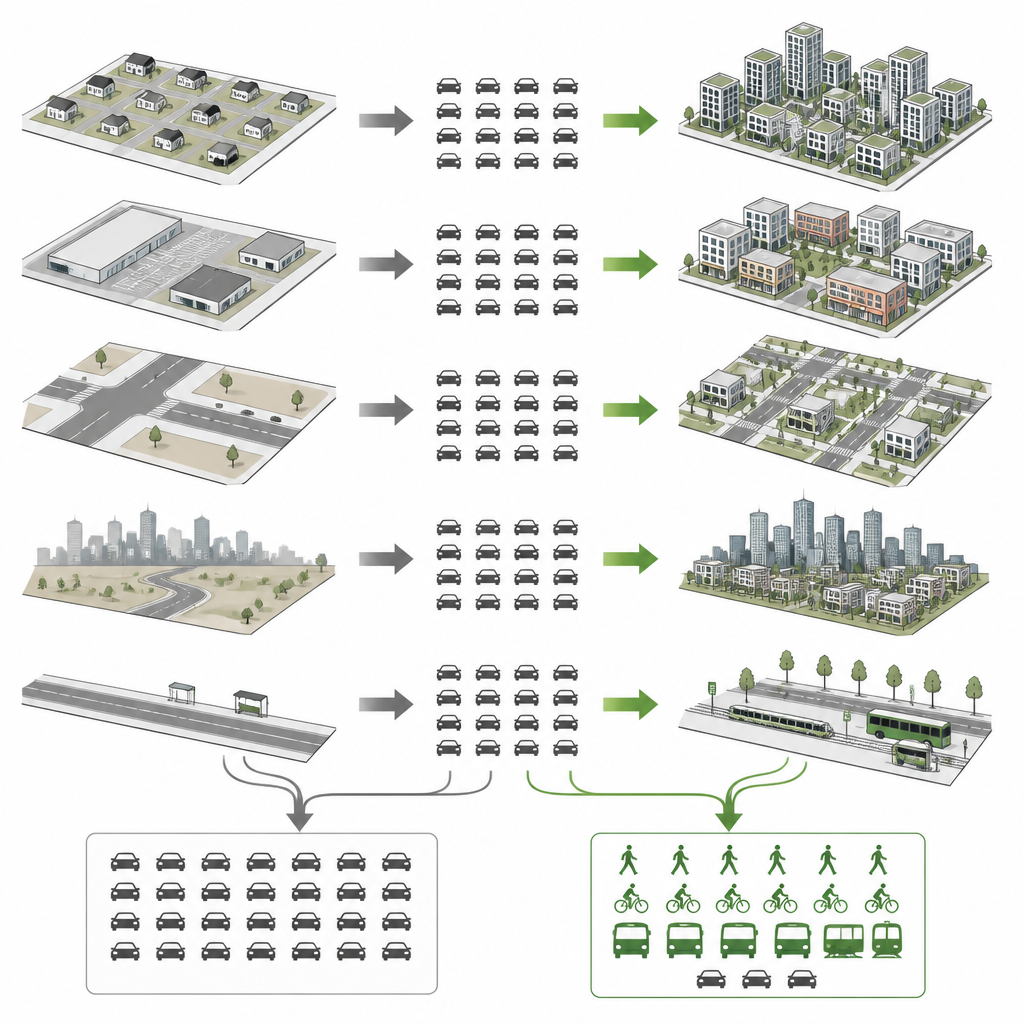
What This Means for Everyday Life
For a layperson, the core message is simple: how your neighborhood is built strongly influences whether you feel you need a car for every trip. Sidewalks, bike lanes, nearby shops, parks, schools, and reliable buses or trains do more than add convenience; they can collectively cut national car travel by a fifth over a few decades. The study shows that if countries like China pair national pushes for cleaner vehicles with local efforts to make walking, cycling, and transit natural choices, they can move much closer to ambitious climate targets. Rather than relying only on new engines and fuels, planners and residents can help shape streets and districts so that low‑carbon travel becomes the easiest, most attractive option.
Citation: Wang, T., Tong, X. & Shi, X. Diverse built environment pathways for bridging global ambitions with local initiatives in sustainable transportation transitions. npj. Sustain. Mobil. Transp. 3, 36 (2026). https://doi.org/10.1038/s44333-026-00098-0
Keywords: sustainable transport, urban form, built environment, China mobility, travel demand