Clear Sky Science · en
Autistic children sample costly information with increased variability due to inflexible updating
How kids weigh choices in everyday life
Everyday decisions, from picking an ice cream flavor to choosing a game, quietly rely on how much information we collect before we decide. This study looks at how autistic children and non-autistic (neurotypical) children gather information when it has a price, using a playful computer game to reveal how their decision habits differ.
A game of mystery islands and hidden clues
Researchers turned a classic psychology task into an adventure game for children aged five to eight. On each round, children saw two cartoon islands, each with its own mix of dogs and cats. They were secretly placed on one island and could “meet” up to 20 animals, one at a time, by pressing a button. After sampling, they guessed which island they were on to win points. Sometimes looking at another animal was free, but in other rounds each extra sample cost a few points. The trick was to stop at the right time: too few samples meant more wrong guesses, but too many meant losing points to sampling costs.
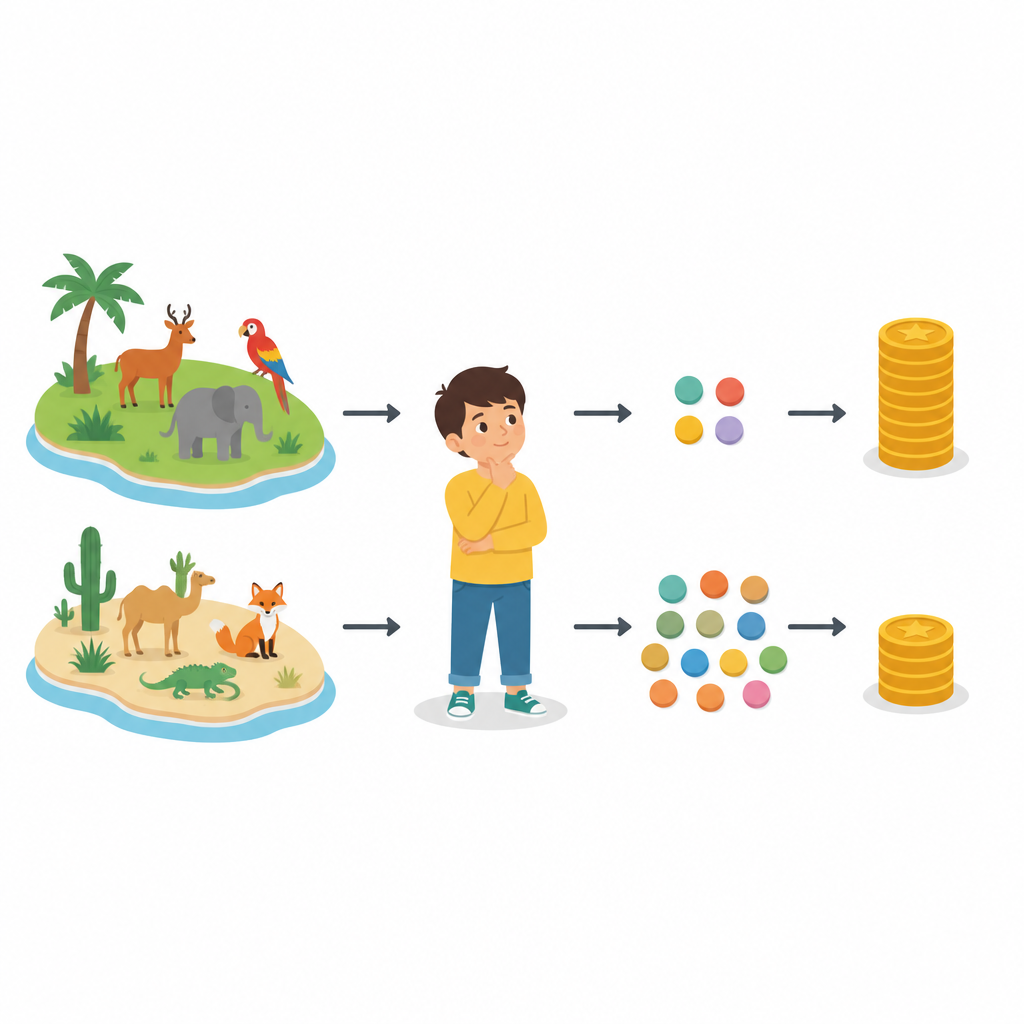
When cost matters, strategies start to diverge
Across 73 children, autistic and neurotypical groups were just as accurate at identifying the correct island. The big difference lay in how efficiently they used information. Neurotypical children tended to stop earlier overall, especially when samples were free, which sometimes left useful information on the table. Autistic children often kept sampling longer, which helped them when sampling cost nothing. In costly rounds, however, their payoffs dropped more sharply. They earned fewer points than their peers, not because they misunderstood the task, but because their sampling was less tuned to the changing costs and evidence in each situation.
More ups and downs from trial to trial
The researchers then asked whether autistic children were consistently oversampling or whether something subtler was happening. They found that both groups sometimes took more or fewer samples than would be mathematically ideal, but autistic children showed much larger swings from trial to trial when sampling was costly. In other words, under conditions where each extra animal reduced their reward, their number of samples varied a lot more. This greater scatter in behavior, rather than a simple tendency to take too many or too few samples, explained much of their lower efficiency.
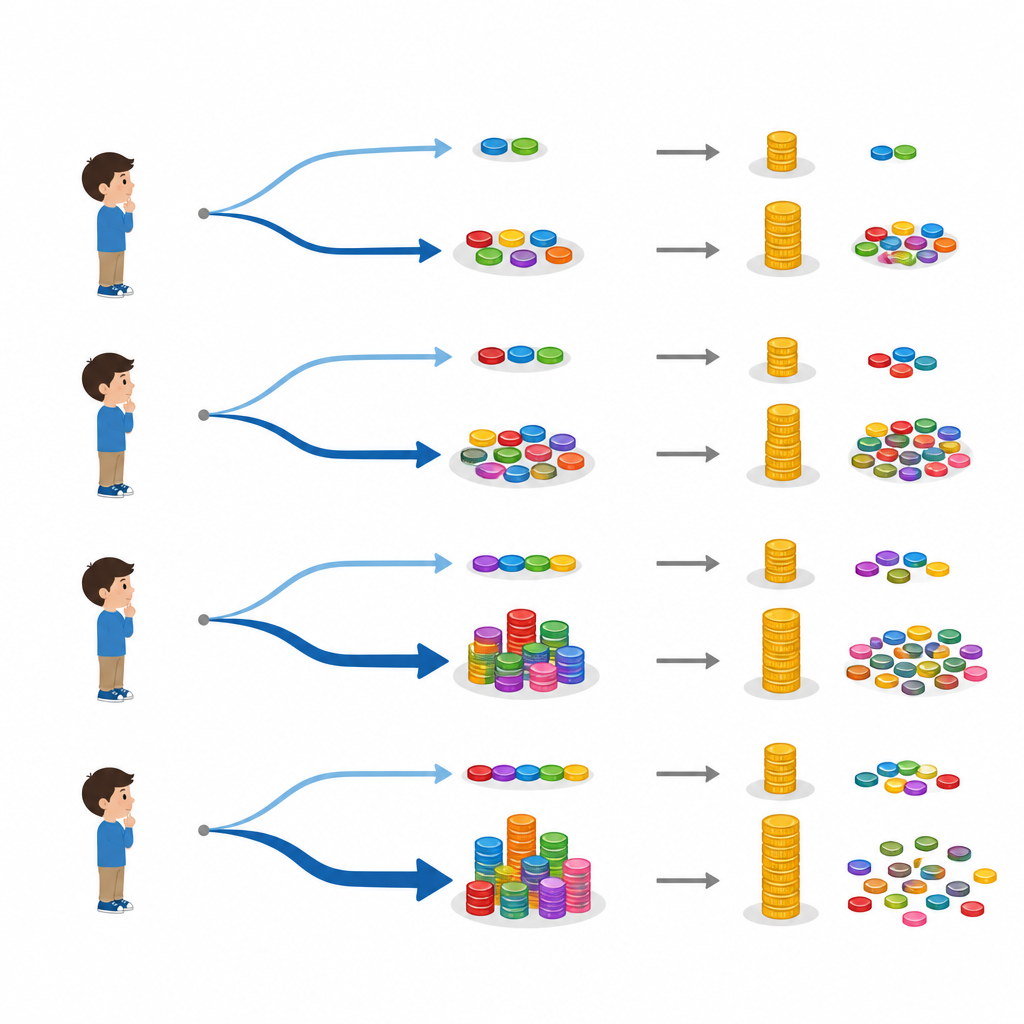
Peeking inside the decision process
To probe what might drive these patterns, the team fit computer models that simulate how children might combine clues about cost and evidence when deciding to stop. Both autistic and neurotypical children were best described by the same kind of model, suggesting that they relied on a similar basic recipe: consider how expensive another sample would be and how strong the current evidence is. But the model parameters revealed important differences. Neurotypical children adjusted their behavior more smoothly as total cost and accumulated information built up, and they carried some influence from what they had done on the previous trial. Autistic children, in contrast, were less swayed by these broader, slowly changing signals and more influenced by the most recent samples within a single trial.
What this means for understanding autism
These results fit with ideas that autistic people may focus more on fresh, local details and less on longer-term patterns or context. In this game, that meant autistic children did especially well when extra information was free, but found it harder to keep a stable, efficient sampling strategy when each new piece of information carried a cost. Rather than a simple deficit, the study points to a different balance in how information is used, which may help explain everyday challenges and strengths in learning and decision-making for autistic children.
Citation: Lu, H., Zhang, H. & Yi, L. Autistic children sample costly information with increased variability due to inflexible updating. Commun Psychol 4, 80 (2026). https://doi.org/10.1038/s44271-026-00439-2
Keywords: autism, information sampling, child decision making, cognitive flexibility, computational modeling