Clear Sky Science · en
Additionality constrains investment in carbon sequestration
Why soil carbon and farmer paychecks matter
Most of the world’s farmland soils have lost a great deal of their natural carbon, which harms both food production and the climate. This study asks a simple but powerful question: what if farmers were paid not just for new carbon they add to their fields, but also for the carbon already stored there? By treating soil carbon like a long-lived financial asset, the authors explore how changing the rules of carbon markets could unlock much larger investments in practices that rebuild healthy soils.
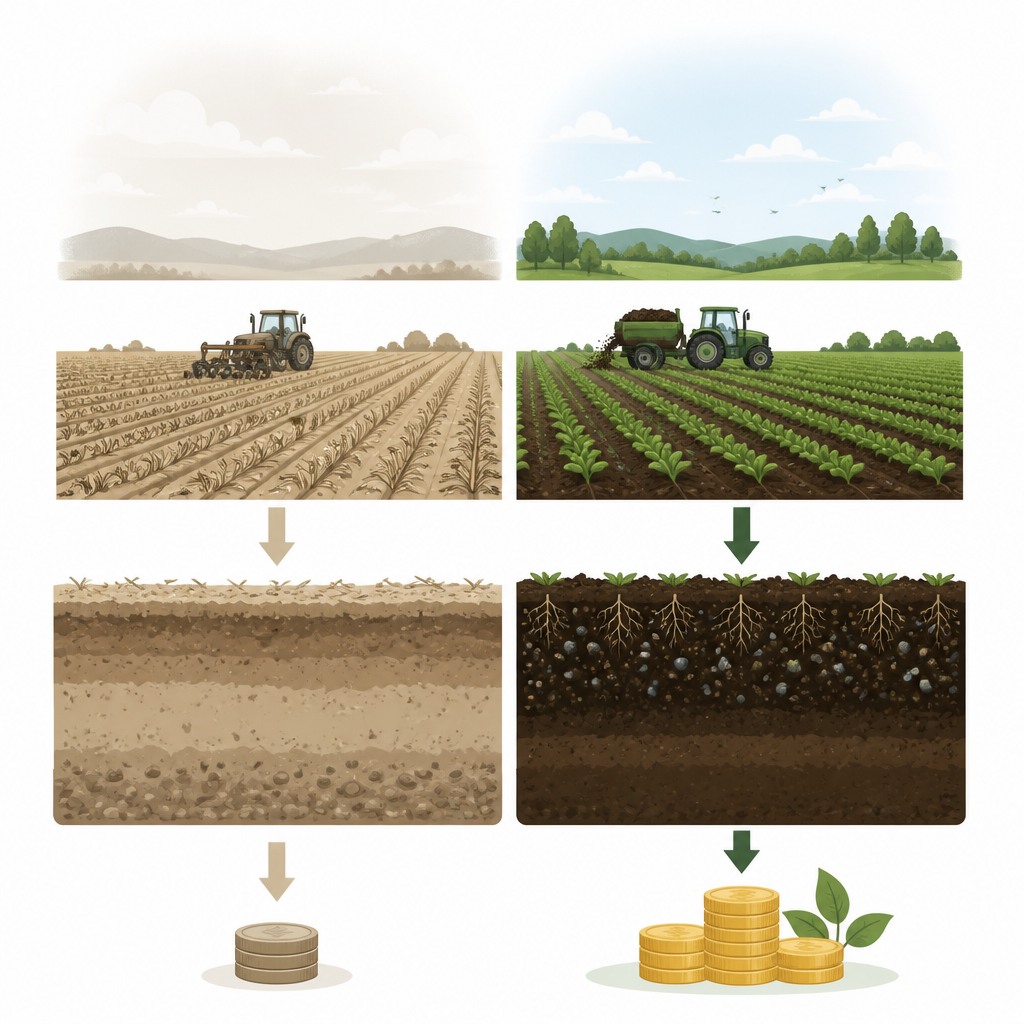
How current rules hold back soil climate solutions
Today’s carbon markets follow a rule called “additionality.” Under this rule, a farmer only earns credits for carbon that would not have been stored without carbon payments. Carbon already in the soil, or gains from common practices like spreading manure, usually does not count. This protects the climate value of credits, but it also means a large share of real soil carbon is treated as if it has no financial value. Early adopters of good practices are left out, low-cost methods are often labeled “business as usual,” and the paperwork needed to prove additionality can be complex and costly.
Turning soil carbon into a true asset
The authors propose a different approach: create a carbon asset class for active carbon stored in the top 30 centimeters of cropland soil. In this design, a farmer receives ongoing annual payments for every unit of stable soil carbon, no matter when it was added, as long as it remains in place. If carbon is later lost through erosion or land-use change, the asset shrinks and its value falls, so buyers of the asset take on the risk that the carbon might be released. This shifts the focus from checking whether each practice is “extra” to simply measuring and rewarding the total amount of carbon stored in the soil.
Testing the idea with a Texas farm model
To see how this change might shape behavior, the researchers built an economic model of a typical crop farm in Texas. They looked at two types of farmers: those growing oilseeds and grains, and those growing vegetables and melons. Farmers can invest in soil amendments such as manure compost or biochar that increase soil carbon over time but involve up-front costs. The model tracks profits from both crop yields and carbon payments and asks how a profit‑seeking farmer would invest over 45 years under two policy cases: the current additionality rule and a fully monetizable soil carbon asset.
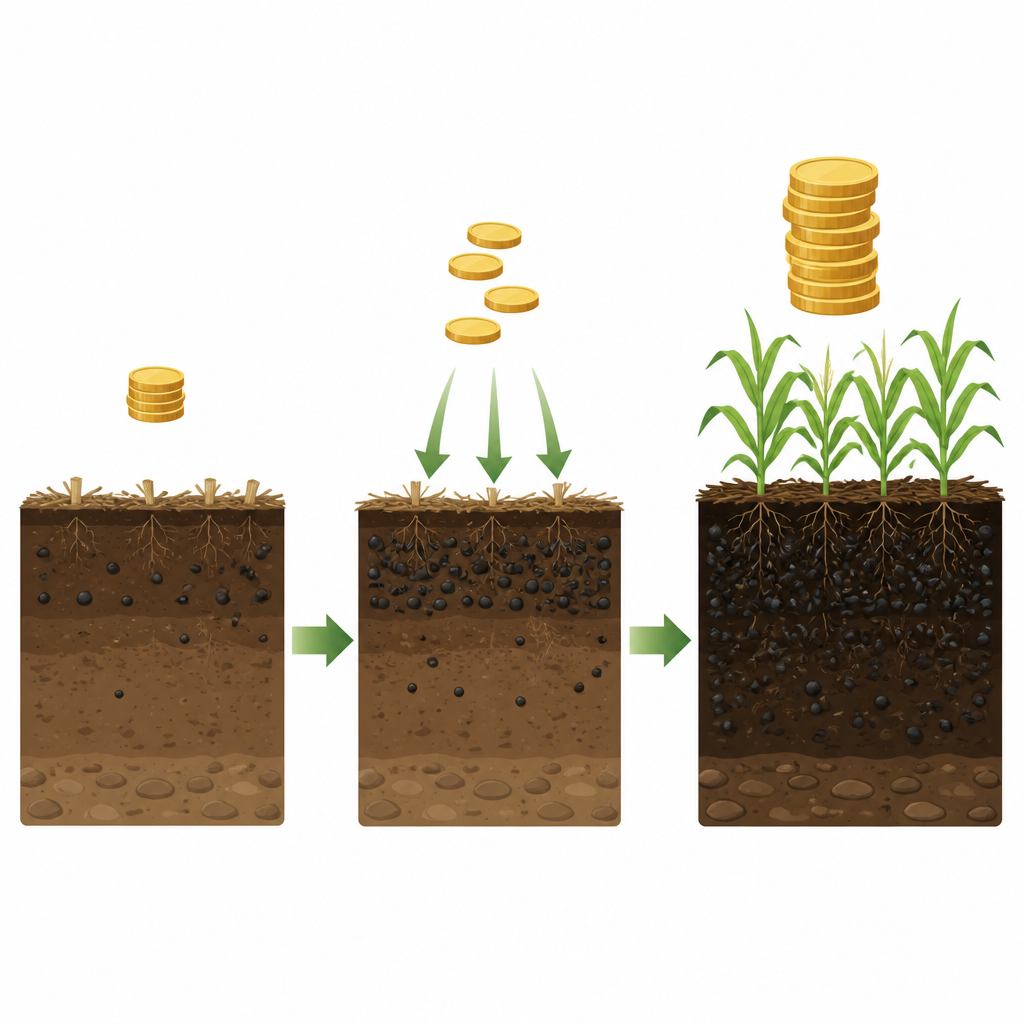
What happens when all stored soil carbon is paid for
With a carbon price linked to $150 per tonne of carbon dioxide, the model finds that the additionality rule leads to almost no extra soil carbon by 2050. For the representative farms, soil carbon actually drifts downward because there is too little financial incentive to invest. When soil carbon is treated as a full asset, the picture changes sharply. Oilseed and grain farmers increase their soil carbon stocks by about 26.9 tonnes of carbon per hectare, a rise of roughly 272 percent over their initial pool. Vegetable and melon farmers add around 30.1 tonnes per hectare, about a 304 percent increase. Sensitivity tests with different soil conditions and shorter time horizons show the same pattern: once all stored soil carbon is monetized, farmers invest more in building and maintaining it.
Limits, open questions, and what it means
The study rests on a mathematical model rather than farm‑by‑farm field trials, and it does not simulate the fine‑scale biology of soils. It assumes average conditions and cannot capture all the diversity of soils, crops, and management styles. Future work will need better models of soil processes, more detailed farm data, and careful design of how a soil carbon index would work in practice. Still, the results highlight a key insight for policy: when soil carbon is treated as real wealth that earns a steady income, farmers are more likely to invest in practices that lock carbon into the ground.
Takeaway for climate and agriculture
For a lay reader, the core message is straightforward. Current carbon market rules aim to protect the environment but unintentionally leave a lot of soil carbon “stranded” with no value. This research suggests that paying farmers for the full stock of carbon stored in their soils could greatly boost the amount of carbon they keep and add, while also supporting more fertile, productive land. In other words, treating soil carbon like a long-lived savings account could benefit both farmers’ bottom lines and the planet’s climate goals.
Citation: Kannegieter, S., Medlock, K.B. Additionality constrains investment in carbon sequestration. npj Sustain. Agric. 4, 40 (2026). https://doi.org/10.1038/s44264-026-00155-8
Keywords: soil carbon, carbon markets, carbon farming, biochar, sustainable agriculture