Clear Sky Science · en
Climate change accelerates global forest deadwood dynamics
Why Fallen Trees Matter for Our Future
When most people think about forests and climate change, they picture green leaves pulling carbon dioxide out of the air. But forests also hold huge amounts of carbon in dead trees lying on the ground or standing as gray trunks. This study asks a simple but important question: as the climate warms, will forests around the world end up with more or less of this deadwood, and what does that mean for carbon storage and wildlife?
The Hidden World of Deadwood
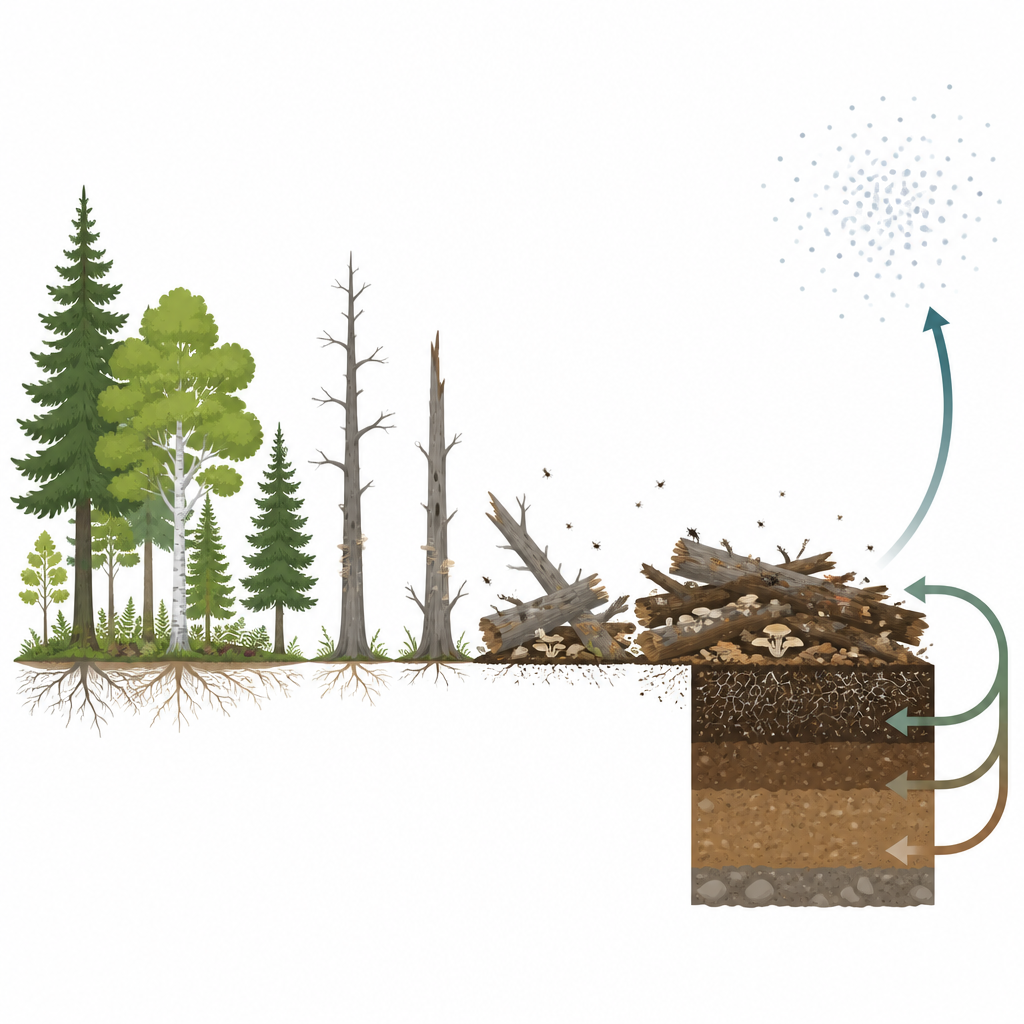
Deadwood is more than just rotting logs. It stores roughly one-twelfth of all the carbon locked up in forests and provides homes and food for thousands of species of insects, fungi, and other organisms. The amount of deadwood at any moment is shaped by a tug-of-war between two forces: the death of trees, which adds new wood to the pool, and decomposition, which breaks it down and returns carbon to the air and soil. Both forces are tightly linked to climate, through effects on tree growth, forest dieback, and the activity of decomposers.
Simulating a Century of Change
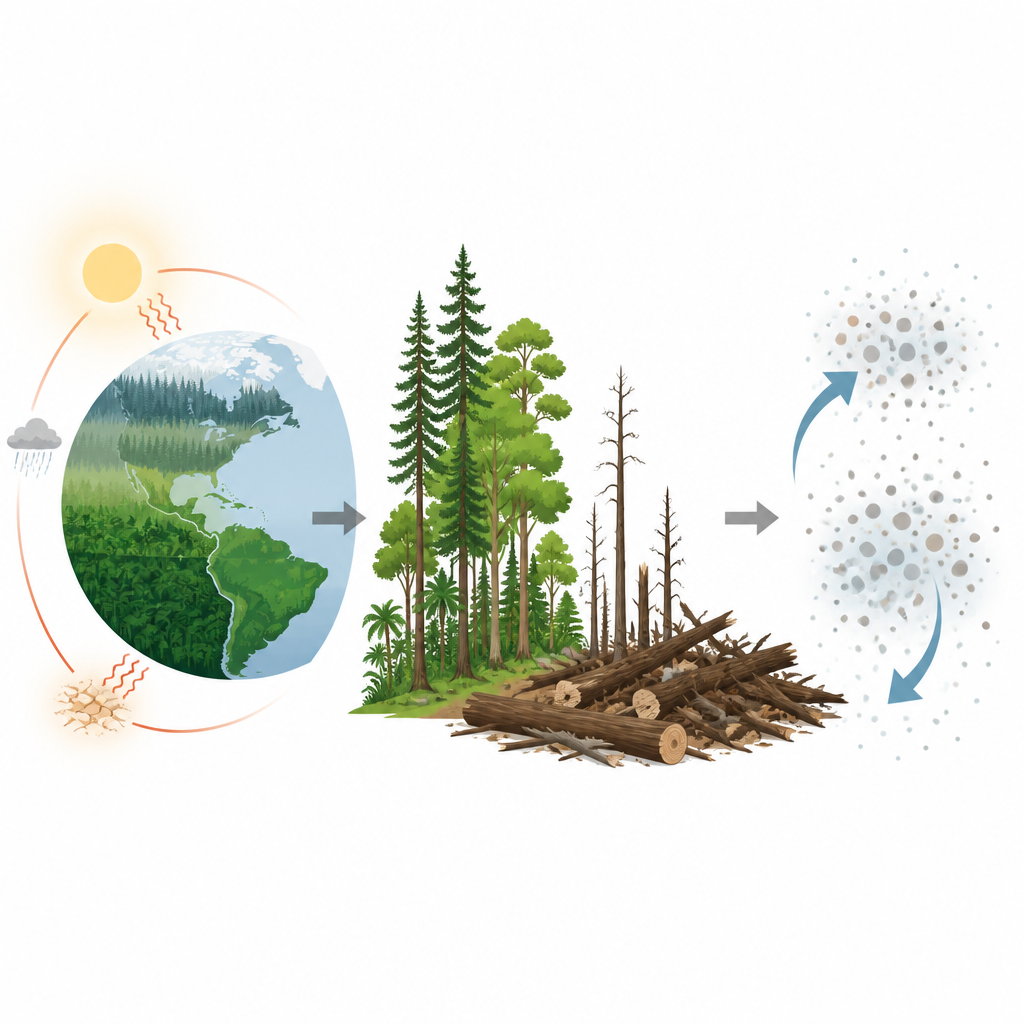
To explore how this balance might shift during the twenty-first century, the researchers combined three powerful data sources. They started with a global map of deadwood in 2010. They then used five large-scale computer models of vegetation to estimate how much wood would be added each year as trees grow and die under different climate futures. Finally, they drew on results from a worldwide field experiment that tracked how quickly deadwood decays in different climates and for different types of trees. By pairing the simulated inputs from dying trees with climate-sensitive decay rates, they calculated how deadwood stocks might evolve in forests across the globe.
More Flux, Slightly More Storage
The team found that climate change speeds up both sides of the deadwood cycle. As temperatures rise and growing seasons lengthen, forests tend to grow faster and experience more tree death, especially where droughts, storms, fires, and pests intensify. That means more deadwood is created. At the same time, warmer conditions stimulate fungi, insects, and other decomposers, so deadwood breaks down more quickly. Across all tested models and climate scenarios, the inflow of new deadwood increased more strongly than its loss through decay, by about five percent on average. This suggests that, overall, forests are likely to accumulate more deadwood carbon by the end of the century, even though in about one out of five simulated futures the opposite occurred.
Different Forests, Different Responses
The picture is not uniform. Boreal and temperate forests at higher latitudes showed the clearest tendency toward rising deadwood stocks, with inputs noticeably outpacing outputs. In the tropics, the margin was much smaller, with deadwood creation only slightly exceeding decay. Within each biome there were sharp contrasts: some coastal temperate areas showed net losses of deadwood, while nearby mountain regions showed gains. The overall sensitivity of deadwood balance to warming also depended strongly on which vegetation model was used. One model indicated that warming would steadily tip the balance toward more deadwood, whereas several others suggested that faster decay could catch up or even overtake inputs. These differences highlight how much uncertainty remains about how forests will respond to future climate conditions.
What Rising Deadwood Means for People and Nature
If deadwood does increase in many forests, it could play a growing role in slowing the loss of carbon from land to atmosphere, because part of the carbon released during decay is stored in soils and living organisms. More deadwood also supports richer forest life, from beetles and fungi to birds and mammals that depend on hollow logs and decaying trunks. At the same time, human choices about logging, land clearing, and protected areas will strongly shape how much deadwood actually remains on the ground. The authors argue that fallen and standing dead trees should no longer be seen as waste, but as a central part of how forests buffer climate change and support biodiversity, and they call for forest policies that take this overlooked resource into account.
Citation: Edelmann, P., Rammer, W., Pugh, T.A.M. et al. Climate change accelerates global forest deadwood dynamics. Commun Earth Environ 7, 453 (2026). https://doi.org/10.1038/s43247-026-03651-4
Keywords: deadwood, forest carbon, climate change, decomposition, biodiversity