Clear Sky Science · en
Cooler and drier climate in the South–Central Pacific during the last glacial period
Why Pacific rainfall in the ice age matters today
The tropical South Pacific is home to millions of people who depend on reliable rain for drinking water, farming and healthy ecosystems. This study looks far back in time to see how rainfall and temperature changed around the island of Nuku Hiva in French Polynesia during the last ice age. By understanding how this region behaved when the planet was much colder, scientists hope to better anticipate how it might respond as the world warms.
A hidden climate archive in island peat
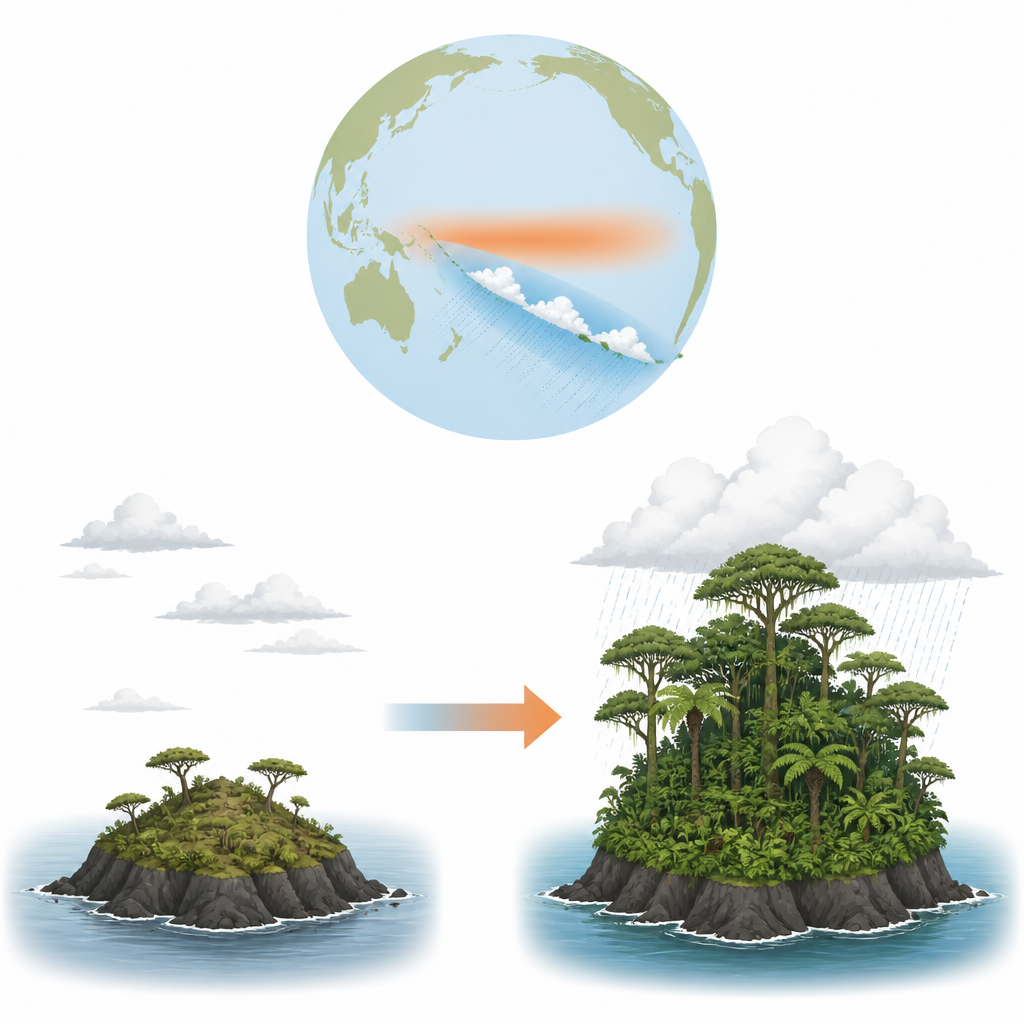
On a high plateau of Nuku Hiva, a long, narrow peat swamp has quietly built up layers of plant material for tens of thousands of years. Each layer preserves chemical traces of past climate and tiny grains of pollen from surrounding plants. The authors extracted a 50,000 year long core from this peat, creating the first continuous land based record of both temperature and rainfall for the South–Central Pacific that reaches well beyond the last few thousand years. This helps fill an important gap in our knowledge of a remote but globally important climate region.
Reading past rainfall from plant wax and pollen
Leaves are coated with waxes that contain hydrogen atoms taken from rainwater. By measuring the hydrogen fingerprint of these waxes in each layer of peat, the team could infer how wet or dry conditions were when the plants grew. They also counted pollen grains to see which types of vegetation were most common over time. On Nuku Hiva, lush cloud forest plants today grow high on the mountains where rain is heavy, while tough herb like plants thrive lower down where it is drier. Shifts between these pollen types therefore reveal changes in moisture and the height of the cloud belt above the island.
Telltale signs of a cooler island
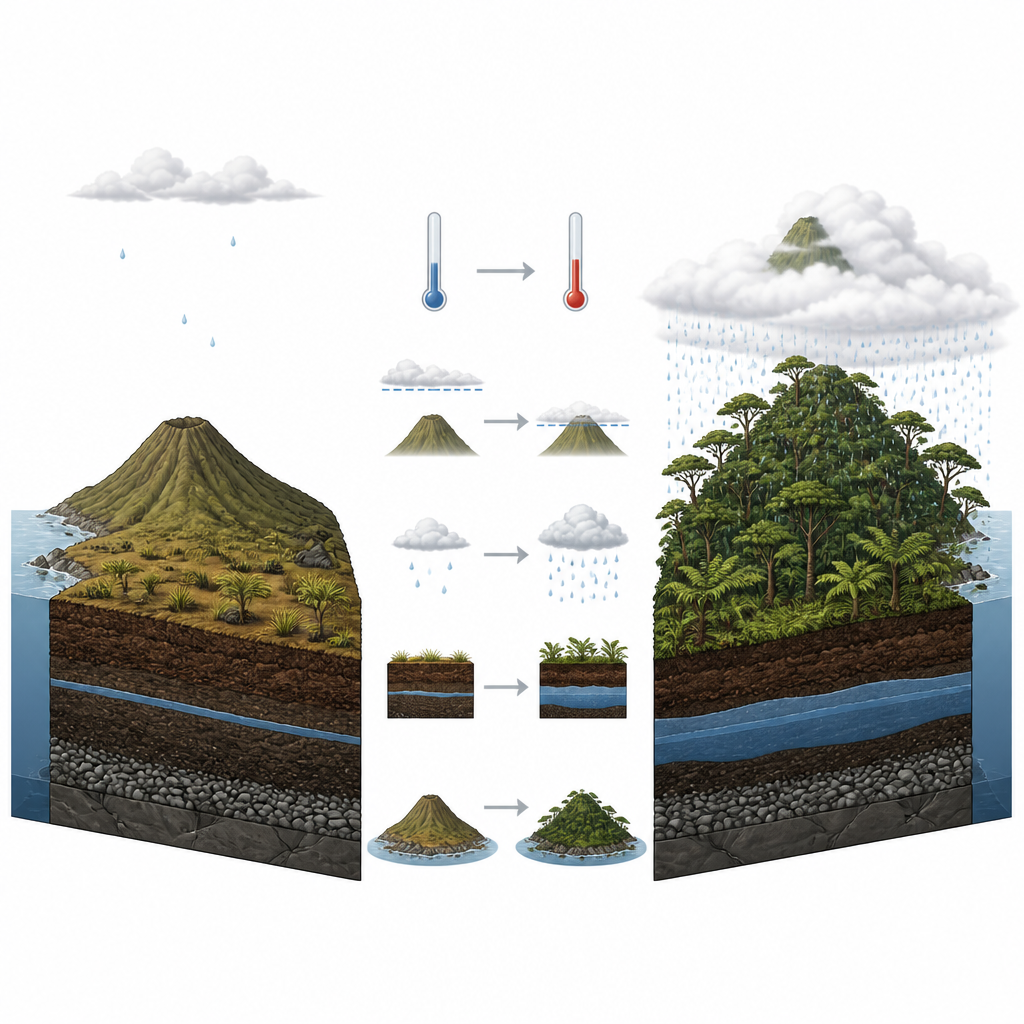
To track temperature, the researchers measured special fats made by soil bacteria whose structure depends on air warmth. Calibrating these molecules against modern conditions showed that they act as a natural thermometer. The peat record indicates that Nuku Hiva was around 9 degrees Celsius cooler at the height of the last glacial period than in recent centuries. The coldest time occurred slightly earlier than the global peak of the ice age but matched evidence from tropical mountain glaciers elsewhere, pointing to a broad cooling of the tropical atmosphere.
A drier South–Central Pacific during the ice age
Both the chemical and pollen evidence point to much drier conditions on Nuku Hiva during the ice age than today. Plant wax signals show that rainwater became isotopically heavier, a sign of reduced rainfall, while pollen from moisture loving cloud forest plants declined and drought hardy herbs became more common. The authors interpret this as the cloud belt lifting to higher elevations as rainfall lessened, leaving the study site drier. When the climate warmed after the ice age, rainfall increased, the cloud base lowered, and cloud forest vegetation expanded again.
Linking warmth and wetness for future insight
When the authors compared their temperature and rainfall reconstructions, they found that cooler times on Nuku Hiva lined up with drier conditions, especially during the glacial period. This suggests that in this part of the South Pacific, a warmer background state tends to favor more moisture in the air and more rain. Climate model simulations disagree on how rainfall in this region changed during the ice age, and many suffer from known biases in tropical rainfall patterns. The new peat record therefore provides a valuable reality check. For a lay reader, the key takeaway is simple: in this corner of the Pacific, cold went hand in hand with drought, while warmth brought back the rain. That relationship offers a clearer window into how future temperature shifts could reshape water supplies and ecosystems across these vulnerable islands.
Citation: Peaple, M.D., Skinner, D.T., Inglis, G.N. et al. Cooler and drier climate in the South–Central Pacific during the last glacial period. Commun Earth Environ 7, 408 (2026). https://doi.org/10.1038/s43247-026-03356-8
Keywords: South Pacific climate, last glacial period, tropical rainfall, paleoclimate record, cloud forest change