Clear Sky Science · en
Rapid revegetation after the Wenchuan earthquake offsets landslide-induced carbon losses
Shaking Mountains and Hidden Carbon
When a powerful earthquake strikes steep mountains, the damage is easy to see: collapsing slopes, broken forests, and muddy rivers. Less obvious is what happens to the vast stores of carbon locked in those soils and trees. This study of the 2008 Wenchuan earthquake in China tackles a deceptively simple question with big climate implications: do such disasters ultimately release more carbon dioxide into the air, or can nature’s recovery turn them into temporary carbon traps?
A Giant Quake and a Scarred River Valley
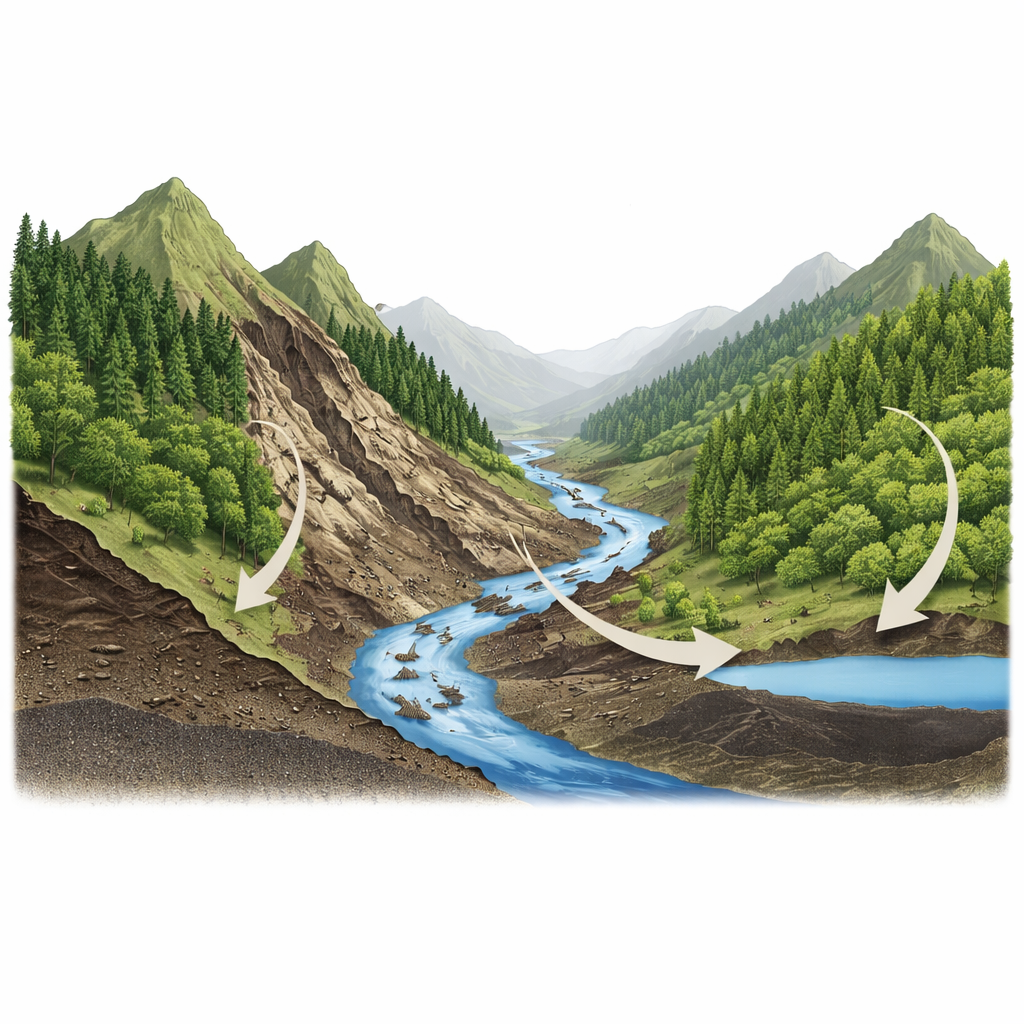
The research focuses on the upper Min Jiang, a rugged river basin along the eastern edge of the Tibetan Plateau, where the magnitude 7.9 Wenchuan earthquake triggered about 20,000 landslides. Before the quake, dense forests and deep soils in this region quietly stored large amounts of organic carbon. When the ground shook, entire hillsides gave way, stripping away trees and soil from ridge tops to valley bottoms. By combining detailed field plots with high-resolution maps of vegetation, soils and landslides, the team estimated how much organic carbon was suddenly put into motion by this single event.
How Much Carbon Was Set Loose?
Measurements from 91 vegetation plots and 78 soil profiles, together with satellite-based vegetation indices, allowed the researchers to reconstruct how much carbon was present before and after the earthquake. They found that landslides in the upper Min Jiang eroded about 2.72 teragrams (billion kilograms) of organic carbon, most of it from soil and the rest from vegetation. Extending the same approach to three nearby river systems raised the total loss for the wider area to 7.80 teragrams, lower than some earlier, less detailed estimates. Viewed globally, the study suggests large earthquakes (magnitude above 7) have collectively moved roughly a half petagram of organic carbon since 2000—around a tenth of the annual organic carbon that rivers carry to the oceans.
Where the Dislodged Carbon Ends Up
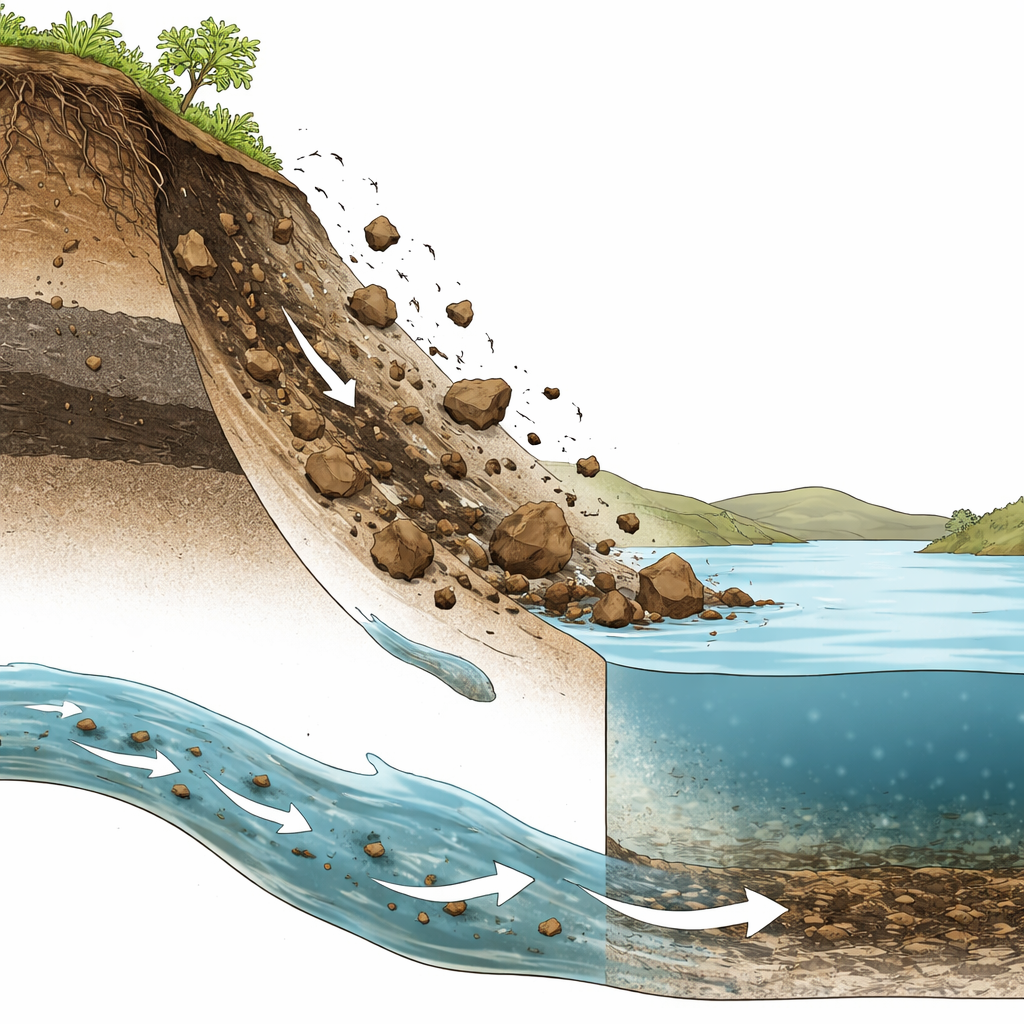
Once soil and wood are torn from slopes, they follow different fates. Some of the exposed organic matter decomposes in the open air, releasing carbon dioxide. Some is swept into rivers as particulate organic carbon and can be carried downstream, buried in reservoirs or offshore sediments, and preserved for centuries or longer. Using a reduced-complexity model and measurements of river sediment and carbon fluxes, the authors show that between about 43 and 56 percent of the earthquake-mobilized carbon in the upper Min Jiang likely escapes oxidation and is transported by rivers. Much of it is expected to settle in a large downstream reservoir, where repeated debris flows after the quake increase the chances that organic matter is buried rather than broken down.
Slow Soils, Faster Forests
The story does not end with the initial landslides. Over years to centuries, plants recolonize bare scars and new soils gradually form, drawing carbon out of the atmosphere. Satellite vegetation indices show that green cover in landslide areas rebounded within roughly a decade, driven first by herbs and shrubs and more slowly by trees. By fitting global biomass recovery curves to their data, the authors estimate that vegetation carbon in the study area will regain half of its pre-quake stock in about 74 years, with shrubs recovering much faster than forests. Soils are another matter: based on global soil studies and local measurements of disturbed and undisturbed sites, the team projects that soil organic carbon will need roughly 500 to 850 years just to recover to 50 percent of its original level.
From Short-Term Source to Long-Term Sink
To see whether the earthquake ultimately behaves as a carbon source or sink, the researchers combined three main processes in a time-evolving budget: oxidation of landslide-mobilized carbon on slopes, burial of exported organic matter in sediments, and the gradual rebuilding of vegetation and soil carbon stores. Depending on how quickly exposed carbon decays, the system can act as a short-lived carbon source before recovery and burial tip it into net storage. For higher decay rates, they find a source phase lasting on the order of decades (about 60–70 years) before the landscape becomes a net sink. For lower decay rates, the basin behaves as a sink throughout the recovery period. In everyday terms, the study shows that even though a major earthquake violently strips away forests and soils, the combination of rapid revegetation, slow but persistent soil rebuilding, and efficient burial of eroded carbon means that, over decades to centuries, such events can help lock carbon away rather than simply venting it to the atmosphere.
Citation: Zhu, C., Wang, J., Wen, M. et al. Rapid revegetation after the Wenchuan earthquake offsets landslide-induced carbon losses. Commun Earth Environ 7, 292 (2026). https://doi.org/10.1038/s43247-026-03314-4
Keywords: earthquake landslides, carbon cycle, reforestation, soil recovery, mountain rivers