Clear Sky Science · en
Urban blue and green spaces: distribution, social equity, and ecological implications in Great Britain
Why water and greenery in cities matter
Cities are often pictured as endless concrete, but they also contain vital pockets of water and vegetation that quietly support our health and the natural world. This study looks across almost 500 towns and cities in Great Britain to ask a simple question with far-reaching consequences: how fairly are rivers, canals, coasts, ponds, parks, and other natural areas shared among different communities, and what does that mean for wildlife and climate resilience?
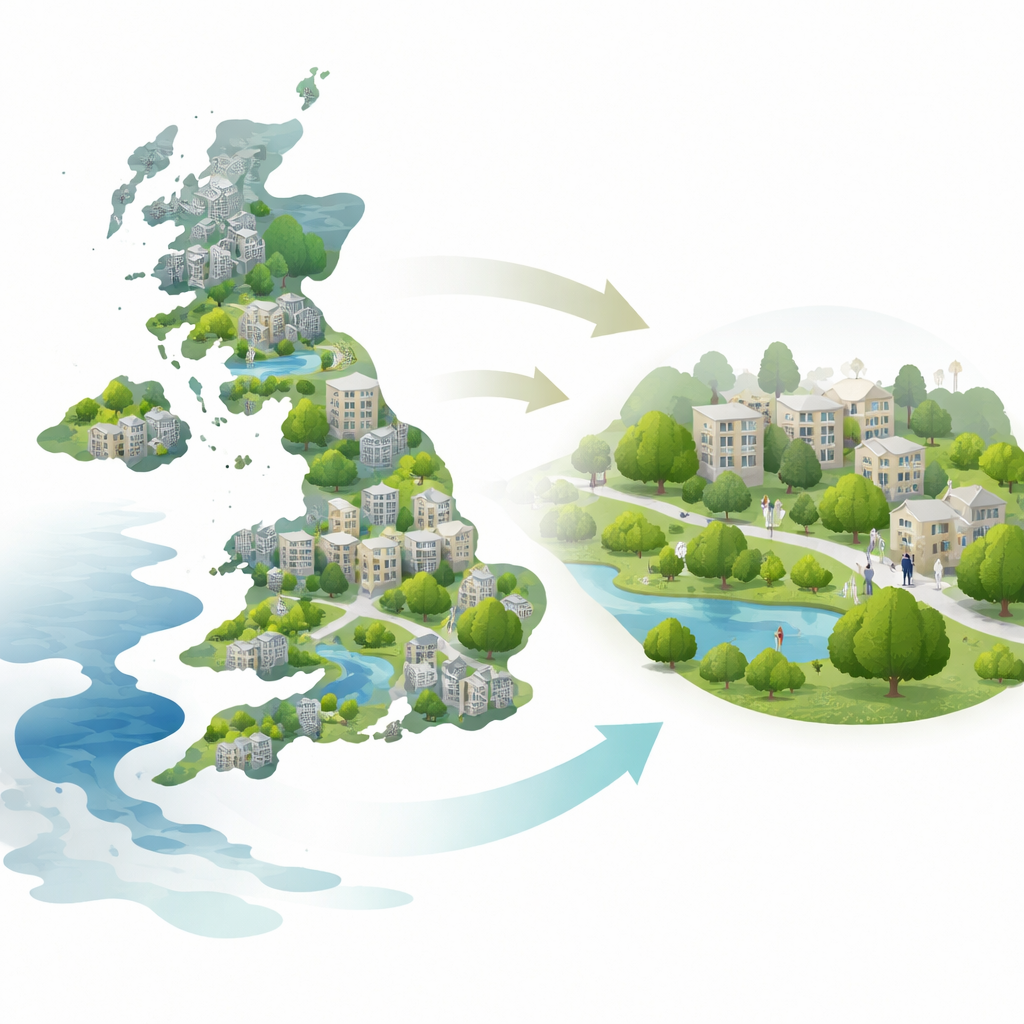
Two colors of nature in the city
The researchers distinguish between two main types of urban nature. “Blue” spaces are places where water is the main feature, from canals and rivers to beaches, estuaries, and small ponds. “Green” spaces include parks, woods, gardens, road verges, and other vegetated land. Both can cool cities, reduce flood risk, clean the air, and offer places for exercise and relaxation. Yet most previous work, in Britain and elsewhere, has focused on greenery and treated water as an afterthought. This study set out to correct that imbalance by building a detailed, national picture of where blue spaces are, how much area they cover, and who lives near them.
Mapping the hidden water in urban areas
To do this, the team combined several high-quality maps and government datasets. They began with official outlines of built-up areas, then expanded each city boundary by 200 meters to capture beaches, riverbanks, and nearby natural ground that people can easily see or reach on foot. They overlaid a land-cover map that divides Great Britain into 21 habitat types, from woodland and grassland to salt marsh. Because coarse maps often miss narrow rivers, canals, and small ponds, the researchers added fine-scale layers from the national mapping agency to better trace water lines and shorelines. Finally, they grouped all land into three broad categories: blue (water-related habitats), green (vegetated habitats), and grey (buildings and other hard surfaces), and calculated how much of each category existed in every city.
Where blue and green spaces are found
The results show that blue spaces are present almost everywhere but are usually scarce compared with other land types. On average, only about 3–4% of urban land is blue, versus roughly one-third green and nearly two-thirds grey. Coastal and estuarine cities stand out as the “bluest,” thanks to their proximity to the sea and tidal rivers, whereas most inland cities have very little open water. Interestingly, as coastal cities grow larger and more densely populated, the share of blue space tends to shrink, possibly because new development pushes inland or replaces waterfront habitats. Inland cities show the opposite pattern: bigger inland cities often have slightly more blue space, perhaps due to reservoirs, park lakes, and engineered water bodies built for supply and recreation.
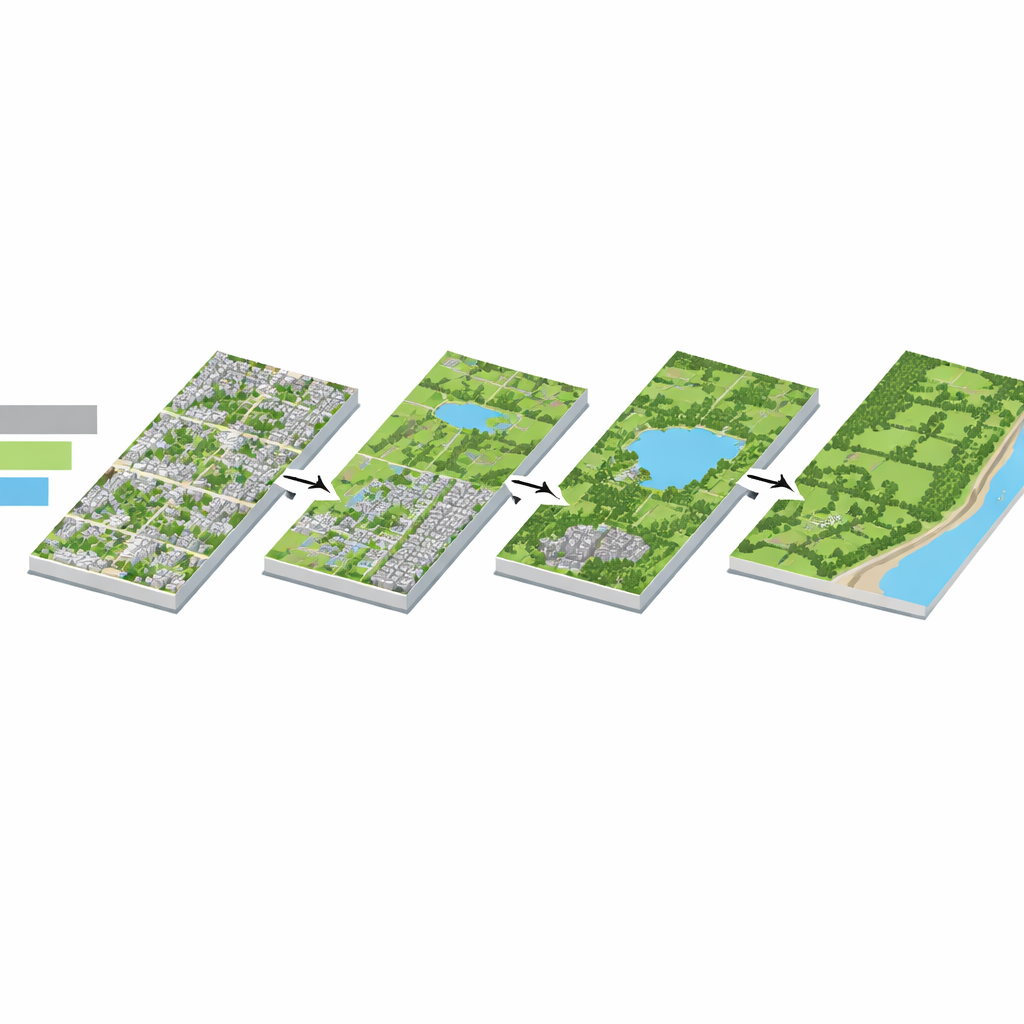
Nature, poverty, and city makeovers
The researchers then turned to social questions: how do these patterns line up with economic hardship? In England, they compared blue and green cover, as well as overall variety of land types, with an official index that ranks areas from most to least deprived. Green space showed a clear social divide: richer areas tend to have more greenery. Blue space, however, was surprisingly even across the deprivation scale, suggesting that rivers, canals, coasts, and other water bodies are not as strongly skewed toward wealthier neighborhoods—at least in terms of simple area. Another striking result is that the most deprived cities tend to have a greater mix of different land types, including leftover industrial plots and rough ground that can harbor diverse wildlife. As cities undergo regeneration, these varied patches are often replaced by more uniform, heavily managed lawns and paved surfaces, potentially reducing habitat diversity even as wealth increases.
What this means for future cities
Overall, the study shows that water-rich places in cities are both rarer and differently distributed than green areas, yet just as important for health and biodiversity. Because blue space is limited—especially inland—and not easily expanded, the authors argue it must be carefully protected and woven into planning for new housing, transport, and flood defenses. They also warn that urban renewal can unintentionally smooth away the messy, mixed landscapes that support many species. For a fairer and more sustainable urban future, they recommend that planners treat blue and green spaces together as a single life-support system, making sure that coasts, canals, rivers, wetlands, parks, and informal wild corners remain accessible to all city residents.
Citation: Morgan, M.C., Forster, R., Hopkins, C.R. et al. Urban blue and green spaces: distribution, social equity, and ecological implications in Great Britain. npj Urban Sustain 6, 73 (2026). https://doi.org/10.1038/s42949-026-00349-6
Keywords: urban blue spaces, green infrastructure, social equity, wetlands and coasts, urban planning