Clear Sky Science · en
Genomic signatures of migratory preference and historical whaling in eastern South Pacific humpback whales
The long journeys of giant travelers
Humpback whales are among the great voyagers of the oceans, migrating thousands of kilometers each year between warm breeding grounds and icy feeding areas. This study asks what those epic journeys, and a century of intense whaling, have left behind in the whales’ DNA. By reading whole genomes from whales in the eastern South Pacific, the authors reveal how these animals are connected, how their numbers have changed over time, and what that means for their future resilience.
Where these whales live and travel
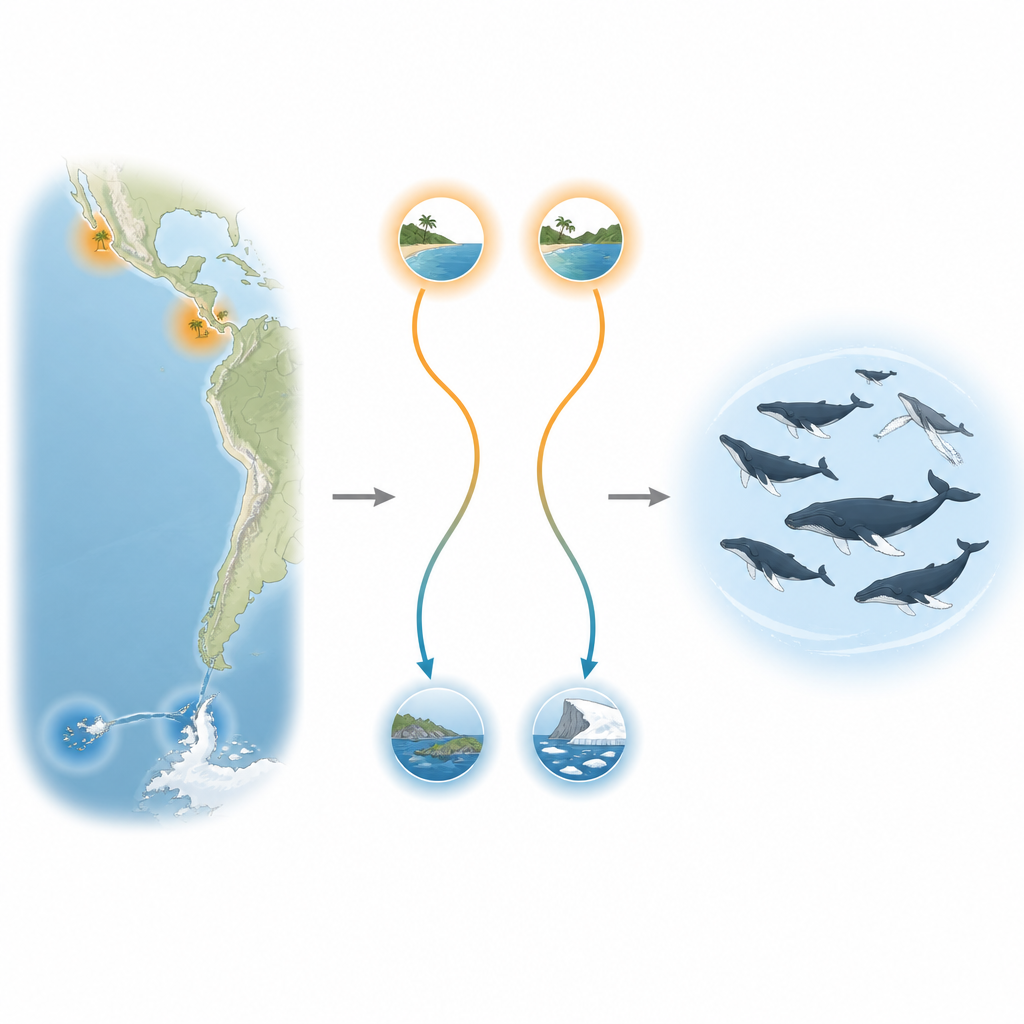
The research focuses on humpback whales that breed off the coast of Ecuador and feed in two main regions far to the south: the Magellan Strait in southern Chile and the waters around the Antarctic Peninsula. Earlier work based on photos and pigmentation patterns hinted that whales using these feeding areas might prefer different parts of the breeding range. Historical records also show that this population was heavily targeted by industrial whaling throughout the twentieth century, with numbers falling sharply before beginning to recover after hunting bans were introduced.
Reading the whales’ DNA
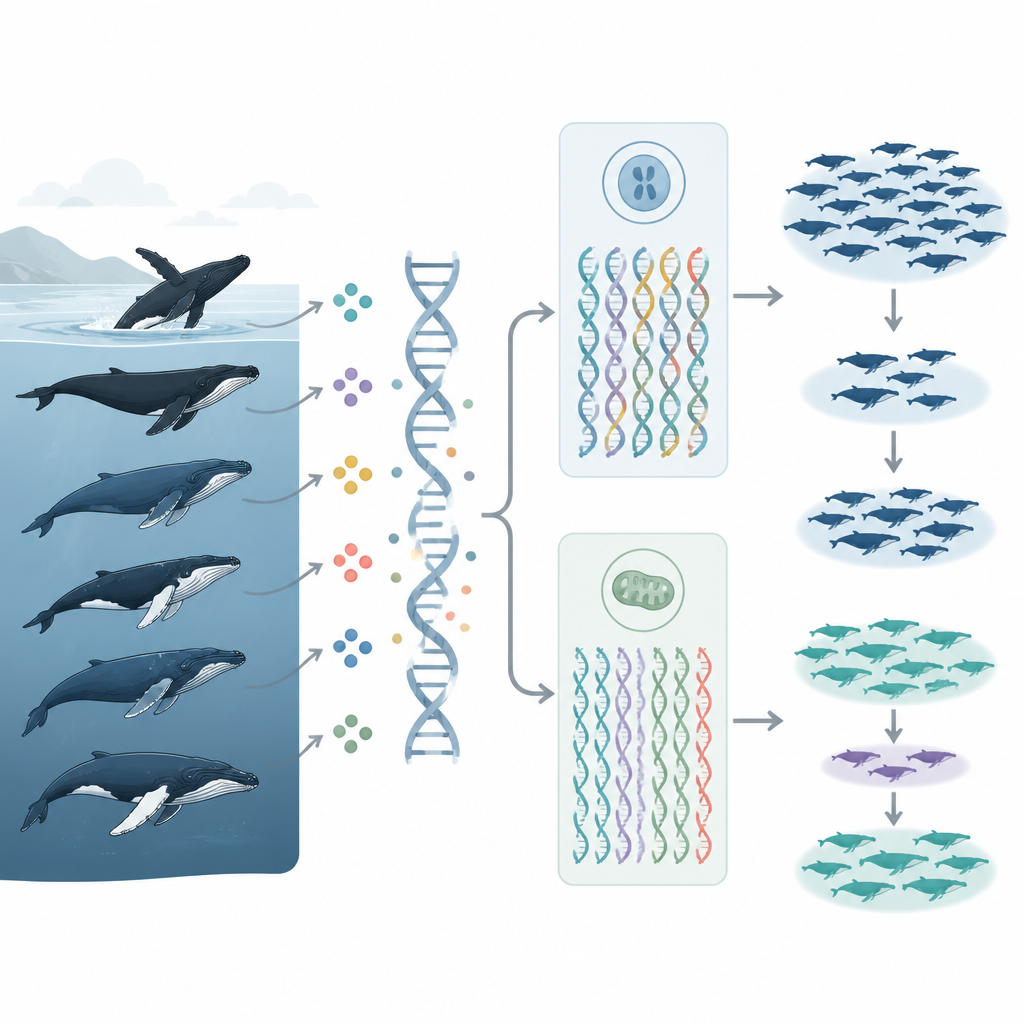
To examine how these movements and past losses shaped the population, the team sequenced entire genomes from 26 whales, then analyzed 22 that were not closely related. They compared two types of genetic information. Nuclear DNA, which comes from both parents and shuffles every generation, gives a broad view of how individuals interbreed. Mitochondrial DNA, which is passed only from mothers to offspring, preserves clues about female movements and family lines. Together, these sources allowed the scientists to look for hidden divisions within the population and to reconstruct changes in its size over tens of thousands of years.
One shared population, but different family routes
The nuclear DNA painted a picture of a single, well-connected population. Statistical analyses showed that whales from Ecuador, the Magellan Strait, and the Antarctic Peninsula are genetically very similar, suggesting that they freely interbreed over time even if they visit different feeding spots. In contrast, the mitochondrial DNA told a more nuanced story: many of the maternal lineages from the Magellan Strait clustered closely together, forming a tight group distinct from most lineages in the Antarctic region and Ecuador. This pattern fits with the idea that females often stick to traditional migratory routes, passing them from mother to calf, while males roam more widely and mix genes across regions.
Echoes of ice ages and whaling in the genome
By modeling the distribution of genetic variants, the authors traced the population’s past size. They found signs of a large expansion beginning roughly 53,000 years ago, likely as conditions improved after the last ice age and new feeding grounds opened in the Southern Ocean. More recently, the genetic data indicate a sharp decline in effective population size, consistent with the era of industrial whaling that began in the early 1900s. Yet, despite this contraction, the whales still carry relatively high genetic diversity, and long uninterrupted stretches of identical DNA within individuals are short and uncommon, suggesting that severe inbreeding has so far been avoided.
What this means for the whales’ future
For a general reader, the key message is that these eastern South Pacific humpback whales behave like one large, interlinked population, even though family traditions steer some lineages toward particular feeding areas. Their genomes still reflect the double imprint of ancient climate change, which enabled past growth, and recent hunting, which drastically reduced their numbers. The fact that genetic diversity remains high offers cautious optimism for their ability to adapt to future challenges, but the authors warn that the full genetic impact of the whaling era may not yet be visible. Because humpbacks live long lives and reproduce slowly, any hidden loss of resilience could emerge only in generations to come, underscoring the importance of continued protection and monitoring.
Citation: Celemín, E., Acevedo, J., Hagberg, L. et al. Genomic signatures of migratory preference and historical whaling in eastern South Pacific humpback whales. Commun Biol 9, 630 (2026). https://doi.org/10.1038/s42003-026-10037-x
Keywords: humpback whales, whaling history, population genetics, animal migration, marine conservation