Clear Sky Science · en
Simultaneous spectrofluorimetric determination of nasal cyclic nucleotides as biochemical markers in post-COVID-19 olfactory dysfunction using supramolecular-enhanced derivative spectroscopy
Why losing smell after illness matters
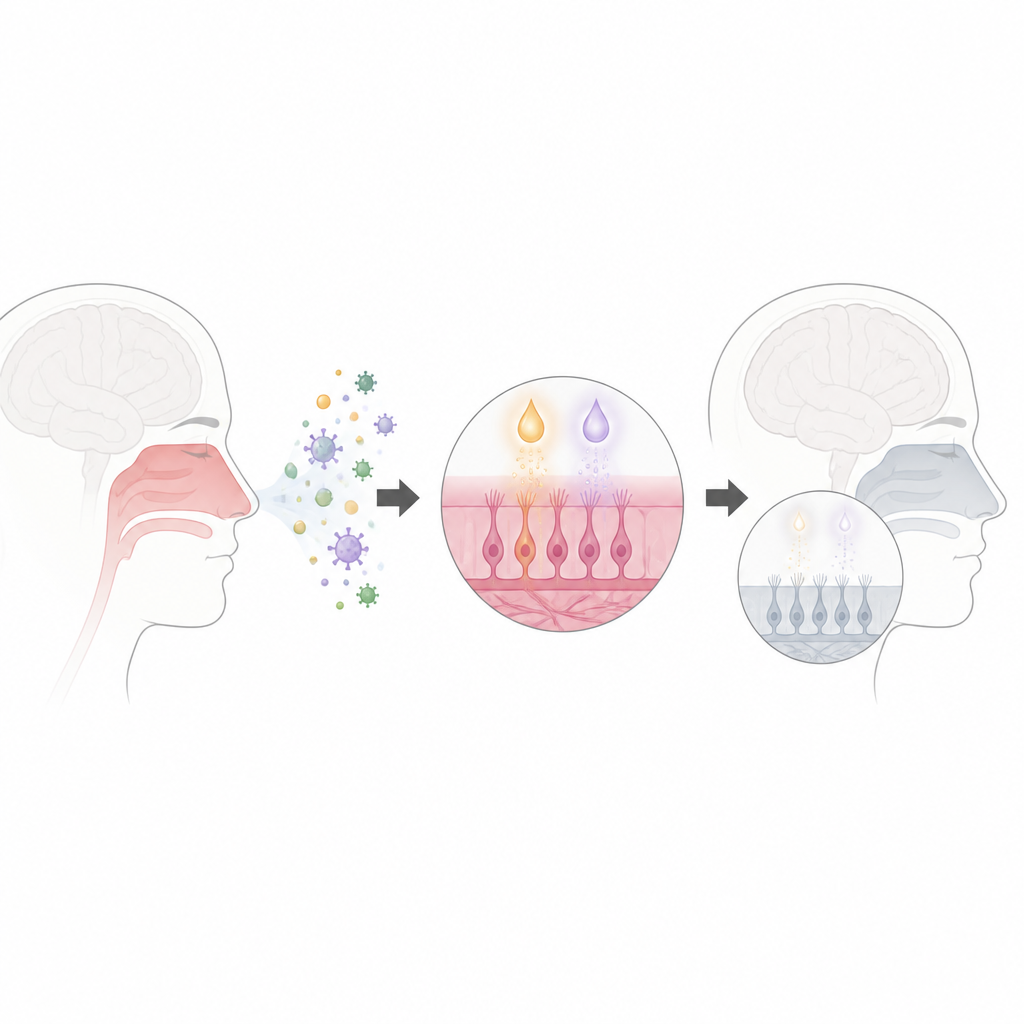
Many people who recovered from COVID-19 were surprised to find that their sense of smell did not come back, or returned only slowly. Beyond spoiling food and coffee, smell loss can dull the taste of meals, reduce safety by hiding gas leaks or smoke, and affect emotional well being. This study looks inside the nose at tiny chemical messengers to see how their levels change in people with long lasting smell loss after COVID-19, and introduces a new, practical test to measure them.
Tiny messengers behind our sense of smell
Our noses are lined with special nerve cells that turn airborne chemicals into electrical signals for the brain. To do this, the cells rely on two small molecules called cyclic nucleotides, which act like on off switches in the signaling pathway. When an odor reaches the nose, these messengers briefly rise inside the cells, helping open channels that let charged particles flow in and start a nerve impulse. Earlier work suggested that disturbed levels of these messengers might be linked to smell problems, but measuring them precisely in real nasal secretions has been difficult.
A new way to read faint chemical signals
Common laboratory tests for these nasal messengers either suffer from interference from other substances in mucus or require expensive, highly specialized instruments. In this work, the researchers designed a different approach based on light. They used a ring shaped host molecule that can cradle the messenger molecules and make them glow more strongly under ultraviolet light. By carefully scanning how this glow changes with wavelength and then applying a mathematical step that sharpens overlapping signals, they created a method that can clearly separate the two messengers and measure very low amounts of each in a single run.
Turning nasal fluid into readable numbers
To put the method into practice, the team first mixed known amounts of the two messengers into samples of pooled nasal secretions. They then removed proteins, added the host molecule and buffer solution, and recorded the light signals. The response was nicely proportional over a wide range of concentrations, with very low limits of detection, meaning the method could pick up tiny traces. Tests of repeat measurements, small changes in solution conditions, and the presence of common nasal components such as albumin and salt all showed that the method remained accurate and stable. This suggests it is robust enough to be used on real clinical samples.
Comparing people with and without smell loss
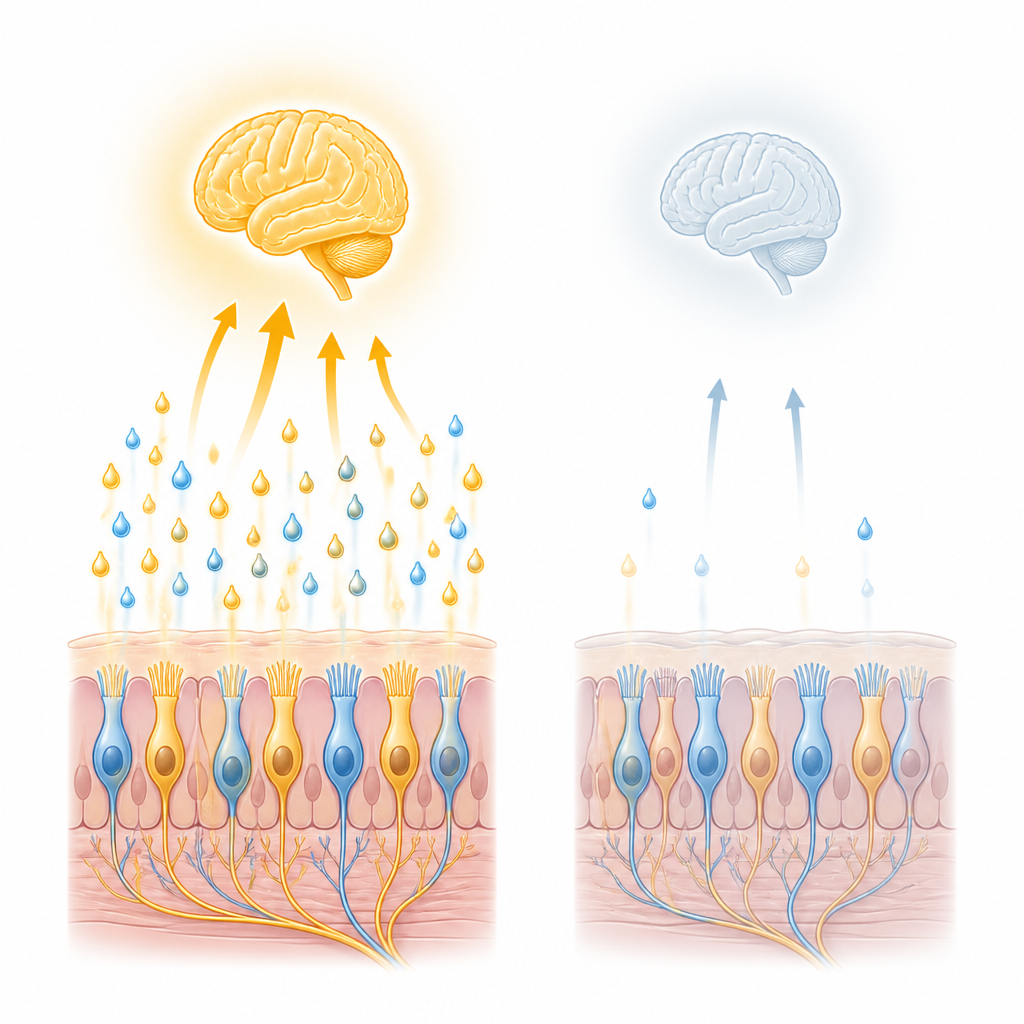
The researchers then studied nasal secretions from a small group of volunteers. One group had normal smell as confirmed by a standard sniff test, while the other had complete smell loss that persisted for at least six months after COVID-19 infection. Using their light based method, the team found that both messenger molecules were much lower in the patient group than in healthy people. The lower the levels, the worse the sniff test scores. Statistical analyses showed that measuring these chemicals could distinguish patients from healthy volunteers with high accuracy, suggesting that they form a clear biochemical fingerprint of post viral smell loss.
What this means for patients and clinics
The study concludes that prolonged smell loss after COVID-19 is strongly associated with depleted levels of key signaling messengers in nasal secretions. It also shows that these molecules can be measured sensitively and cost effectively using a relatively simple light based setup rather than complex, high end machines. While larger and longer studies are still needed, this work points toward practical lab tests that might one day help doctors track smell related disorders, monitor recovery, and better understand how infections disrupt our sense of smell at the molecular level.
Citation: Alsobky, M.E., Younes, A., Al kamaly, O. et al. Simultaneous spectrofluorimetric determination of nasal cyclic nucleotides as biochemical markers in post-COVID-19 olfactory dysfunction using supramolecular-enhanced derivative spectroscopy. Sci Rep 16, 16010 (2026). https://doi.org/10.1038/s41598-026-54824-2
Keywords: smell loss, COVID-19, nasal biomarkers, cyclic nucleotides, olfactory dysfunction