Clear Sky Science · en
The intrinsically disordered protein SPE-56 is required for acrosomal-like exocytosis and fertility in Caenorhabditis elegans
Why tiny worms can teach us about fertility
Fertility hinges on a dramatic moment when a sperm cell switches from a quiet, storage form into an active, egg-fusing machine. This study uses the microscopic roundworm Caenorhabditis elegans to reveal how a little-known sperm protein, SPE-56, helps drive that transition. Because many of the basic steps of sperm activation and membrane fusion are shared across animals, understanding this protein in worms may shed light on why sperm fail in other species, including humans.
From quiet seed cell to active swimmer
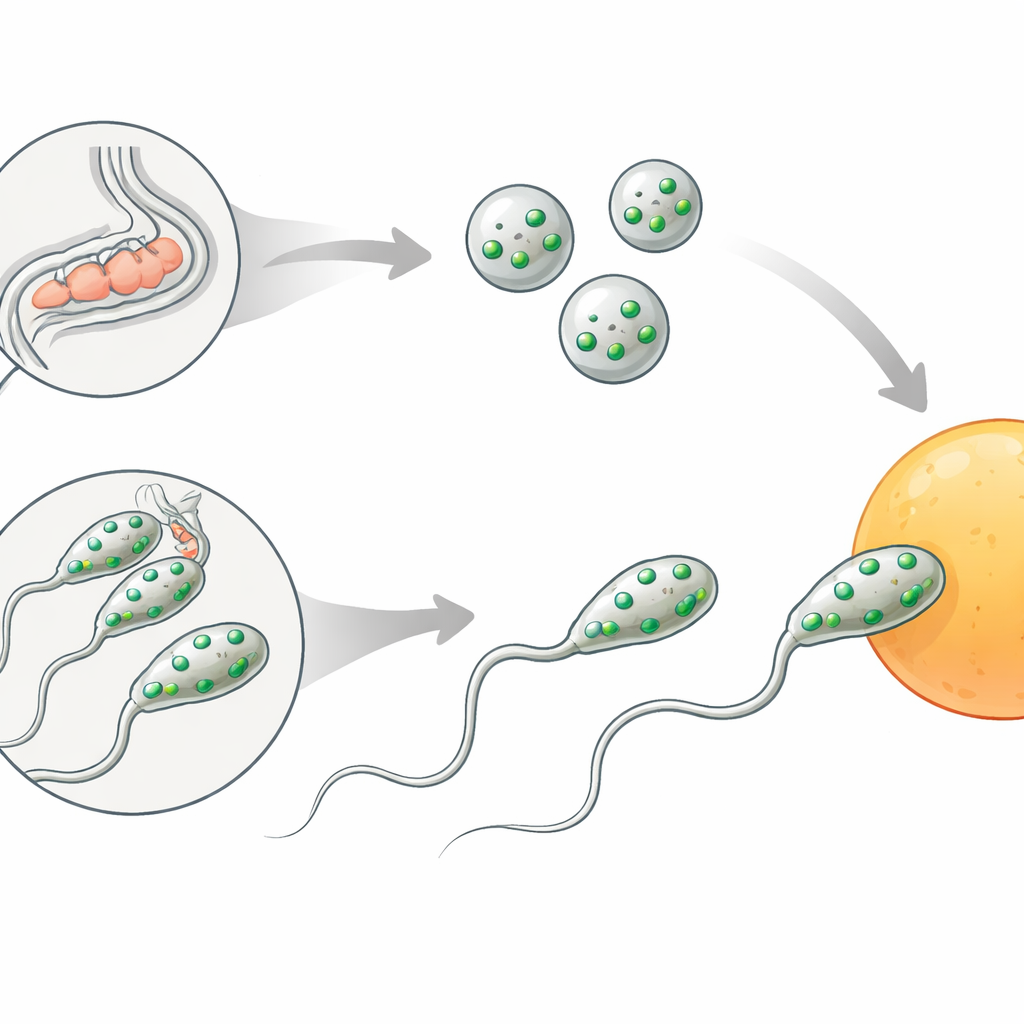
In both worm sexes, sperm begin as simple round cells called spermatids. To become capable of fertilization, these must undergo a makeover known as spermiogenesis. Two changes are crucial: internal sacs called membranous organelles fuse with the outer surface of the sperm, and a flexible “foot” called a pseudopod grows out, allowing the cell to crawl toward the egg. These steps resemble the acrosome reaction in human and other mammalian sperm, where a special compartment empties its contents and the sperm’s surface is remodeled just before fertilization.
A fertility switch hiding in sperm
The authors focused on a previously uncharacterized gene, now named spe-56. Worms lacking spe-56 produce normal numbers of sperm and show no obvious defects in body shape, movement, or egg production. Yet these animals are almost completely sterile when relying on their own sperm: they lay unfertilized oocytes that degenerate in the uterus. When mutant hermaphrodites are mated with normal males, fertility is restored, proving that their eggs and reproductive tract work fine and that the problem lies within their own sperm. Likewise, spe-56 mutant males can mate and transfer sperm normally, but their sperm fail to sire offspring, pointing again to a sperm-intrinsic defect.
When the fusion step fails
Closer examination showed that spe-56 mutant sperm stall during activation. Under the microscope, their round starting form looks normal, but after activation they grow only short, stubby pseudopods and move poorly. Using a fluorescent dye that highlights membrane fusion sites, the researchers observed bright spots along the surface of normal sperm, marking where internal organelles had fused with the outer membrane. In contrast, spe-56 mutant sperm showed a smooth, uniform signal with no fusion puncta, revealing that the crucial fusion step failed. Genetic tests placed spe-56 downstream of known sperm-activation regulators, meaning that the activation signal still arrives but cannot be translated into full structural change without SPE-56.
A flexible protein at the fusion interface
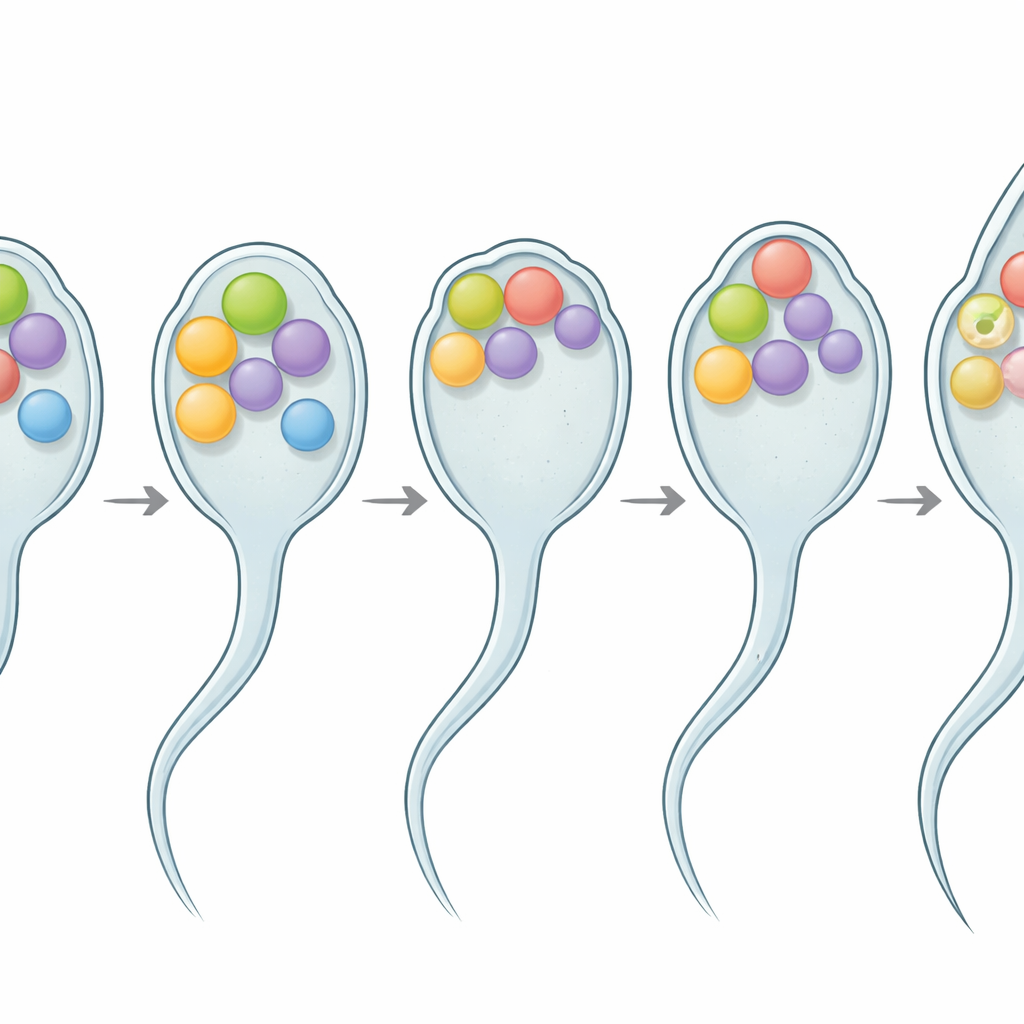
Biochemical and imaging work showed that SPE-56 is a single-pass membrane protein that sits mainly on the membranes of those internal organelles in sperm. Its tail region, which extends into the cell interior, lacks a rigid shape and instead behaves as an “intrinsically disordered” segment—a floppy, flexible chain rather than a fixed scaffold. Such disordered regions are increasingly recognized as powerful tools cells use to bend, remodel, and fuse membranes. Here, deleting parts of this flexible tail gradually undermined fertility, especially at higher temperatures, without changing how many sperm were produced. The more of the tail removed, the more severe the fertility loss, suggesting that its length and flexibility help sperm stay functional across temperature fluctuations.
How structural looseness can support life
Altogether, the study reveals SPE-56 as a key worker at the final stage of sperm activation in C. elegans. Without it, sperm rarely complete the membrane fusion step or form a proper crawling pseudopod, and fertilization almost never occurs. The findings support a broader idea: flexible, disordered protein regions can act as adaptable “molecular shock absorbers” that help membranes come together, destabilize just enough to fuse, and still maintain integrity. By showing how such a protein preserves sperm function across different temperatures in a simple worm, this work points to a potentially conserved, evolutionarily ancient strategy that may help sperm—and other cell types—remain reliable in a changing world.
Citation: Gottschling, DC., Eiser, S. & Döring, F. The intrinsically disordered protein SPE-56 is required for acrosomal-like exocytosis and fertility in Caenorhabditis elegans. Sci Rep 16, 12062 (2026). https://doi.org/10.1038/s41598-026-47896-7
Keywords: sperm activation, membrane fusion, intrinsically disordered proteins, Caenorhabditis elegans, fertility