Clear Sky Science · en
Gait asymmetry in Parkinson’s disease – a systematic review and meta-analysis (AsymmGait-Parkinson study)
Why Walking Becomes Uneven
Many people think of Parkinson’s disease as a condition of tremor and stiffness in the hands. But one of its most troubling effects shows up in the simple act of walking. This study pulls together results from 42 previous investigations to ask two big questions: how often do people with Parkinson’s walk with an uneven step pattern, and does standard Parkinson’s medication help to even things out? The answers matter because subtle changes in how the two legs move can raise the risk of stumbling, freezing, and falling.
How Parkinson’s Affects the Two Sides of the Body
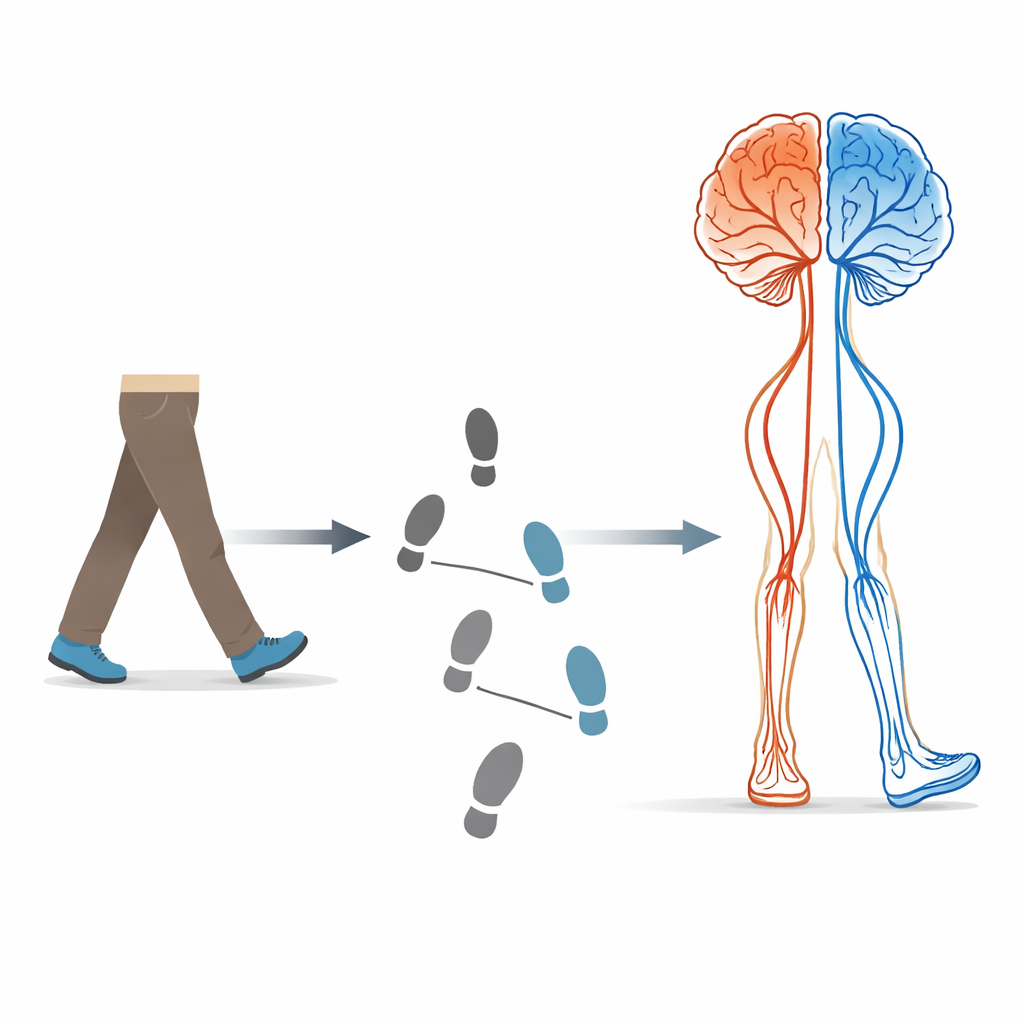
Parkinson’s disease usually starts on one side of the body: one hand shakes more, or one leg feels slower and weaker. That early imbalance reflects changes deep in the brain, where the chemical messenger dopamine is lost more on one side than the other. Over time, this uneven damage can show up in walking. Instead of both legs sharing the work equally, one leg may take shorter or slower steps, or spend more or less time on the ground than its partner. The review defines “gait asymmetry” as any measurable difference between the right and left legs during walking, such as step length or the time each foot spends in the air.
What the Researchers Looked At
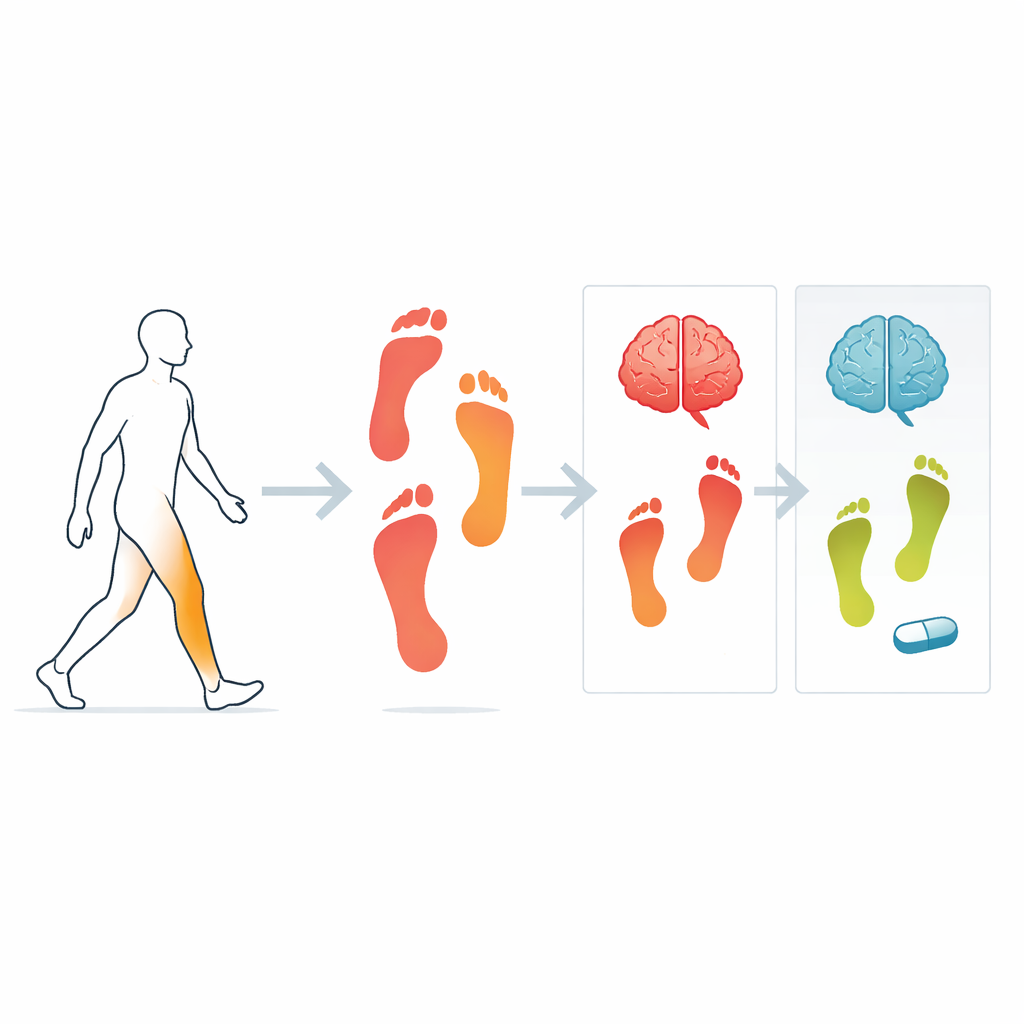
The authors searched several medical databases and screened more than 500 papers, eventually including 42 studies that examined walking over level ground at a comfortable speed. These studies compared over 2,100 people with Parkinson’s to about 1,600 healthy peers of similar age. Some studies tested patients on and off their usual dopamine-based drugs. The researchers focused on simple timing and spacing measures—how long each step lasted, how far it reached, and how long each foot spent in the air or on the ground. They also noted a wide variety of methods used to compute asymmetry, from basic right–left differences to more complex mathematical indexes.
Where the Imbalance Shows Up Most
Across the studies, people with Parkinson’s tended to show more uneven walking than healthy adults, but the effect was modest and not always present. The clearest differences were in timing: the “swing time” (when a foot is off the ground) and “step time” (how long each step lasts) were more often out of balance than the distance of each step. In other words, the clock of walking was more disrupted than the ruler. These timing differences were seen both when patients were off medication and when they had taken their usual drugs. In contrast, forces under the feet and muscle activity were less consistently uneven, and almost no work had directly measured right–left differences in brain activity while people walked.
What Medication Can and Cannot Fix
One hope was that levodopa and similar drugs, which restore some dopamine, might also restore symmetry. By combining results from several trials, the authors found that medication did help with one key feature: swing time became more even between the two legs when patients were in the medicated “ON” state compared with the “OFF” state. However, the drugs did not reliably correct uneven step length or overall step time. This suggests that dopamine replacement can improve the rhythm of walking more readily than it can fully rebalance the size and shape of each step. The authors note that many studies used different testing setups and formulas, making it harder to detect clear, consistent effects.
Why These Findings Matter
From a patient’s perspective, the study’s message is both cautionary and hopeful. It confirms that people with Parkinson’s often walk with a subtle but real imbalance between their legs, especially in how long each step lasts. That timing mismatch may contribute to unsteady walking and a higher risk of freezing and falls. The good news is that standard medication seems able to partially smooth out this rhythm, particularly the time each foot spends in the air. The authors argue that simple timing measures, such as how evenly each leg swings, should become routine checks in clinics and in future research. Better ways to measure and track these imbalances—especially during everyday walking at home or in crowded, challenging settings—could guide more targeted therapies and, ultimately, help people with Parkinson’s move more safely and confidently.
Citation: Silveira-Ciola, A.P., Seuthe, J., Coelho, D.B. et al. Gait asymmetry in Parkinson’s disease – a systematic review and meta-analysis (AsymmGait-Parkinson study). Sci Rep 16, 11682 (2026). https://doi.org/10.1038/s41598-026-46469-y
Keywords: Parkinson’s disease, gait asymmetry, walking balance, dopaminergic medication, fall risk