Clear Sky Science · en
Saturation behavior and full-field reconstruction of residual stress in quenched AISI 304 stainless steel via the contour method
Hidden Forces Inside Everyday Metal Parts
Many metal parts we rely on—from airplane bolts to chemical plant piping—are cooled quickly during manufacturing to improve their strength. But this rapid cooling, or quenching, leaves behind invisible internal forces called residual stresses that can either protect a part or help cracks grow. This study looks inside a common stainless steel, AISI 304, to map those hidden stresses in full detail and to understand how different cooling conditions shape them.
How Cooling Locks In Internal Push and Pull
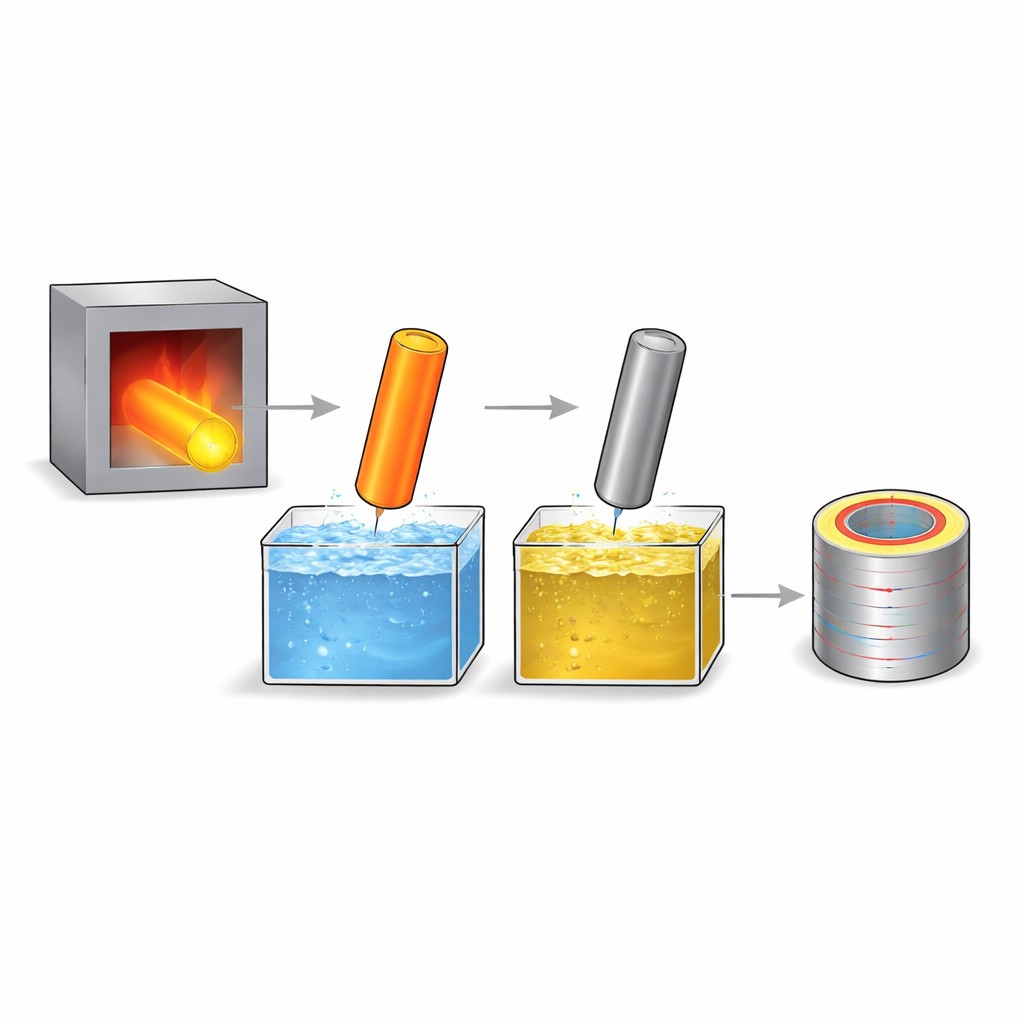
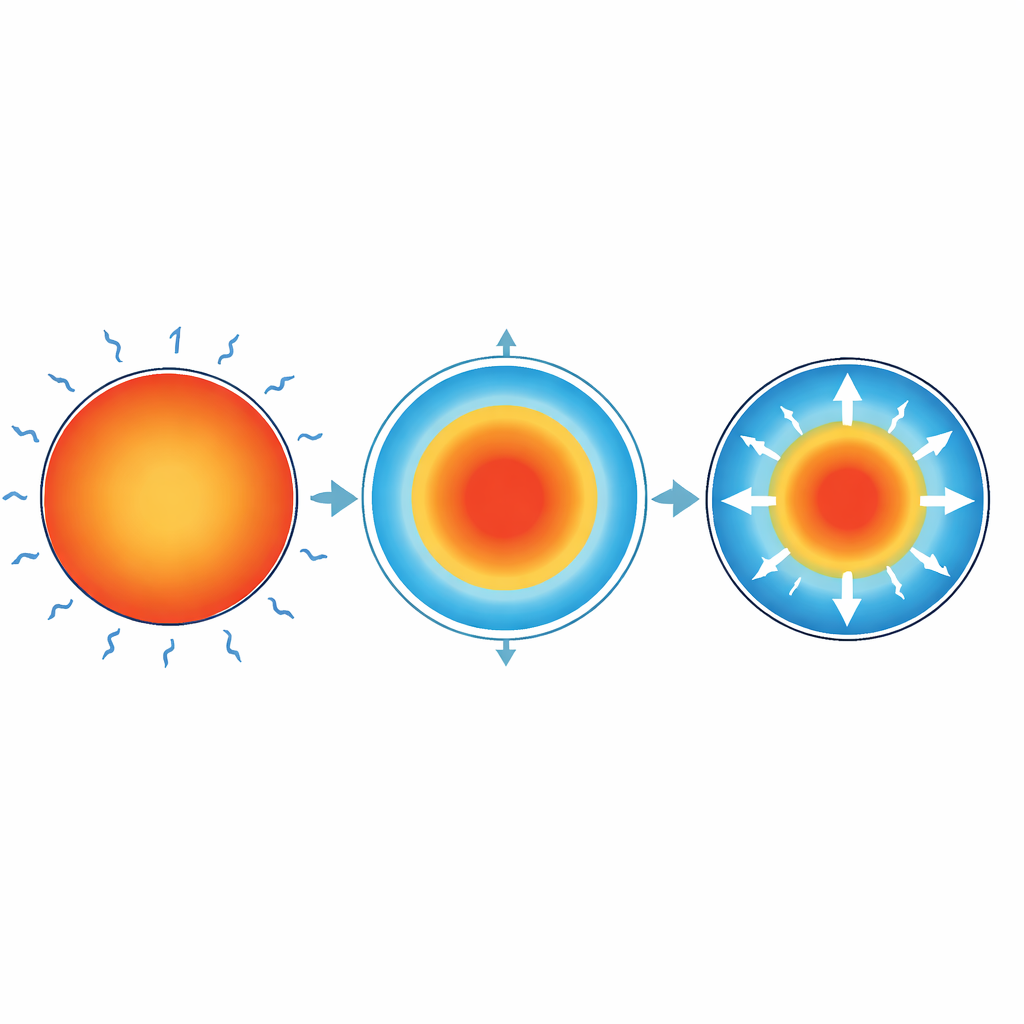
When a hot metal cylinder is plunged into a cooling liquid, its surface chills and shrinks first while the core is still hot and expanded. The hot interior holds the surface back, stretching it. Later, as the core cools and shrinks, it pulls on the already stretched surface. The end result is a frozen-in pattern: the surface is left in a state of compression (squeezed), while the interior is in tension (pulled). These self-balanced internal forces exist even when the part looks perfectly still from the outside, and they can strongly influence how long a part resists cracking and fatigue in service.
Cutting Metal to See Invisible Stress
To reveal these hidden forces, the researchers used a technique called the contour method. They first heated short stainless-steel cylinders to temperatures between 400 °C and 1000 °C and then quenched them either in water (very fast cooling) or oil (slower cooling). After cooling, they carefully cut the cylinders in half along different planes using a fine electrical-discharge wire so that the cutting itself would not distort the metal. Releasing the internal stress during cutting makes the freshly exposed surfaces warp by tiny amounts. These surface shapes were then measured with high-precision optical equipment, smoothed and aligned digitally, and finally fed into a computer model that ran the deformation backward to reconstruct the original stress patterns across full cross-sections.
Comparing Fast and Slow Cooling
The full-field maps showed a clear difference between water and oil quenching. Water quenching, with its more violent cooling, produced much larger compressive stresses near the surface and sharper changes from compression to tension toward the center. Oil quenching led to gentler, more gradual stress profiles with lower peak values. In both cases, the cylinders developed the same basic structure: a compressive “shell” that helps resist cracking at the surface, balanced by a tensile “core” inside. By analyzing both slices across the cylinder and along its length, the team confirmed that these patterns were consistent throughout the part, not just in one narrow region.
When Hotter Stops Making a Difference
A key discovery was that beyond a certain starting temperature, making the metal even hotter before quenching did not significantly increase the final residual stresses. For both water and oil, the stress patterns kept changing noticeably as the quench temperature was raised up to about 700 °C. Above roughly 700–800 °C, however, the shapes and magnitudes of the stress profiles changed very little, even when the starting temperature reached 1000 °C. Computer simulations that coupled heat flow and mechanical response reproduced this “saturation” behavior and matched the experimental stress maps closely, confirming that the main driver is how heat leaves the surface during the most intense boiling and cooling stage.
What This Means for Safer, Longer-Lasting Parts
For this widely used stainless steel, the study shows that engineers can tune residual stresses mainly by choosing the cooling medium and by reaching, but not greatly exceeding, about 700–800 °C before quenching. Faster cooling in water builds a stronger protective compressive layer but also higher interior tension, while oil gives milder stresses overall. Since these patterns were mapped across the entire cross-section and verified by detailed simulation, designers can use them to better predict how parts will resist cracking and fatigue in demanding applications—without needing more complex phase changes or exotic modeling to capture the essential behavior.
Citation: Meng, L., Khan, A.M., Shan, Y. et al. Saturation behavior and full-field reconstruction of residual stress in quenched AISI 304 stainless steel via the contour method. Sci Rep 16, 11694 (2026). https://doi.org/10.1038/s41598-026-45542-w
Keywords: residual stress, quenching, stainless steel, heat treatment, finite element analysis