Clear Sky Science · en
A unified time series classification framework via adaptive Gaussian image representation
Turning Complex Time Signals into Pictures
From heartbeats and brain waves to stock prices and traffic flows, much of our digital world is recorded as time series: numbers changing over time. Yet these tangled streams are hard for computers to classify reliably, especially when they come from many sensors at once or vary in length. This paper introduces a way to turn such messy signals into images that modern vision models can understand, making it easier to build dependable systems for monitoring health, finance, and everyday devices. 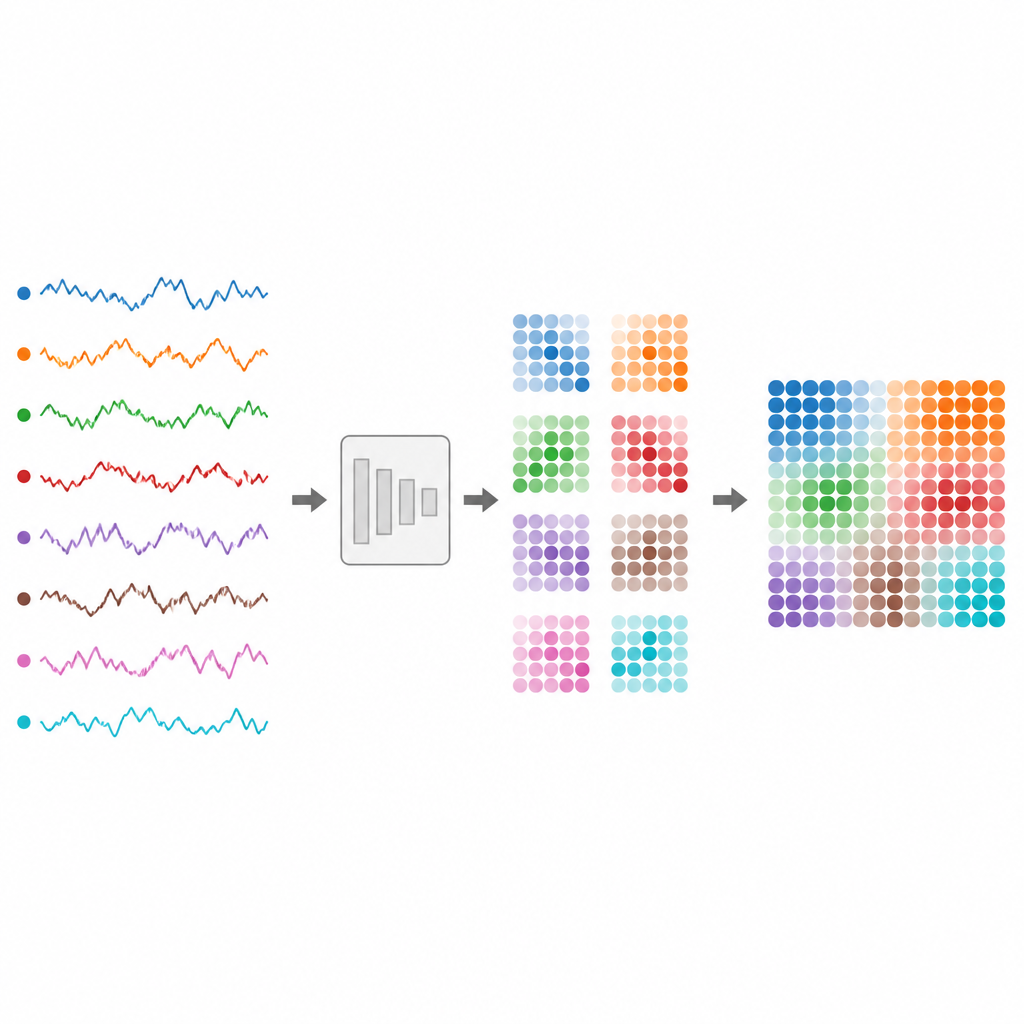
Why Time Series Are So Hard to Classify
Time series in the real world rarely behave nicely. Different sensors may record at different speeds, stop and start unexpectedly, or produce noisy readings. Some applications track a single signal, such as a heartbeat, while others combine dozens of channels, such as motion, muscle activity, and brain waves together. Traditional methods either handcraft features or use deep learning models that operate directly on raw time sequences. These approaches can work, but they often struggle to generalize across many datasets and require careful tuning for each new problem.
From One Dimensional Waves to Two Dimensional Images
The authors propose TS2Vision, a framework that converts time series into images before classification. First, each channel is standardized and smoothly resized so that shorter and longer sequences share a common length. Then an adaptive mapping called Adaptive Time Series Gaussian Mapping turns each moment in time into a small square patch inside an image. Within that patch, every sensor channel is assigned a circular region. A bell shaped pattern, controlled by the current value of the signal, is drawn inside each circle. This process captures local ups and downs in a way that is both smooth and resistant to noise.
Packing Many Signals into a Single View
A key challenge is how to place all those circular regions so that they do not overlap while still using the limited space in each patch efficiently. The authors treat this as a circle packing puzzle: how to fit equal circles snugly inside a square. They rely on proven layouts from geometry research to arrange the circles for any number of channels. These layouts are fixed in advance, so the model does not waste effort learning where to place each channel. As time moves forward, patches are ordered in sequence, forming a larger image that preserves both how each signal changes and how channels relate to one another. 
Letting Vision Models Read Time
Once the time series has been turned into an image, TS2Vision feeds it to a Vision Transformer, a type of model originally designed for picture recognition. This model slices the image into smaller tiles and uses attention mechanisms to connect patterns across distant parts of the image, which here correspond to distant time steps. The authors show mathematically that their mapping is stable: small changes in the input signals lead only to bounded changes in the image, which helps the classifier stay robust when data are noisy or sensors jitter.
Testing Across Many Real World Datasets
To see how well TS2Vision works in practice, the researchers tested it on 158 benchmark datasets collected from two major archives. These cover a wide mix of domains, including device readings, motion capture, medical recordings, images turned into time series, and more. Across both single channel and multichannel tasks, TS2Vision achieved the best average ranking among modern deep learning methods and competitive accuracy compared with leading non deep learning techniques, while keeping training times reasonable. It also showed strong resilience when artificial noise was added, degrading more gently than rival models.
What This Means for Everyday Systems
In plain terms, TS2Vision shows that treating time series as carefully designed pictures can unlock the power of computer vision for temporal data. By combining a stable, adaptive way of drawing signals as images with a strong vision model, the framework offers a unified method that works across many kinds of sensors and sequence lengths. For builders of monitoring and decision systems, this means a more general tool that can handle varied and noisy data while remaining efficient enough for practical use.
Citation: Ren, X., Li, D., Gao, X. et al. A unified time series classification framework via adaptive Gaussian image representation. Sci Rep 16, 14817 (2026). https://doi.org/10.1038/s41598-026-44760-6
Keywords: time series classification, image representation, vision transformer, multivariate sensors, robust encoding