Clear Sky Science · en
Medium controlled redox activity and coordination behavior of a triazole indolinone ligand with vanadyl lons
Why this study matters
Clean water, safer medicines, and smarter sensors all rely on tiny chemical helpers that can grab and release metal ions on cue. This study explores one such helper molecule, a tailor‑made organic compound called H2TIS, and shows how its behavior can be finely tuned simply by changing the acidity or basicity of the surrounding liquid. By understanding how this molecule exchanges electrons and binds to vanadium, a technologically and biologically important metal, researchers move closer to designing better catalysts, detectors for pollution, and advanced battery or sensor materials.
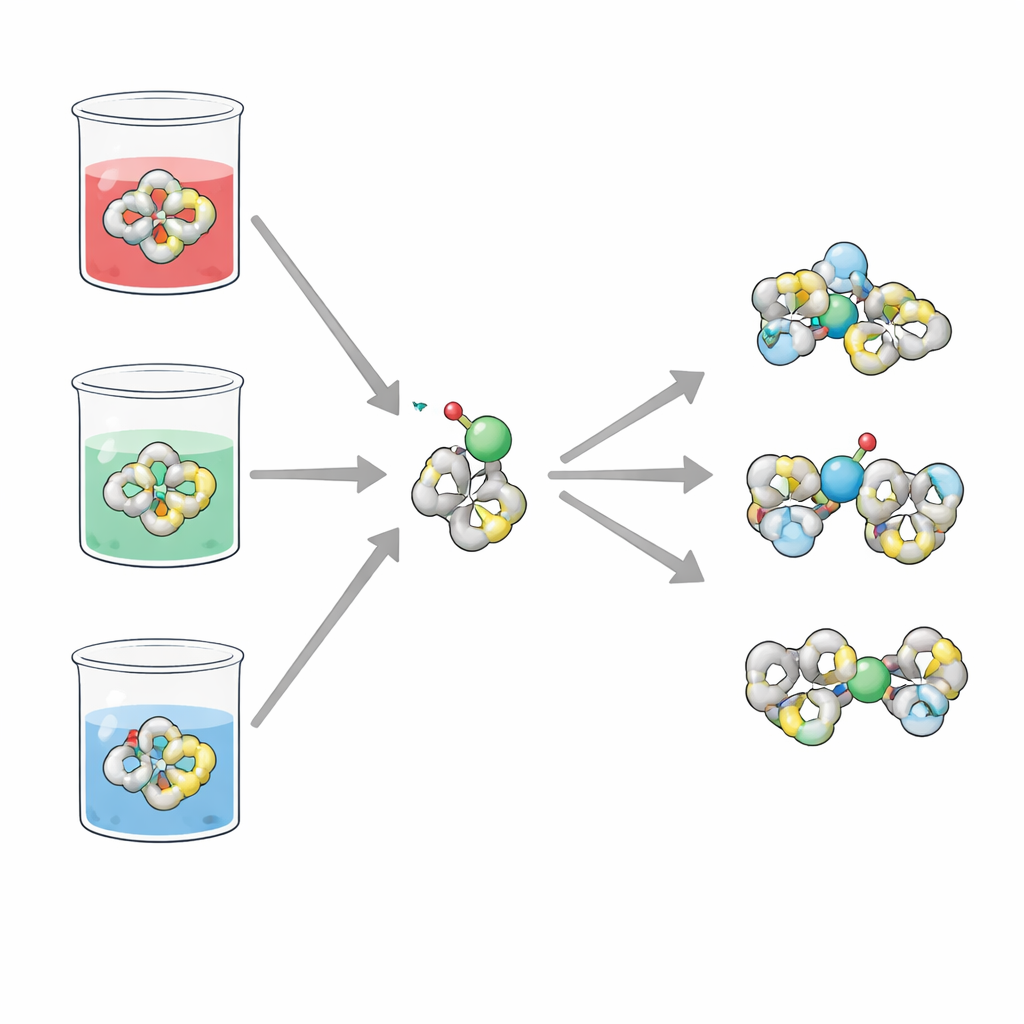
A shape‑shifting helper molecule
H2TIS is a compact organic molecule built from several ring structures and chemical groups that can donate pairs of electrons. These "donor" spots include sulfur, nitrogen, and oxygen atoms, which together make H2TIS an excellent candidate for gripping metal ions. The team focused on how this ligand behaves when it gains or loses electrons (its redox activity) and how it attaches to vanadyl ions, a common form of vanadium in water. Because these processes depend strongly on whether the solution is acidic, neutral, or basic, the researchers probed H2TIS in three simple salt solutions that mimic these conditions.
Watching electrons move with tiny voltage sweeps
To track the electron‑moving behavior of H2TIS, the scientists used cyclic voltammetry, a technique where the voltage at a carbon electrode is swept back and forth while the resulting current is measured. In acidic solution, they observed a current peak when electrons were added to the carbonyl group of the molecule, effectively converting a carbon–oxygen double bond into a more reduced form. On sweeping in the opposite direction, another peak appeared, linked to oxidation at the sulfur‑containing part of the ligand. The positions and shapes of these peaks, and how they changed with concentration and scan speed, showed that both electron transfer and follow‑up chemical steps were involved, and that the process depended on the presence of protons in the solution.
How the surrounding liquid changes the story
When the same ligand was tested in neutral solution, its carbonyl group behaved more like a well‑balanced switch, showing a pair of peaks that nearly mirrored one another. This pattern signaled a quasi‑reversible redox couple, where the forward and backward electron transfers are reasonably well matched, making the system more stable and predictable. In strongly basic solution, however, the ligand changed personality: the sulfur group lost its proton, became more reactive, and showed only a single oxidation peak with no matching reduction signal on the way back. The data suggest that once oxidized under these conditions, the sulfur sites link together to form disulfide‑bridged dimers, which do not easily revert, highlighting how a simple change in pH can redirect the entire reaction pathway.
Teaming up with vanadium
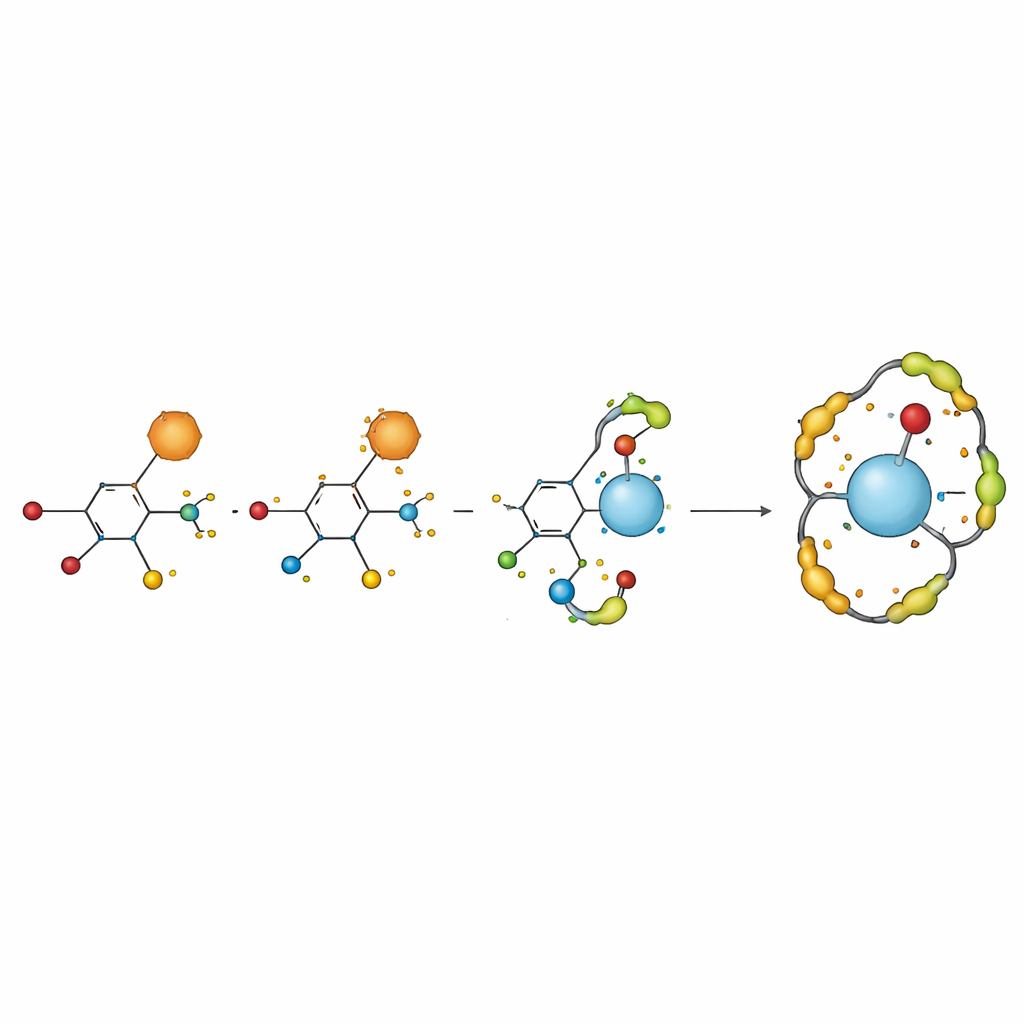
The next step was to see how H2TIS interacts with vanadyl ions in near‑neutral salt solution. On its own, the vanadyl ion shows a redox pattern that is only partly reversible, reflecting a balance between electron transfer at the electrode and rapid side reactions in water. When the ligand was added, the voltammetry curves shifted and narrowed, and the peak currents changed, clear signs that the metal and ligand were forming new complexes. By analyzing these shifts with established electrochemical equations, the researchers found evidence for two main structures in solution: one vanadyl ion bound to one H2TIS molecule, and another where the same metal center is wrapped by two ligand units. These complexes showed improved electrochemical stability compared with the free metal ion.
Confirming complex shapes with light
To back up the electrical measurements, the team turned to simple light‑absorption experiments. They mixed vanadyl ions and H2TIS in different ratios while keeping the total amount constant, and monitored how strongly the solutions absorbed light at a specific color. The absorption reached its highest values at compositions corresponding to one‑to‑one and one‑to‑two metal‑to‑ligand ratios, matching the electrochemical findings. From these data they calculated stability constants and the associated energy changes, showing that complex formation is spontaneous and energetically favorable under the tested conditions. Together, the voltage and spectroscopic results paint a consistent picture of robust vanadyl–H2TIS complexes in water.
What it all means for real‑world uses
In practical terms, this study shows that a single, cleverly designed organic molecule can behave very differently depending on the solution it is placed in, switching between reversible and irreversible electron pathways and forming stable complexes with a redox‑active metal like vanadium. By mapping out how H2TIS responds to acidic, neutral, and basic media and how tightly it binds vanadyl ions, the authors provide design rules for future materials that need to detect or transform metals in complex environments. Such tunable redox and binding properties make H2TIS‑based systems promising candidates for next‑generation electrochemical sensors, catalytic processes, and environmental clean‑up technologies.
Citation: Mannaa, A.H., Gomaa, E.A., Zaky, R.R. et al. Medium controlled redox activity and coordination behavior of a triazole indolinone ligand with vanadyl lons. Sci Rep 16, 11370 (2026). https://doi.org/10.1038/s41598-026-44306-w
Keywords: vanadium complexes, electrochemical sensing, redox chemistry, metal–ligand interactions, environmental catalysis