Clear Sky Science · en
Post-COVID-19 surge in Guillain-Barré syndrome during the Omicron wave in China with clinical characteristics and potential immune-mediated pathways
Why this story matters now
As the world moves past the worst waves of COVID-19, doctors are still uncovering how the virus affects the body long after a sore throat or fever fades. This study from two large hospitals in China looked closely at a sudden rise in a rare nerve disorder, Guillain–Barré syndrome (GBS), during the country’s massive Omicron outbreak. Understanding this link helps patients and clinicians recognize a serious but treatable complication and prepare health systems for future waves of infection.
A rare paralysis that follows infection
Guillain–Barré syndrome is an uncommon condition in which the immune system, after fighting an infection, mistakenly attacks the nerves. People typically develop tingling or numbness that progresses to weakness, sometimes leading to paralysis and breathing failure within days or weeks. GBS has long been known to follow stomach bugs or respiratory infections such as those caused by Campylobacter or certain viruses. Because COVID-19 has infected billions of people, even a small added risk of GBS could translate into many extra patients who need intensive neurological care.
A natural experiment during China’s Omicron wave
China’s shift in COVID-19 policy in December 2022 allowed the highly contagious Omicron variants BA.5.2 and BF.7 to sweep through the population with few restrictions. Infection rates soared above 80 percent within weeks. Neurologists at two tertiary hospitals that serve more than 100 million people took advantage of this "natural experiment" to ask whether GBS cases rose during this period. They reviewed all GBS admissions from December 2022 to February 2023 and compared them with the same months between 2018 and 2019, before the pandemic. Patients were split into those who had a confirmed or strongly suspected SARS-CoV-2 infection within the prior six weeks and those without recent COVID-19.

A clear surge in cases, and a different patient profile
The hospitals recorded 99 GBS admissions during the Omicron wave, compared with 66 in the 2018–2019 winter seasons—a roughly 1.5-fold increase. When statisticians adjusted for the total number of neurology inpatients using a Poisson regression model, the rate of GBS was 54 percent higher than in the pre-pandemic baseline, a difference unlikely to be due to chance. Most of the 99 patients (55) had recent COVID-19 and formed the COVID-GBS group. On average, they developed nerve symptoms about nine to ten days after their coronavirus illness, and the weekly pattern of new GBS cases peaked about two weeks after the regional COVID-19 peak, matching the delay expected for an immune-triggered disease.
Older, sicker patients but similar long-term recovery
Patients with COVID-related GBS tended to be older (mid-50s versus early 40s) and more likely to have nerves of the face and throat affected, especially those controlling speech and swallowing. They showed signs of more severe disease at the worst point: more often needing admission to intensive care units, requiring mechanical ventilation, and reaching higher scores on a standard disability scale; one patient died. Blood tests in a subset revealed higher levels of the inflammatory messenger IL-6 in COVID-GBS patients, particularly in those admitted to intensive care, hinting at a stronger immune storm. Interestingly, classic antibodies that frequently appear in traditional GBS were less common in the COVID-related group, suggesting a somewhat different immune pattern. Despite these worrying acute features, follow-up at six months told a more reassuring story: most survivors in both groups improved to similar levels of independence, and statistical modeling showed that the best predictor of long-term outcome was how disabled patients were at the beginning—not whether they had Omicron.
Clues to how COVID-19 might trigger nerve damage
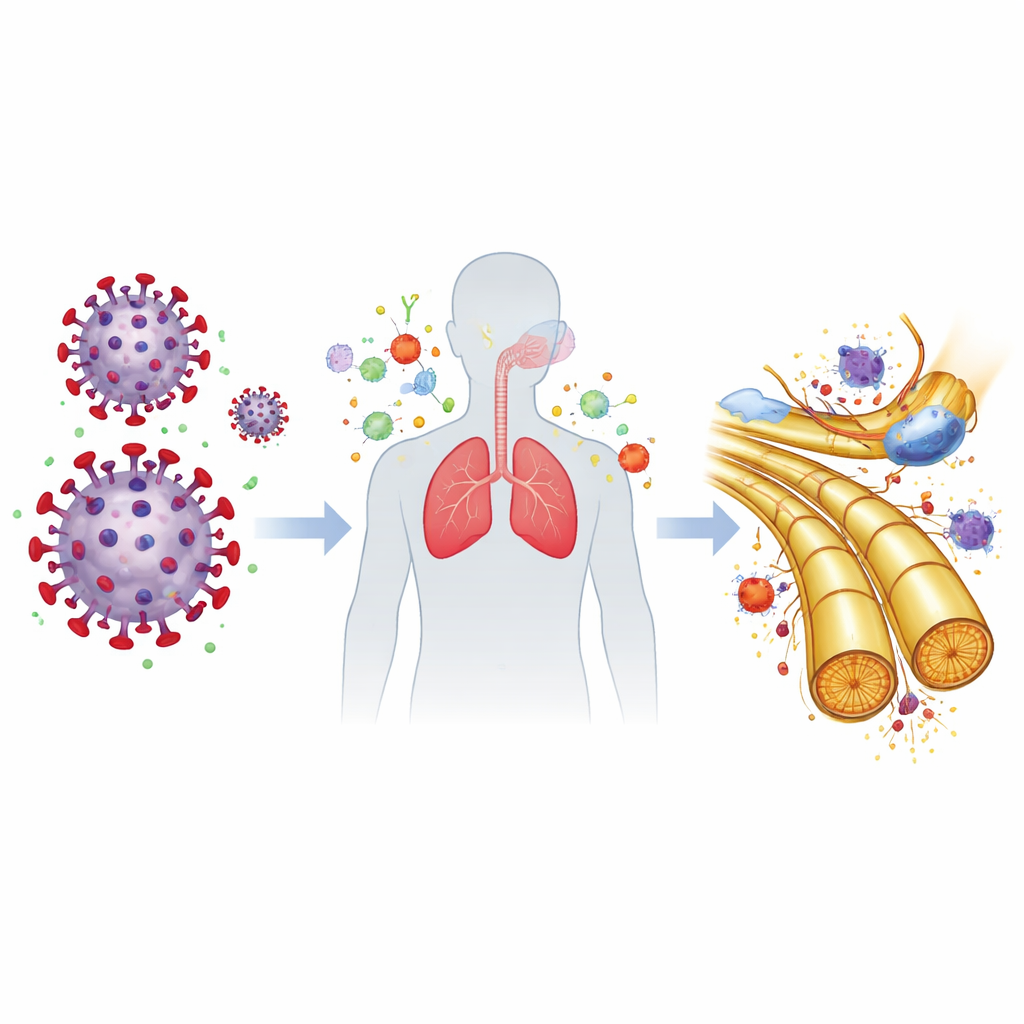
The authors explored how a virus that primarily infects the airways could spark a nerve disorder. Laboratory work from other groups has shown that the coronavirus spike protein can latch onto fatty molecules called gangliosides on nerve-related cell membranes, a property shared with some microbes already known to trigger GBS. This raises the possibility of "molecular mimicry," in which the immune system, primed to attack virus-coated surfaces, accidentally recognizes similar structures on peripheral nerves. At the same time, COVID-19 can unleash high levels of inflammatory molecules such as IL-6, which may weaken the protective blood–nerve barrier and allow immune cells to infiltrate nerve tissue. Together, these mechanisms could explain why GBS risk rises after infection even when the virus itself rarely enters the spinal fluid.
What this means for patients and doctors
For the general public, the main message is that GBS remains a rare complication, but waves of infection like Omicron can noticeably increase the number of severe cases needing hospital and intensive care. Older adults and those recovering from COVID-19 should seek urgent attention if they notice rapidly worsening weakness, trouble walking, or difficulty speaking and swallowing, especially within a few weeks of infection. For clinicians and planners, the study underscores the need for heightened vigilance and capacity to diagnose and treat GBS promptly during and after major outbreaks. Encouragingly, when patients receive timely immune-based therapies, their chances of meaningful recovery over six months appear similar whether their GBS followed Omicron or other triggers.
Citation: Zhang, J., Guo, Y., Wei, L. et al. Post-COVID-19 surge in Guillain-Barré syndrome during the Omicron wave in China with clinical characteristics and potential immune-mediated pathways. Sci Rep 16, 13260 (2026). https://doi.org/10.1038/s41598-026-44136-w
Keywords: Guillain-Barré syndrome, COVID-19 Omicron, autoimmune neuropathy, post-infectious complications, neuroinflammation