Clear Sky Science · en
Current-use and legacy pesticides in canal waters of Chiang Mai, Thailand, during longan flowering and fruit set: occurrence and ecological and human health risk assessment
Why Water Near Fruit Farms Matters
Canals that thread through fruit orchards do more than move water. They can also carry traces of the chemicals farmers use to protect their crops. This study looks at a major longan-growing area in Chiang Mai, Thailand, and asks a simple but important question: what happens to pesticides sprayed on trees when they wash into nearby canals, and what might that mean for fish, insects, and people who rely on that water?
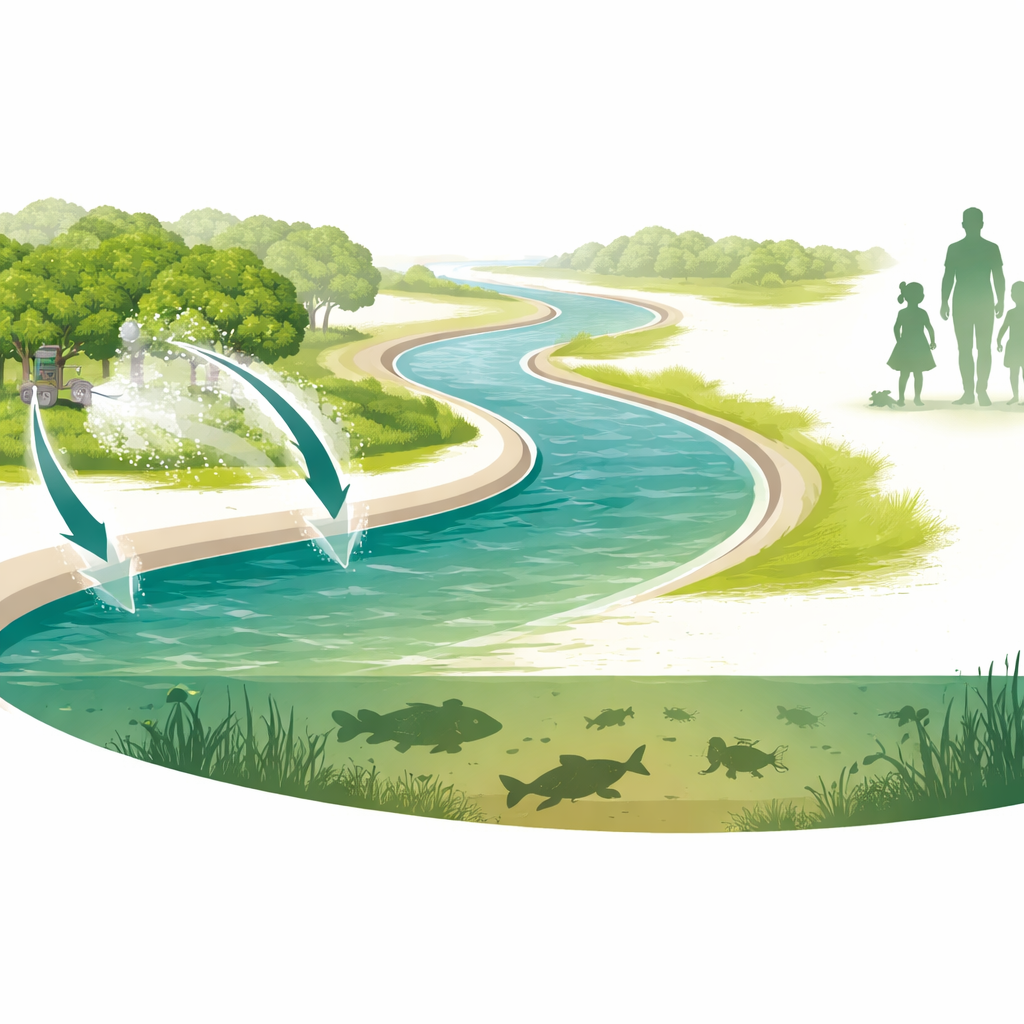
Fruit, Flowers, and a Busy Spray Season
Longan is a high-value tropical fruit, and farmers work hard to shield it from insects and diseases, especially when trees are in bloom and tiny fruits are forming. During these weeks, spraying is frequent. The researchers focused on two key moments in the growing season—flowering in February and early fruit development in April—because these are when canals are most likely to receive short, sharp pulses of chemicals from many orchards at once. They sampled water at three points along a single irrigation–drainage canal: upstream, midstream where orchards are densest, and downstream where all the runoff converges.
What Was Found in the Canal
The team tested for 25 widely used pesticides, including fungicides, insecticides, and herbicides that are common in fruit orchards and nearby fields. Every sampling period revealed a mix rather than a single chemical. During flowering, one insecticide in particular, carbosulfan, dominated the picture with very high levels, especially at the upstream site. By early fruit set, carbosulfan and many other insecticides had dropped sharply, while certain fungicides and herbicides rose. Carbendazim and hexaconazole, used to fight fruit diseases, increased midstream and downstream, likely because farmers intensified disease control as fruits developed. At the same time, some weed killers declined, while others such as isoproturon and metobromuron surged, suggesting a shift toward a different style of weed management later in the season.
Different Places, Different Chemical Mixes
Not all points on the canal looked the same. In general, insecticide “spikes” were strongest upstream during flowering, when spray from nearby orchards and irrigation return flows could quickly reach the water. Midstream, where many orchards cluster, saw the highest peaks for both fungicides and insecticides as the season progressed. Downstream, herbicides became more prominent, and breakdown products of older weed killers accumulated as water flowed and chemicals slowly transformed. These patterns reflect how the timing of spraying, the properties of each compound, and the way water moves through soil and canals combine to shape what ends up in the channel at any given time.
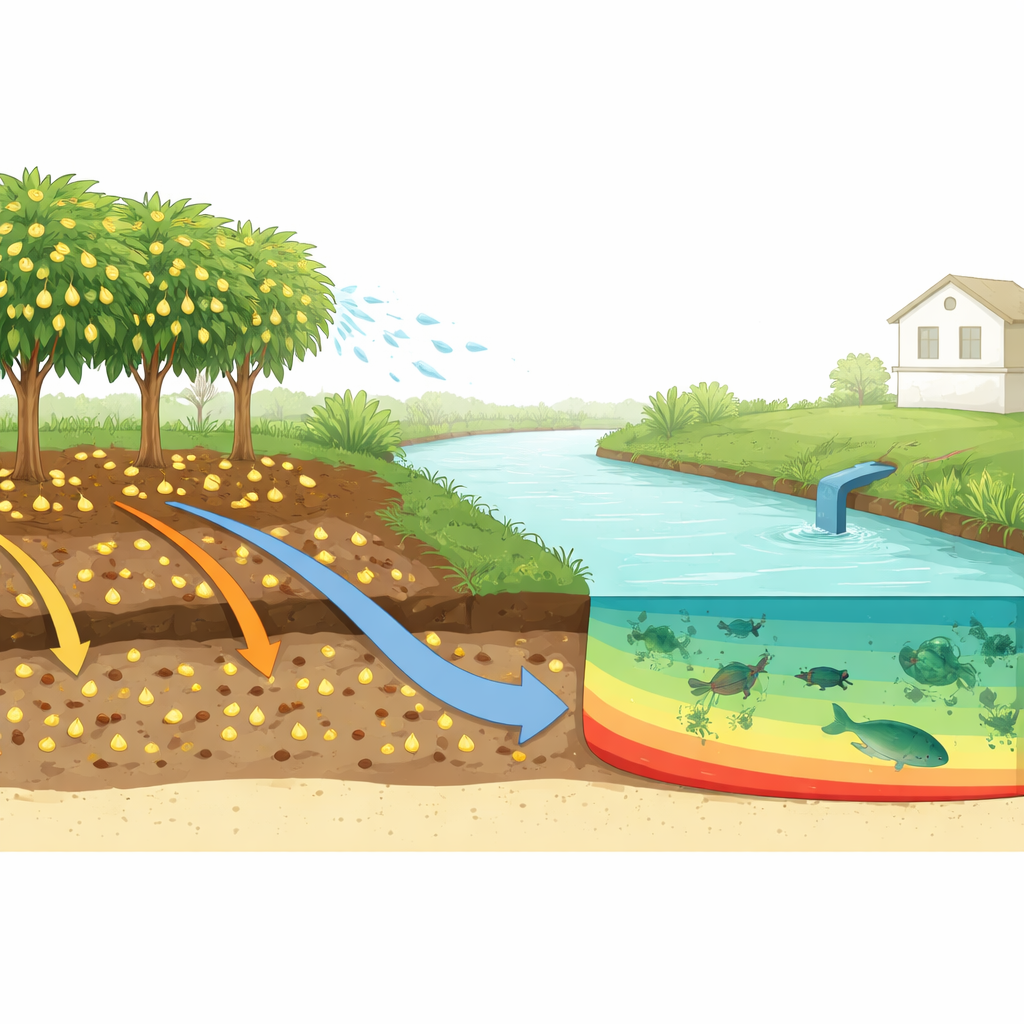
Risks for Aquatic Life and People
Finding pesticides in water does not automatically mean serious harm, so the authors compared measured levels to toxicity benchmarks for algae, small crustaceans, and fish. Two compounds stood out: the fungicide carbendazim and the insecticide carbosulfan repeatedly reached levels where they could threaten sensitive aquatic organisms, while other chemicals, especially most herbicides, generally stayed in lower-risk ranges. For people, the researchers imagined a worst-case situation in which adults, children, and infants drank the canal water directly during spray periods. For each individual pesticide, estimated daily intakes stayed below international safety reference doses. However, when all chemicals were added together, a screening indicator called the hazard index went above 1 at every site, particularly downstream and especially for infants, signaling that the combined “cocktail” deserves attention even if each ingredient alone appears acceptable.
What This Means for Farming and Communities
The study shows that short windows of heavy spraying tied to flowering and fruit set can send complex mixtures of old and new pesticides into nearby canals, creating hot spots of ecological stress and raising questions about the safety of untreated water. While actual household supplies are usually treated and may be much safer than the worst-case scenario modeled here, the work highlights the value of tracking mixtures, not just single chemicals, and of paying attention to when and where sprays are applied. The authors suggest practical steps such as better-targeted pest control, reduced spray drift, vegetated buffer strips along canals, and careful management of irrigation return flows. These measures could help protect both aquatic ecosystems and downstream communities while still allowing farmers to produce healthy, marketable longan fruit.
Citation: Udomkun, P., Rupngam, T., Graham, M. et al. Current-use and legacy pesticides in canal waters of Chiang Mai, Thailand, during longan flowering and fruit set: occurrence and ecological and human health risk assessment. Sci Rep 16, 10980 (2026). https://doi.org/10.1038/s41598-026-43950-6
Keywords: pesticide contamination, irrigation canals, longan orchards, ecological risk, drinking water safety