Clear Sky Science · en
Fixed-time formation behavior control for unmanned ground vehicle-manipulators
Robots That Move Together and Work Together
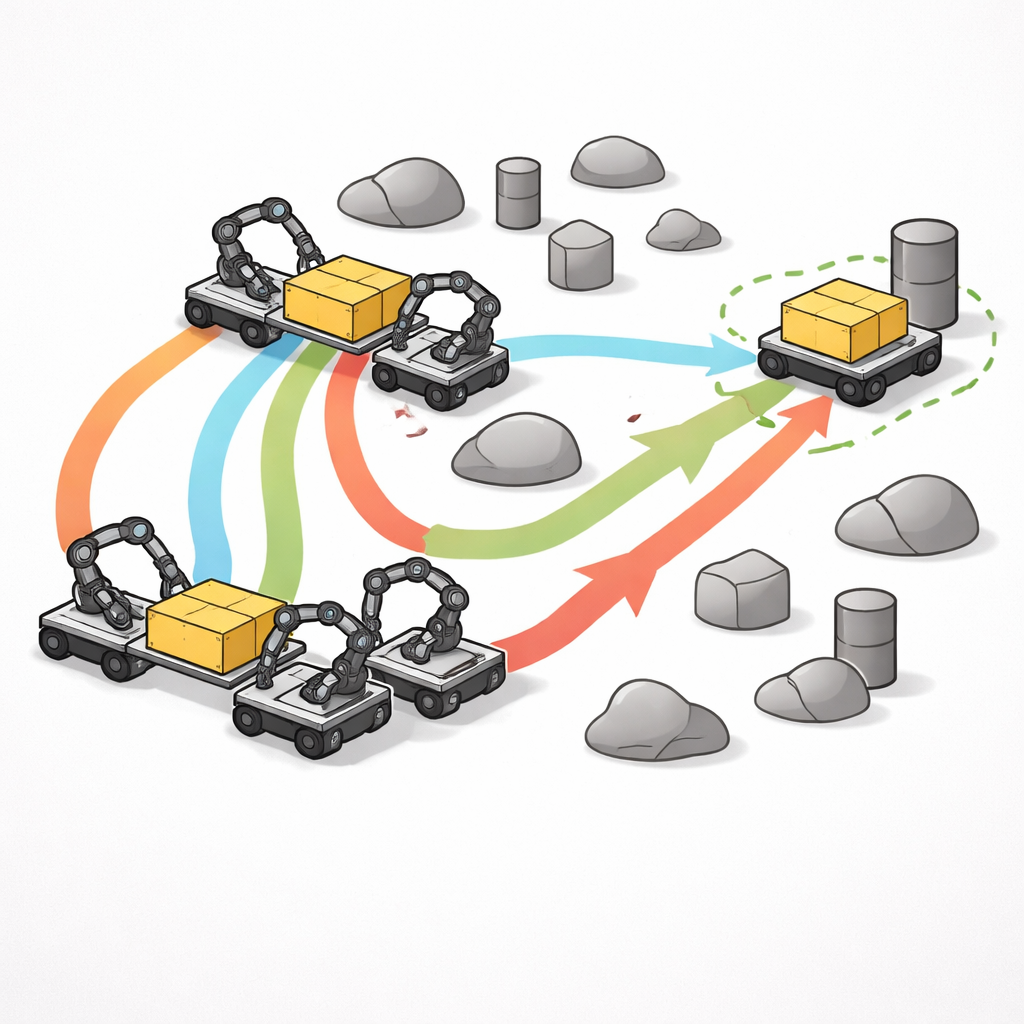
Imagine a team of small mobile robots, each with its own robotic arm, carrying a shared load through a cluttered warehouse or disaster site. They must stay in formation, avoid obstacles, and keep a firm grip on the object, all while disturbances like bumps, friction, or payload shifts try to throw them off. This paper presents a new control method that lets such robot teams coordinate these competing demands and reach their goals reliably within a guaranteed, short time.
Why Teamwork Is Hard for Ground Robots
Unmanned ground vehicle-manipulators (UGVMs) combine a wheeled base with a robotic arm, so they can both move around and manipulate objects. This makes them attractive for tasks like material handling, cooperative assembly, and search-and-rescue. But coordinating several of these machines at once is tricky. Their wheels cannot slide sideways, which restricts how they can move. At the same time, their arms introduce complex forces and motions, and the environment adds disturbances such as uneven ground or unknown payloads. When several UGVMs carry one object, they must maintain a stable formation, steer around obstacles, and move their arms correctly, three goals that often conflict with each other.
Limitations of Existing Control Approaches
Earlier research tackled parts of this puzzle but rarely all of it at once. Behavior-based methods mix basic actions like “go to goal” and “avoid obstacle,” but they often lack rigorous guarantees that the team will remain stable. Consensus-based methods let robots agree on a common motion via communication, but they usually focus on a single objective and offer no systematic way to prioritize conflicting tasks. Other advanced strategies, such as model predictive control and safety barrier functions, can provide strong safety guarantees but at a heavy computational cost, which is problematic for real-time multi-robot systems. Many of these methods also assume robots that can move freely in any direction, ignoring the non-sliding wheel constraints that real UGVMs face, and most only ensure that errors shrink gradually rather than within a known time bound.
A Two-Layer Plan for Fast, Reliable Coordination
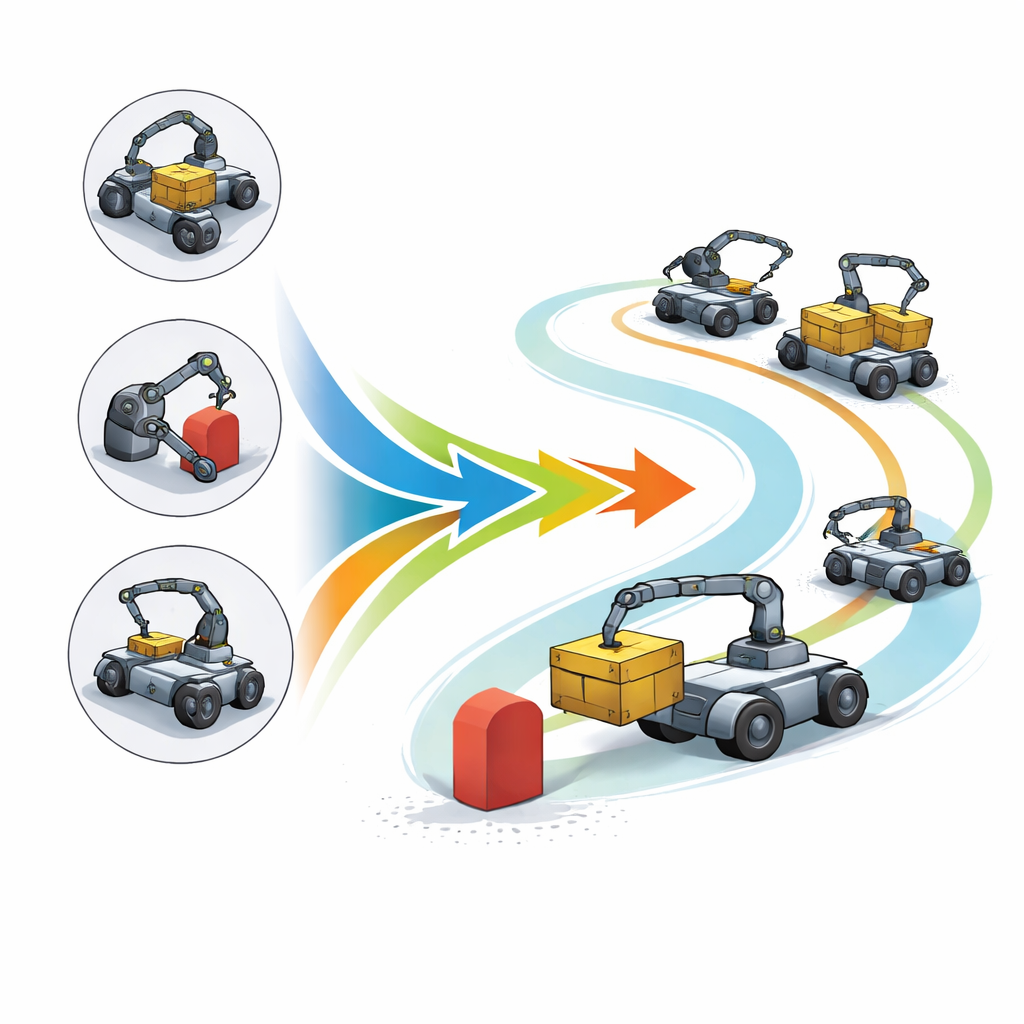
The authors propose a two-layer fixed-time formation behavior control (Fixed-FBC) method that unifies multi-robot coordination, non-sliding wheel constraints, and robustness to disturbances. At the motion-planning (kinematic) layer, they extend a mathematical framework called null-space-based behavioral control so that it respects wheeled motion limits and directly handles the coupling between a vehicle’s heading and its position. Within this framework, they design three basic behaviors: keeping the group formation, avoiding obstacles as a formation, and controlling each robot’s arm motion. These behaviors are stacked in priority order—obstacle avoidance above formation keeping, and both above arm motion—and lower-priority actions are projected into the “leftover” motion space of higher-priority ones. A fixed-time stability strategy shapes how errors are corrected, guaranteeing that all task errors shrink to small values within a time bound that does not depend on how large the errors were at the start.
Robust Control Against Disturbances and Uncertainties
Once the motion-planning layer produces a desired velocity for each UGVM, a second, dynamic layer ensures the actual motors and joints follow this plan despite uncertain robot parameters and external disruptions. Here, the authors design an adaptive fixed-time tracking controller. Adaptive laws continuously estimate unknown properties, such as mass and friction terms, while a sliding-mode component works to reject external disturbances. By combining these elements, the controller drives the mismatch between desired and actual velocities to a small neighborhood around zero within a guaranteed fixed time. Theoretical analysis using Lyapunov methods shows that both the task-level errors (formation, obstacle clearance, arm positions) and the tracking errors converge rapidly and predictably.
What Simulations Reveal About Performance
Computer simulations demonstrate the method on a team of four UGVMs transporting an object through environments with static circular obstacles. The robots successfully maintain their formation and keep a safe distance from obstacles while their arms track desired joint motions, even when subject to time-varying disturbances. When the formation path conflicts with obstacle avoidance, the controller automatically prioritizes safety, steers around the obstacle, and then smoothly restores the desired formation. Compared with earlier “finite-time” and classical formation controllers, the new Fixed-FBC approach cuts settling times by up to about three quarters in some phases, meaning the robots reach stable, coordinated behavior much faster without sacrificing safety or robustness.
Takeaway for Real-World Robot Teams
For a lay reader, the key idea is that this work gives multi-robot teams a kind of disciplined, fast-acting “group reflex.” Instead of slowly drifting into the right configuration, the robots are mathematically guaranteed to settle into safe formations and correct arm motions within a preset time, even when bumped, loaded with uncertain payloads, or forced to weave around obstacles. By unifying formation keeping, obstacle avoidance, and arm control in one framework that respects how wheeled robots truly move, this method brings coordinated robot swarms in factories, warehouses, and rescue missions a step closer to dependable, real-world deployment.
Citation: Xue, W., Lu, W., Zhang, X. et al. Fixed-time formation behavior control for unmanned ground vehicle-manipulators. Sci Rep 16, 10703 (2026). https://doi.org/10.1038/s41598-026-43223-2
Keywords: multi-robot coordination, mobile manipulators, formation control, obstacle avoidance, fixed-time control