Clear Sky Science · en
End-to-end deep attention-based multitask pipeline for predicting uncertainty-quantified peptide properties from mass spectrometry data
Why this research matters for health and biology
Modern biomedical research relies heavily on mass spectrometry to read out which proteins are present in our cells and tissues. Yet, despite powerful instruments and large databases, a surprising fraction of the data remains unexplained, especially for rare or unusual proteins that may be key to diseases like cancer or neurological disorders. This paper introduces ProteoRift, a machine-learning system that helps uncover more of this hidden information by predicting key properties of protein fragments directly from raw data, while also telling scientists how confident those predictions are.
The bottleneck in reading protein fingerprints
Mass spectrometry works by breaking proteins into smaller pieces called peptides and measuring the mass of the resulting fragments. Standard software then searches large protein databases for peptide sequences whose calculated mass matches each observed spectrum. To keep this search computationally feasible, most tools apply a simple rule: they only consider candidates whose overall mass closely matches the measured value. This mass-based filtering speeds things up, but it comes at a cost. If the mass is slightly misassigned, or if a peptide carries an unexpected chemical modification, the correct answer may be excluded before it is ever considered, contributing to the large pool of unassigned spectra and to a bias toward abundant, well-behaved peptides.
A smarter way to narrow the search
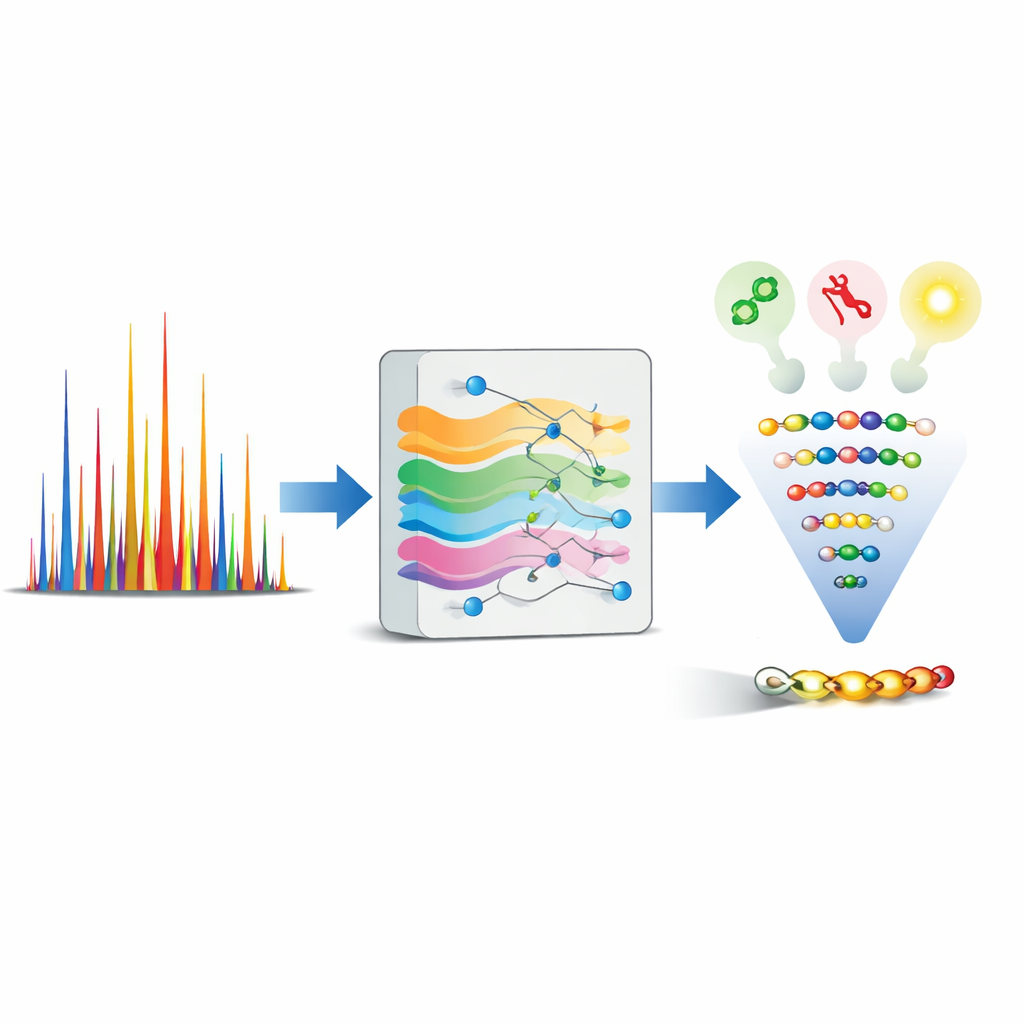
ProteoRift offers a different strategy: instead of filtering candidates using only mass, it learns to extract richer information from each spectrum before any database search occurs. The system is built around an attention-based deep neural network that takes as input the pattern of peaks in a spectrum along with basic acquisition details. From this, it simultaneously predicts three properties of the underlying peptide: how long it is, how many times it was cut during sample preparation (missed cleavages), and whether it carries any modifications. Because these tasks are related, training them together encourages the model to form a robust internal representation of spectra, improving its ability to generalize to new data.
Turning predictions into faster and leaner searches
To put these predictions to work, the authors integrate ProteoRift into an end-to-end pipeline alongside a previously developed tool called SpeCollate, which matches spectra to peptide sequences in an embedding space. First, ProteoRift assigns each spectrum to a class defined by length range, number of missed cuts, and modification status. Peptides in the database are similarly grouped based on their known properties. The search engine then only compares spectra to peptides in the same class, instead of scanning through every peptide with a similar mass. Across multiple human and microbiome datasets, this targeted filtering shrinks the candidate search space by more than 90% in theory and delivers practical speedups of roughly 8- to 12-fold compared with mass-only filters, while recovering similar numbers of confidently identified peptides. In some very large proteogenomic and meta-proteomic databases, speedups can be even higher, reaching over 40-fold in specific tests.
Knowing when the model might be wrong
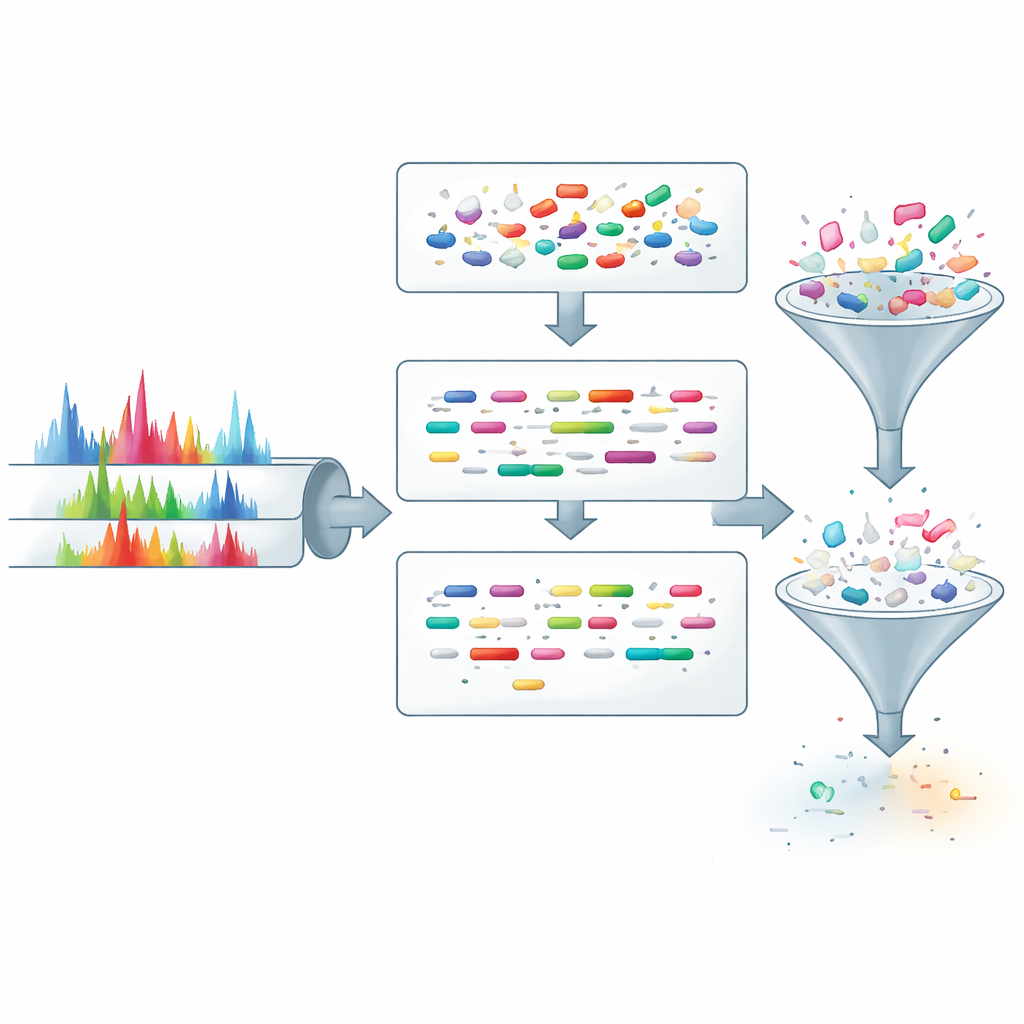
Because machine-learning systems are often viewed as black boxes, the authors also develop measures of uncertainty tailored to mass spectrometry data. They probe how much a spectrum’s internal representation changes under controlled distortions, how densely it is surrounded by similar training examples, and how well the structure of the original data is preserved in the learned space. These three metrics capture different aspects of uncertainty: noise in the measurements themselves and gaps in what the model has seen during training. Combined, they can distinguish familiar from unfamiliar data with very high accuracy and help flag cases where the model’s top-scoring peptide match is likely to be correct.
What this means for future discoveries
In everyday terms, ProteoRift functions like a smart gatekeeper that looks at a spectrum and says, “this is probably a short, unmodified peptide with one cut,” or “this looks longer and modified,” and then only allows appropriate candidates into the detailed search. By doing so, it speeds up analysis dramatically without sacrificing much accuracy, even on complex or very large protein databases. At the same time, its uncertainty metrics give researchers a clearer sense of when to trust a result or when more data or model fine-tuning may be needed. Together, these advances could help move mass spectrometry beyond its current focus on abundant, well-characterized proteins and open new windows onto the rare and modified peptides that often hold the most interesting biological clues.
Citation: Tariq, U., Shabbir, B. & Saeed, F. End-to-end deep attention-based multitask pipeline for predicting uncertainty-quantified peptide properties from mass spectrometry data. Sci Rep 16, 13331 (2026). https://doi.org/10.1038/s41598-026-43215-2
Keywords: proteomics, mass spectrometry, deep learning, peptide identification, uncertainty estimation