Clear Sky Science · en
Decoding the evolution of melodic and harmonic structure of Western music through the lens of network science
Why today’s songs may sound strangely alike
From Bach to Beyoncé, music has always sounded incredibly diverse. Yet many listeners and musicians feel that modern hits are starting to blur together. This study asks whether that sense of sameness can be measured, not just felt. By turning thousands of songs into mathematical networks, the authors look for hidden patterns in how melodies and harmonies are put together, and how those patterns have changed over nearly four centuries of Western music.
Turning songs into webs of notes
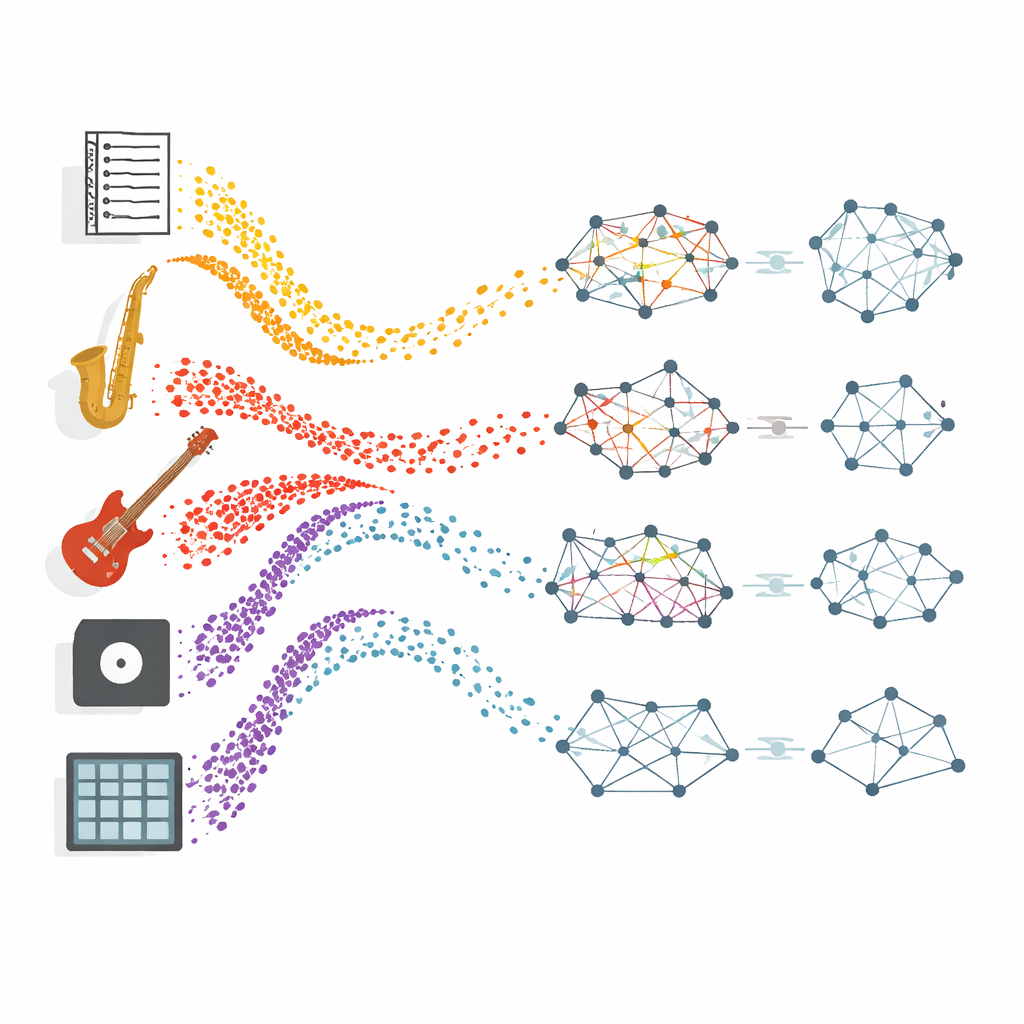
Instead of working with raw audio, the researchers use around 20,000 digital scores in MIDI format, covering six broad groups: Classical, Jazz, Rock, Pop, Hip Hop, and Electronic. In each piece, every distinct note becomes a dot, and every move from one note to the next becomes a line linking two dots. Lines that repeat more often are drawn “heavier” in the underlying math. The result is a web-like picture of how a piece travels through pitch space: which notes it favors, how often it returns to old ground, and how widely it roams.
What makes a musical web rich or simple
Once they have these webs, the authors apply tools from network science to describe their structure. One key idea is how efficiently a piece “explores” possible note combinations, captured by measures related to the shortest paths through the web and how evenly different connections are used. When a network shows many distinct routes and avoids leaning too heavily on just a few favorite note jumps, the piece counts as more complex in this framework. Another measure looks at how often a move from note A to note B is paired with a move back from B to A, which hints at repetitive back-and-forth patterns typical of some styles.
How genres differ under the hood
Across genres, the web structures look strikingly different. Classical and Jazz pieces tend to use a wider variety of note transitions and spread their attention more evenly across them. Their networks are less dominated by heavily repeated patterns and show higher values of the authors’ complexity measures. In contrast, Rock, Pop, Hip Hop, and Electronic tracks generally rely more on a smaller set of recurring transitions, with stronger back-and-forth links. Yet when you ignore how often each connection is used and look only at which notes are connected at all, the average distance between notes is surprisingly similar across genres. This suggests the real differences lie not in the basic “map” of reachable notes, but in how intensively each path is traveled.
Following change from old masters to streaming age
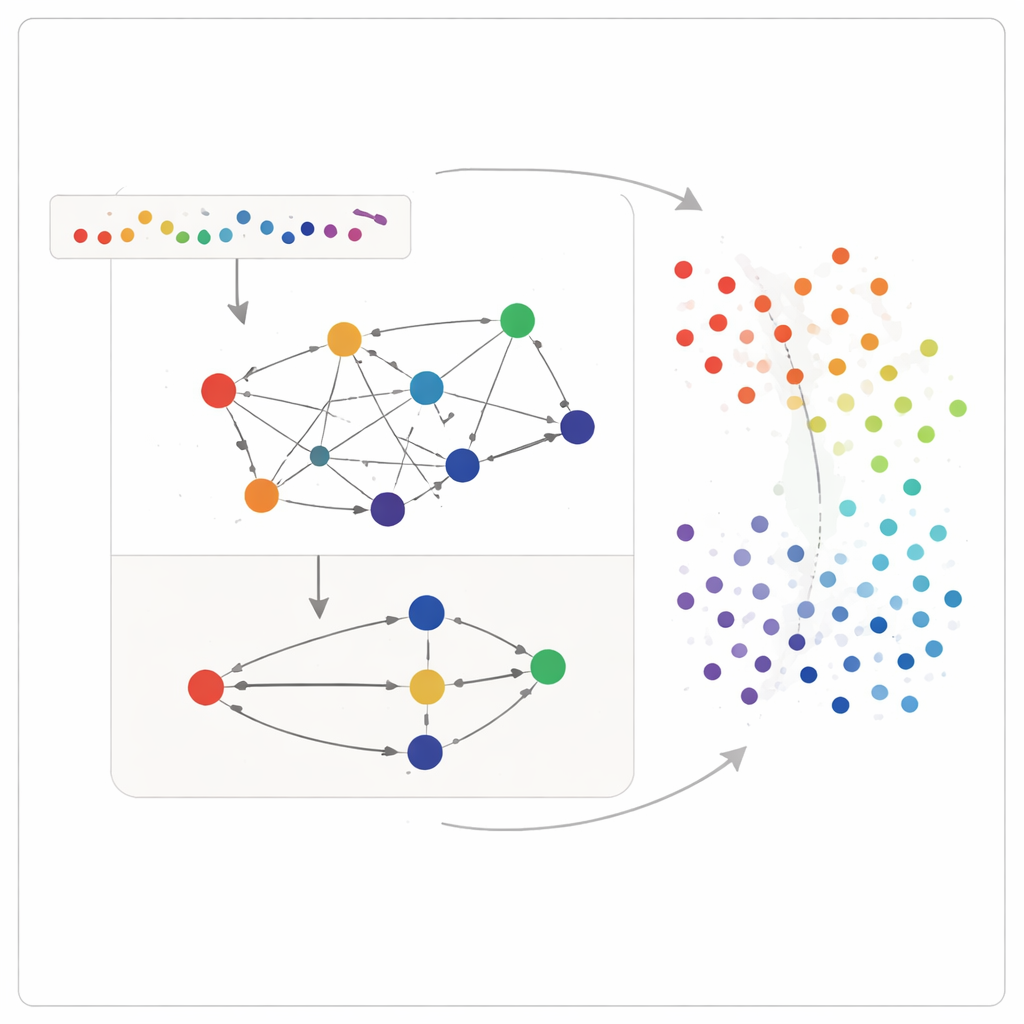
To see how these structures shift over time, the team links each piece to an approximate release date, combining Spotify data with estimates from a language model for older works. They then examine how complexity changes across five broad eras, from before 1900 to the 21st century. Classical music shows a clear decline in the richness of its melodic and harmonic webs over the centuries. Jazz, after an early rise in complexity, also drifts toward simpler patterns, leveling off closer to the newer popular genres. Meanwhile, Rock, Pop, Hip Hop, and Electronic music keep relatively steady—and simpler—structures, so that in recent decades all six macro-genres look more similar to each other than in the past. Using an additional representation based on the size of pitch jumps between notes, the authors also see pieces from different eras clustering closer together in a common “musical space,” reinforcing the picture of growing homogenization.
What this means for how music is changing
To a non-specialist, the main takeaway is that, within the narrow lens of notes and their connections, Western music appears to have become less structurally varied and more alike across genres over time. The study does not claim that music as a whole is getting worse or simpler in every sense—factors like sound design, rhythm, production, and lyrics are not captured by these symbolic networks. But it does show that when you strip songs down to their melodic and harmonic skeletons and compare them at scale, older Classical and early Jazz pieces occupy a richer, more diverse region of this space, while recent music of all sorts converges toward a common, more streamlined pattern. This quantitative view offers a starting point for deeper questions about how technology, streaming platforms, and global culture are reshaping the way our music is built beneath the surface.
Citation: Di Marco, N., Loru, E., Galeazzi, A. et al. Decoding the evolution of melodic and harmonic structure of Western music through the lens of network science. Sci Rep 16, 11121 (2026). https://doi.org/10.1038/s41598-026-42872-7
Keywords: music complexity, network science, Western music evolution, melody and harmony, digital music analysis