Clear Sky Science · en
First detection of an H5N2 subtype of Influenza A virus detected in Charadrius collaris from the Brazilian Pantanal
Why this bird virus story matters
Hidden in the vast wetlands of the Brazilian Pantanal, scientists have discovered a new piece of the global bird flu puzzle. They found, for the first time, a specific type of avian influenza virus called H5N2 in a small shorebird known as the collared plover. This finding matters not because it signals an immediate crisis, but because it reveals how viruses quietly travel with migratory birds, mix and change, and sometimes edge closer to farm animals and people.
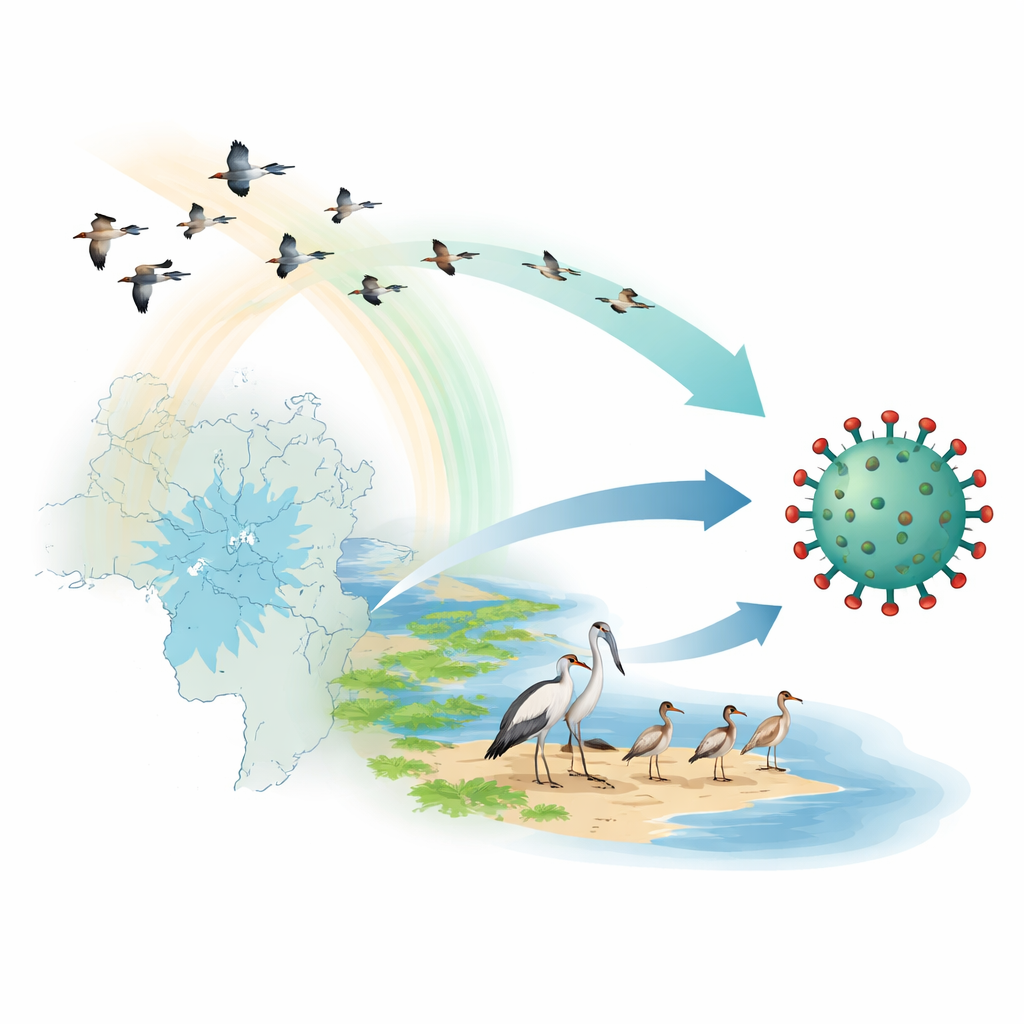
A giant wetland crossroads for birds
The Pantanal is the world’s largest tropical wetland, a huge floodplain in the heart of South America. It sits beneath two major migratory routes used by birds that travel thousands of kilometers between North, Central, and South America. These birds stop to rest and feed on exposed sandbanks, shallow lagoons, and flooded fields, often right next to resident birds that live in the region year-round. Because so many species from so many places mingle there, the Pantanal becomes a natural crossroads not only for birds, but also for the viruses they carry.
How the team searched for hidden infections
Between 2021 and 2023, researchers carried out 17 field campaigns in eight areas of the northern Pantanal. Using mist nets and active capture, they sampled 1,108 individual birds representing 157 species, and also collected 94 fresh droppings from flocks on the ground. From each captured bird they took swabs from the throat and the cloaca (the common exit for digestive and respiratory tracts) and stored them in special tubes to preserve any viruses present. In the laboratory, they used a sensitive molecular test called RT-qPCR to look for genetic material from influenza A viruses, then followed up positive results with more detailed sequencing.
The first H5N2 case in a Pantanal bird
Out of all these samples, the team detected influenza A virus in a single bird: a collared plover caught in August 2023 on a beach in Chacororé Bay. The virus turned out to be of subtype H5N2, a combination of one type of surface protein (H5) and another (N2). Sequencing showed that its key genes were closely related to H5N2 viruses found more than a decade earlier in wild ducks in Colombia, as well as to other strains from North America and Asia. Importantly, the pattern of amino acids at a critical “cleavage site” in the virus’s coat revealed that this strain is low pathogenic for birds, consistent with the absence of any die-offs or obvious illness in the Pantanal.
A traveling, shape‑shifting virus
By comparing each of the virus’s eight gene segments to databases of influenza sequences, the researchers saw signs that its genetic material had been shuffled through past mixing events. Some segments were most similar to viruses from North American ducks, others to strains found in Asia or Mexico. This patchwork pattern fits with what scientists know about bird flu: when different viruses infect the same bird, they can swap parts, creating new combinations. The team also checked for known changes that would make the virus better adapted to mammals, such as certain mutations in two key genes, and did not find them. That supports the view that this H5N2 strain is still essentially a bird virus with no clear sign of enhanced risk for humans or other mammals.

What this means for farms and people
The collared plover is mostly a local bird, moving shorter distances within and around the Pantanal as water levels rise and fall. Its infection suggests that resident species can act as local holders of viruses introduced by long-distance migrants. Even though this particular H5N2 strain is low pathogenic and shows no markers of mammal adaptation, its presence reveals active circulation of avian influenza in an inland region that had not previously reported infected wild birds. The study underscores that surveillance cannot focus only on coasts and poultry farms: inland wetlands like the Pantanal, where wild birds gather in large numbers close to rural communities and domestic animals, are also crucial early warning sites in the global effort to track and contain avian influenza.
Citation: Magalhães, T.B.S., da Rosa Bueno, E., de Assis Pereira, N. et al. First detection of an H5N2 subtype of Influenza A virus detected in Charadrius collaris from the Brazilian Pantanal. Sci Rep 16, 14496 (2026). https://doi.org/10.1038/s41598-026-42819-y
Keywords: avian influenza, migratory birds, Pantanal wetlands, H5N2 virus, wildlife disease surveillance