Clear Sky Science · en
Evaluating generative AI’s potential to dispel misinformation about wind farms
Why talking to AI about wind power matters
Debates over wind farms are no longer just about noisy turbines on the horizon. Around the world, false claims about wind power – from exaggerated health risks to conspiracy theories – are spreading online and shaping public opinion. This matters because large-scale wind energy is one of the pillars of a cleaner, climate-safe future. This study asks a timely question: can everyday conversations with a popular AI chatbot help people sort fact from fiction about wind farms, and in doing so, gently shift their attitudes toward cleaner energy?
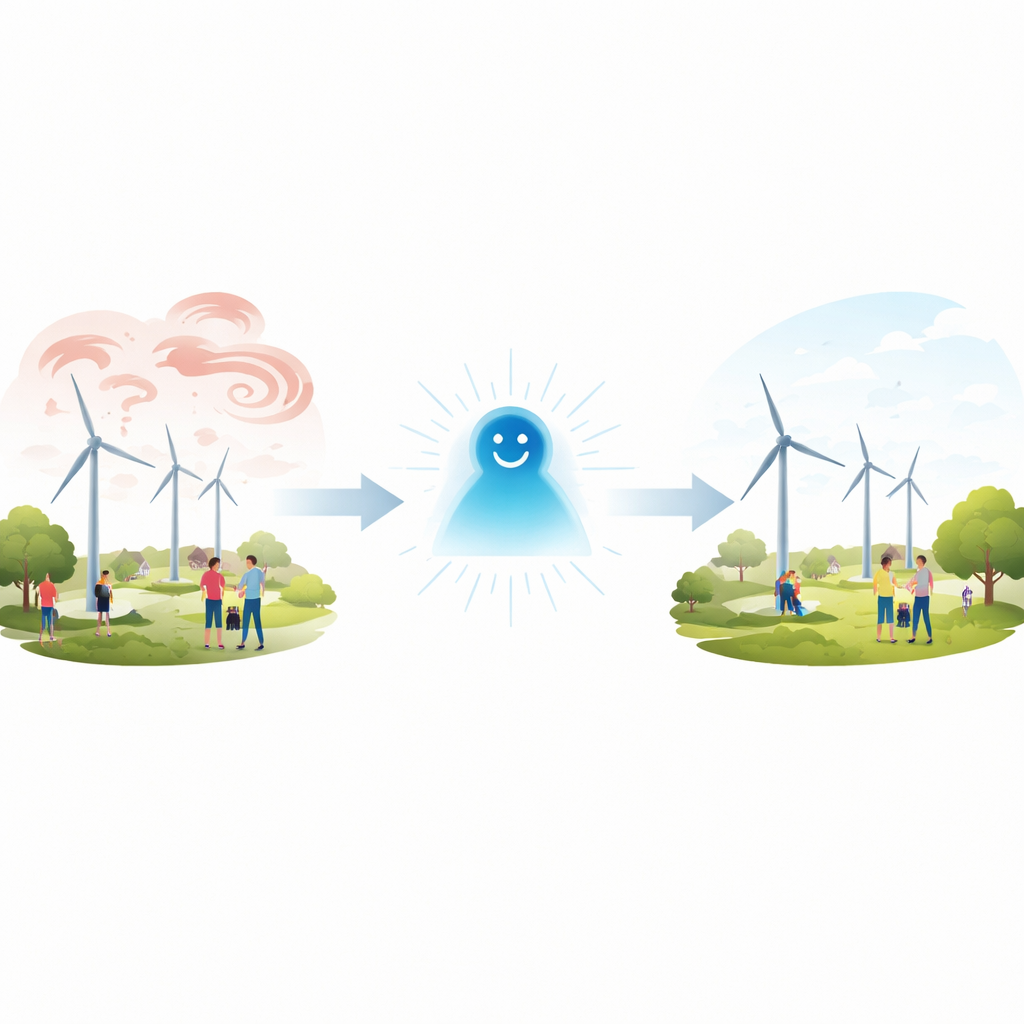
How wind myths spread and why they are hard to shift
Surveys in countries such as Australia and the United States show that large numbers of people accept misleading claims about wind turbines – including ideas that scientists are hiding the truth or that turbines cause serious illness and even cancer. These beliefs do not mainly stem from lack of education. Instead, they are tied to people’s worldviews, including general distrust of powerful institutions and a tendency to see secret plots behind major events. Once beliefs are rooted in identity and emotion rather than simple facts, they become stubborn. Traditional tools like fact sheets and public information campaigns often produce only small, short-lived changes.
Putting AI conversations to the test
To explore a new way forward, the researchers ran two large online experiments with over 2,400 U.S. adults, focusing especially on people who held negative views of wind farms. First, participants wrote freely about what they thought and how confident they were in those views. Then, depending on the study, they either had a three-round chat with ChatGPT about wind farms, chatted with the same AI about a neutral topic like sports, or read a three-page myth-busting fact sheet from the U.S. Department of Energy. Everyone then repeated the earlier questions so the team could track changes in confidence, belief in specific myths, and support for wind energy policies. Follow-up surveys, up to a month later, tested whether any shifts lasted.
What changed after talking with the AI
The AI conversations produced meaningful, if modest, improvements. Among people who began with strongly negative views, confidence in their own anti–wind farm stance dropped by around 9–10 percent immediately after chatting with the AI. Agreement with common myths – such as that turbines do more environmental harm than good – also decreased, and support for pro–wind farm policies rose. Importantly, an independent expert review and automated checking of hundreds of chat transcripts found no clear cases where the AI itself introduced new misinformation under the conditions tested. However, the benefits were not permanent. Some gains in confidence and policy support faded over time, although reduced agreement with false claims tended to hold up better than the broader attitudinal shifts.
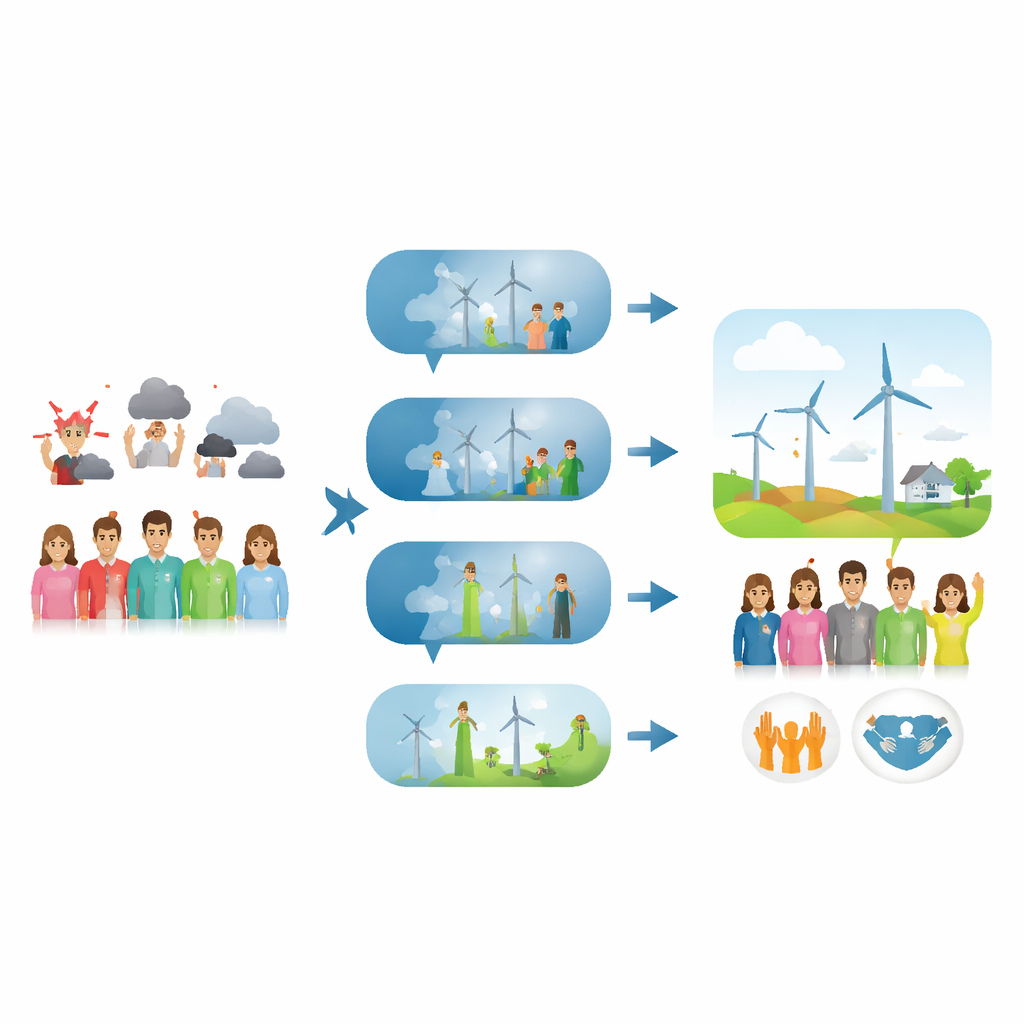
How AI stacked up against a classic fact sheet
In the second experiment, the team staged a head-to-head comparison between AI chats and the government fact sheet. Both interventions improved beliefs and policy support compared with baseline. The static document, however, was consistently better at reducing agreement with a wide range of myths, likely because it systematically addressed many specific claims in one go. The AI conversation excelled at responding to individuals’ particular worries, but that focus meant it did not always cover the full menu of common misconceptions. Over a month, the overall size of the improvements from AI and from the fact sheet was similar for many measures, though neither produced dramatic, permanent shifts on its own.
What this means for our energy future
For non-specialists, the key message is that AI is not a magic wand – but it can help. Unscripted conversations with a widely used chatbot, operating much as the public already encounters it, did not appear to make wind misinformation worse and were associated with real, if modest, improvements in understanding and policy support. Fact sheets remain a powerful, low-tech tool, especially for correcting a broad set of specific myths. The authors argue that the most promising path is not to replace traditional communication, but to add AI as a flexible, accessible complement – one that can meet people where they are, answer their particular questions, and be refined and supervised to stay accurate and trustworthy as societies push toward a cleaner energy system.
Citation: Pearson, S., Hornsey, M.J., Bretter, C. et al. Evaluating generative AI’s potential to dispel misinformation about wind farms. Sci Rep 16, 13424 (2026). https://doi.org/10.1038/s41598-026-42790-8
Keywords: wind energy, misinformation, generative AI, public opinion, renewable policy