Clear Sky Science · en
A real-time detection framework for road cracks in noisy and morphologically complex environments
Why keeping roads healthy matters
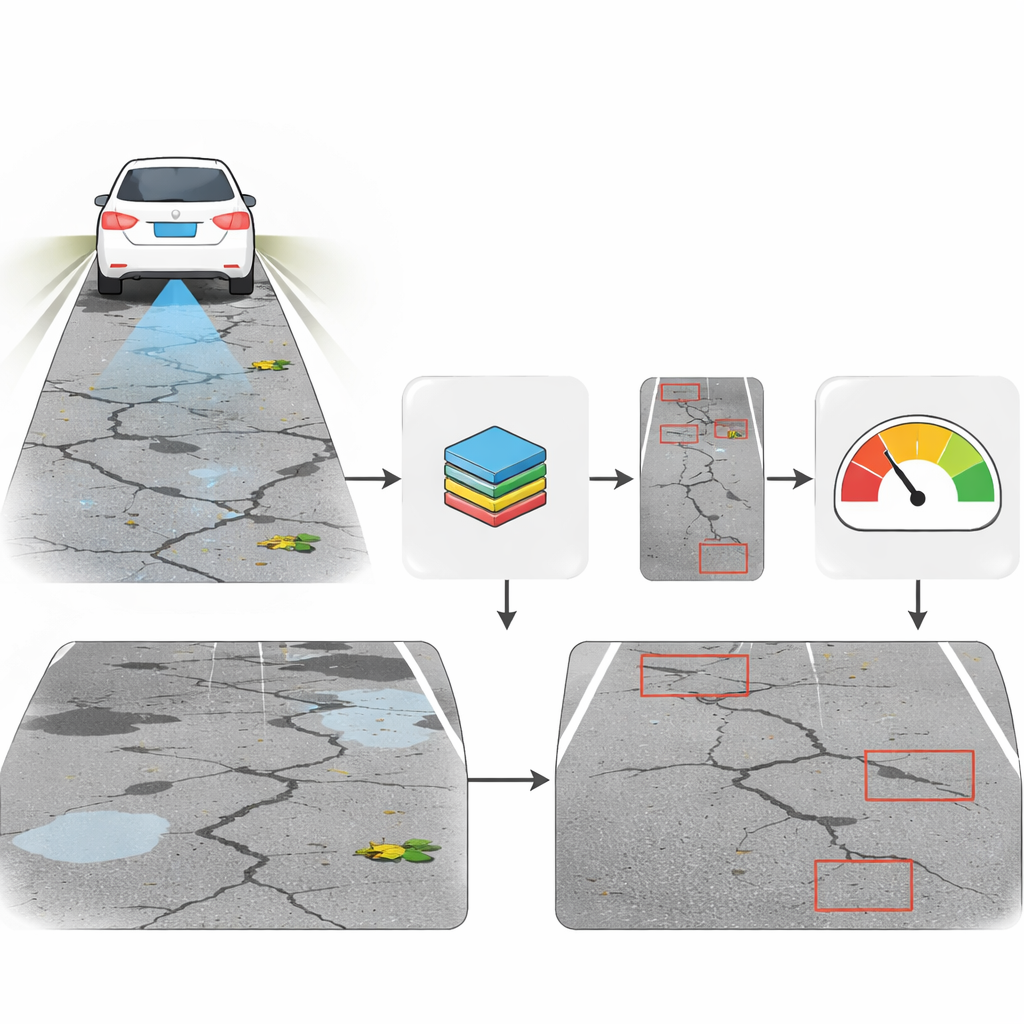
Cracked roads are more than just a nuisance. When small fractures in the pavement go unnoticed, they can grow into deep ruts and potholes that damage vehicles, slow deliveries, and raise the risk of accidents. Highway agencies would like to spot these problems early using cameras mounted on inspection vehicles, but today’s computer vision tools often miss faint cracks or get confused by shadows, puddles, and stains. This paper introduces a new artificial-intelligence model, called Crack-YOLO, that can find road damage quickly and accurately even in messy real-world conditions, and can turn those findings directly into standard pavement health scores.
Seeing cracks in the real world, not just in the lab
Many existing crack detectors work well on tidy test images but falter on actual streets, where headlights, tree shadows, rainwater, oil drops, and fallen leaves all clutter the scene. Thin and hairline cracks are especially hard to recognize: their features are weak, they often break in and out of view, and they can easily be mistaken for harmless surface patterns. The authors frame this as three linked challenges: low accuracy, strong sensitivity to background clutter, and poor detection of very small cracks. Solving these issues is crucial for modern Pavement Management Systems, which rely on accurate maps of road damage to decide when and where to repair.
A lighter, sharper digital eye
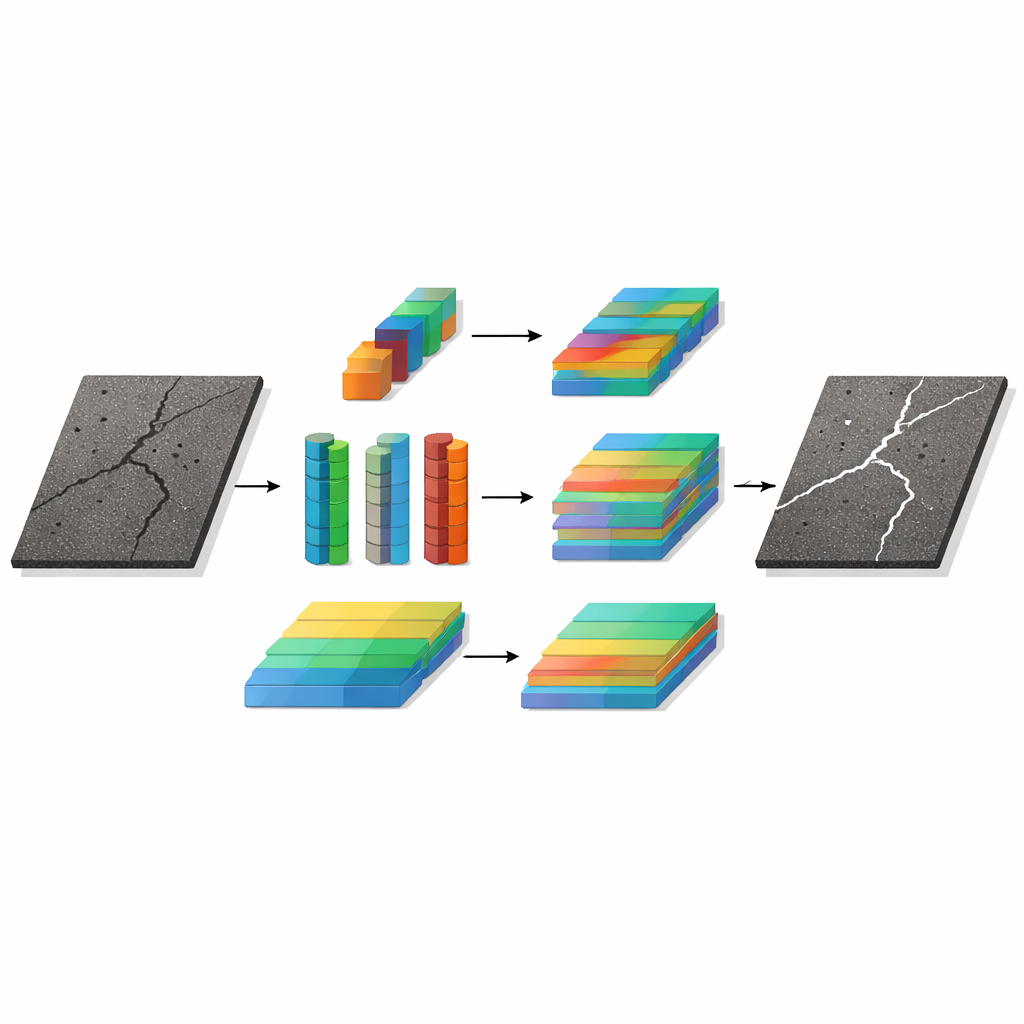
Crack-YOLO builds on a popular object-detection family known as YOLO, but redesigns key parts so the system can "look" more intelligently while staying lightweight enough for small computers. First, the model’s basic building block for analyzing images is upgraded to a context-guided unit. Instead of focusing only on tiny local patches, this unit mixes information from the immediate neighborhood and from the wider scene. That allows the model to see a crack as a continuous line against the overall road surface, making it less likely to confuse dark stains or shadows with damage.
Following fine lines across scales
Cracks come in many shapes and sizes, from long straight lines to branching "alligator" patterns and round potholes. To adapt to this variety, the authors replace fixed filters inside a feature-fusion module with dynamic ones that can change depending on the input. In practice, the model keeps a small set of alternative filters and learns how to blend them on the fly, which helps it capture both thin, winding cracks and larger broken regions without adding heavy computation. On top of that, a new output head lets the network blend information from fine-detail layers and coarse, big-picture layers for every location in the image. This multi-scale fusion helps the system trace cracks that span large areas while still paying attention to sharp edges.
Proving performance on tough road scenes
The team tests Crack-YOLO on four crack image collections from different countries, cameras, and weather conditions, including their own CrackVariety dataset that purposely includes sun, rain, shadows, standing water, oil stains, and obstacles. Across the board, the new model detects more true cracks while running faster than a strong baseline, YOLOv8s. On CrackVariety, its main score for detection quality jumps from about 40% to over 71%, while processing speed nearly doubles to more than 400 images per second on a high-end graphics card. On a particularly noisy low-resolution dataset, it finds useful patterns where many other YOLO-based models fail. Compared with classic detectors such as SSD and Faster R-CNN, it offers a more stable balance of accuracy and speed.
From camera frames to maintenance decisions
To show that the approach is not just a lab exercise, the authors deploy Crack-YOLO on a Raspberry Pi 5—an inexpensive, credit-card-sized computer similar to what might be mounted in a small inspection vehicle. Even without hardware accelerators, the model can analyze several video frames per second, fast enough for slow-moving survey cars or for sampling key frames. The system goes a step further by connecting its detections to the Pavement Condition Index, a standard used worldwide. It estimates the physical area of each crack from camera geometry, corrects for overestimation due to bounding boxes, and plugs the results into established engineering formulas to output a single health score for each road section.
Smarter inspections, smoother rides
Overall, the work shows that it is possible to build a road crack detector that is both swift and smart: Crack-YOLO handles cluttered, low-quality images, tracks many types of defects, and runs on modest hardware. By feeding its findings directly into standard pavement ratings, it helps bridge the gap between artificial intelligence research and day-to-day road maintenance. If refined further to work at the level of individual pixels and to fuse extra information such as 3D depth or infrared, systems like this could underpin highly automated, low-cost monitoring of road networks—catching early signs of wear long before they turn into wheel-bending potholes.
Citation: Fan, L., Tang, S., Ariffin, M.K.A.B.M. et al. A real-time detection framework for road cracks in noisy and morphologically complex environments. Sci Rep 16, 10107 (2026). https://doi.org/10.1038/s41598-026-41043-y
Keywords: road crack detection, pavement monitoring, computer vision, deep learning, infrastructure maintenance