Clear Sky Science · en
Global historical population exposure to heating and cooling degree days
Why this matters for everyday life
Staying safe and comfortable in a changing climate increasingly depends on energy for heating and, especially, for cooling. This study asks a simple but vital question: as the planet warms and populations grow and move, where are people most exposed to uncomfortable or dangerous temperatures, and is the world’s energy demand shifting from keeping us warm in winter to keeping us cool in summer?
From a world of heaters to a world of air conditioners
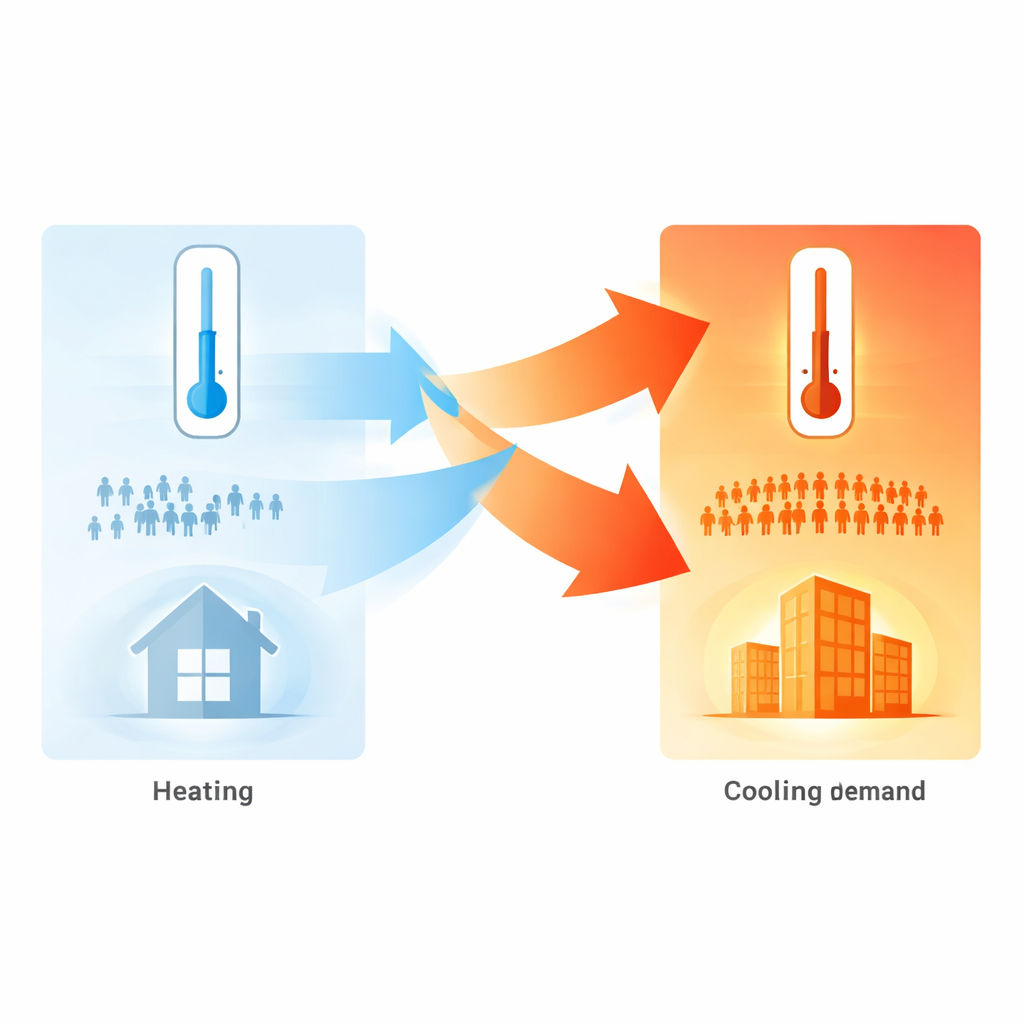
The authors use a measure called “degree days” to track how much a location is colder or hotter than a comfortable indoor temperature over a year. Heating degree days reflect how often and how far temperatures fall below that comfort point, while cooling degree days reflect how often they rise above it. By combining four decades of global temperature records (1980–2020) with detailed maps of where people live, the study shows that heating needs are generally declining while cooling needs are rising almost everywhere, signaling a global tilt toward a hotter, more air‑conditioned world.

Uneven warming across continents
The warming pattern is far from uniform. Cooling demand is climbing fastest in Africa and South America, where the increase is several times higher than the global average. These regions, already warm, are becoming even more heat stressed. At the same time, heating demand is dropping most rapidly in Europe and Asia, particularly at high northern latitudes. In the tropics, heating needs change little because temperatures rarely fall below the comfort threshold in the first place. Overall, the reduction in heating cannot compensate for the sharp rise in cooling demand, meaning more people are being pushed into conditions where they need relief from heat.
Where people live changes the risk
Climate change alone does not determine exposure; the location and growth of populations play a major role. The study finds that rising cooling exposure is driven mostly by population growth and movement, especially in Asia and Africa. Areas like South and East Asia, parts of Indonesia, West and Northeast Africa, and parts of Central and South America now combine dense populations with rapidly growing heat exposure. In contrast, heating exposure remains concentrated in regions north of 30°N—such as Europe, East Asia, and the eastern United States—but its footprint is slowly shrinking toward lower latitudes as winters become milder.
The burden falls hardest on poorer countries
By grouping countries into four income levels, the authors reveal a stark inequality. Low- and lower‑middle‑income countries account for nearly two‑thirds of global exposure to hot conditions, yet they generally have the least access to reliable cooling, modern housing, and robust power grids. By contrast, high‑ and upper‑middle‑income countries, largely in cooler or temperate zones, account for more than 90% of exposure to cold conditions. For them, milder winters can even bring some benefits, such as reduced heating bills and energy savings, and they typically possess better infrastructure to manage both heating and cooling demands.
What this means for energy and fairness
The analysis shows that the combined effects of a warming climate and demographic trends are pushing the world from a heating‑dominated to a cooling‑dominated energy future, and that this shift is fastest in poorer, hotter countries. These nations face mounting health and economic risks from extreme heat, often without widespread air conditioning or strong social safety nets. Meanwhile, wealthier countries are better positioned to adapt and may even gain from lower heating needs. The authors argue that planning for sustainable, affordable cooling, investing in efficient buildings and renewable energy, and recognizing these imbalances are crucial steps if the world is to protect vulnerable populations and avoid deepening global inequalities in a hotter future.
Citation: Gong, Y., Tao, H., Fang, Z. et al. Global historical population exposure to heating and cooling degree days. Sci Rep 16, 9862 (2026). https://doi.org/10.1038/s41598-026-39887-5
Keywords: climate change, heat exposure, cooling demand, energy use, global inequality