Clear Sky Science · en
A Sensor based turning dataset for data-driven surface roughness estimation
Why the smoothness of metal matters
From jet engines to power plants, many critical machines rely on metal parts whose surfaces must be smooth enough to resist wear, corrosion and cracking. Yet checking that smoothness usually happens only after cutting is finished, which risks wasted material, time and money if the result is not good enough. This paper presents a rich new dataset that helps scientists and engineers teach computers to estimate surface smoothness in real time during cutting, especially for a stubborn alloy called Inconel-625 that is widely used in aerospace hardware.
A tough metal that is hard to cut
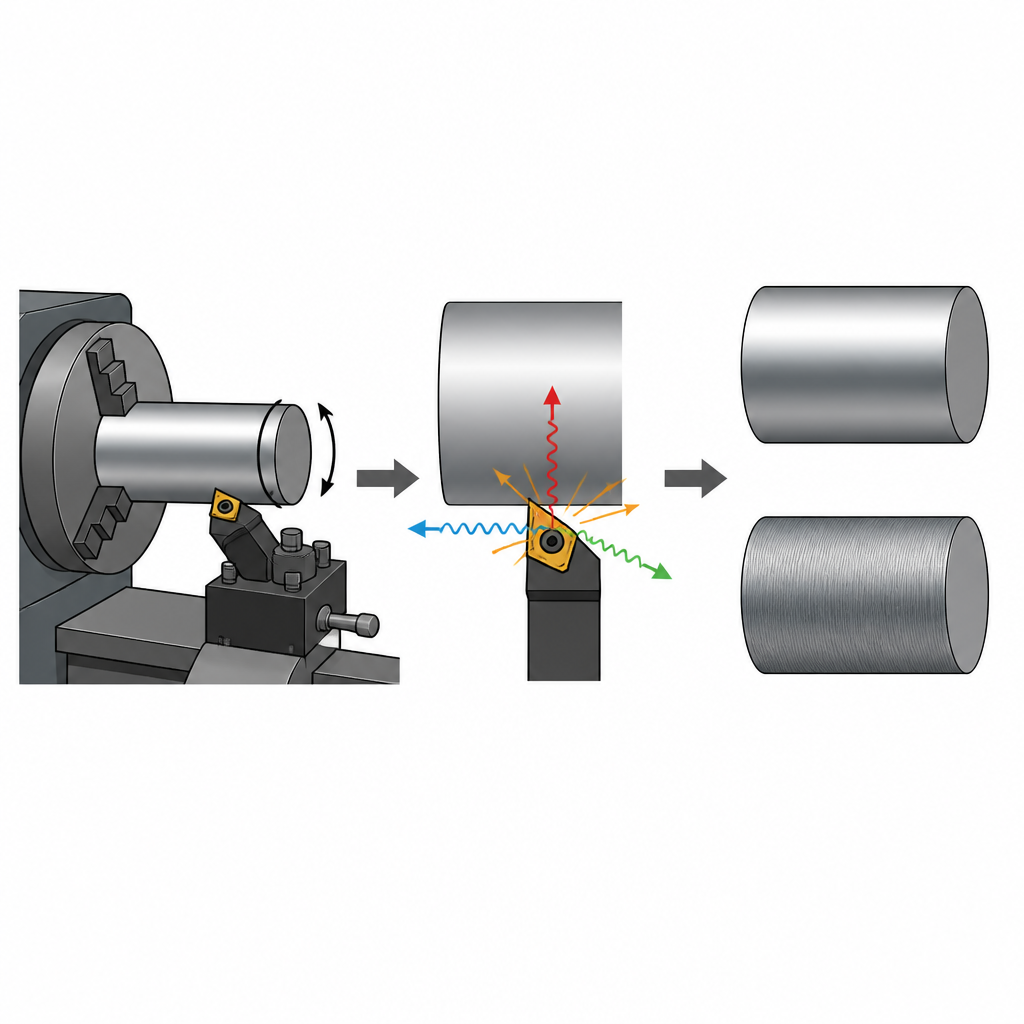
Inconel-625 is a nickel-based alloy prized for its strength and resistance to heat and corrosion, making it a favorite for demanding aerospace and engineering jobs. Those same traits make it difficult to cut cleanly on a lathe. As the cutting tool scrapes away metal in a process called turning, it can chatter, overheat, and wear out, leaving an uneven surface on the workpiece. Because traditional checks of surface roughness happen only after machining, any part that fails the requirement must be scrapped or reworked. For expensive materials like Inconel, that is a costly outcome.
Listening to the cut with sensors
The authors set up a conventional, non-computerized lathe and added two key sensors near the cutting zone. A three-direction accelerometer recorded how the tool and its surroundings vibrated as the metal turned. A dynamometer mounted under the tool holder measured the forces and twisting moments along three directions. After each cut, a separate handheld tester gently traced the surface and recorded three standard roughness measures, capturing average height variations and peak to valley differences on the finished cylinder. Together, these measurements connect what the machine “feels” while cutting with how smooth the surface turns out.
Building a large, flexible dataset
To make the dataset broadly useful, the team systematically varied three basic cutting settings: how fast the workpiece spun, how quickly the tool advanced along the cylinder, and how deep the tool cut into the metal. They chose three levels for each setting, producing 27 combinations in total. For every combination, they recorded vibration and force signals at a high rate of ten thousand samples per second, creating more than 382 million data points. Because the two sensor systems started and stopped at slightly different times, the authors later aligned the recordings using a change detection method that finds where the cutting actually begins and ends, trimming away idle portions of the signals.
What the signals reveal about surface quality
Once the signals were cleaned and synchronized, the researchers summarized each one using simple statistics such as average value, spread, skew and extremes. They then checked how these summary features related to the measured roughness of the finished surfaces. Many of these relationships were clearly nonzero, with some features increasing as surfaces became rougher and others decreasing. This pattern matches earlier findings in the machining literature and confirms that the sensor signals carry real information about surface quality, rather than being random noise.
Why this resource is useful for smart factories
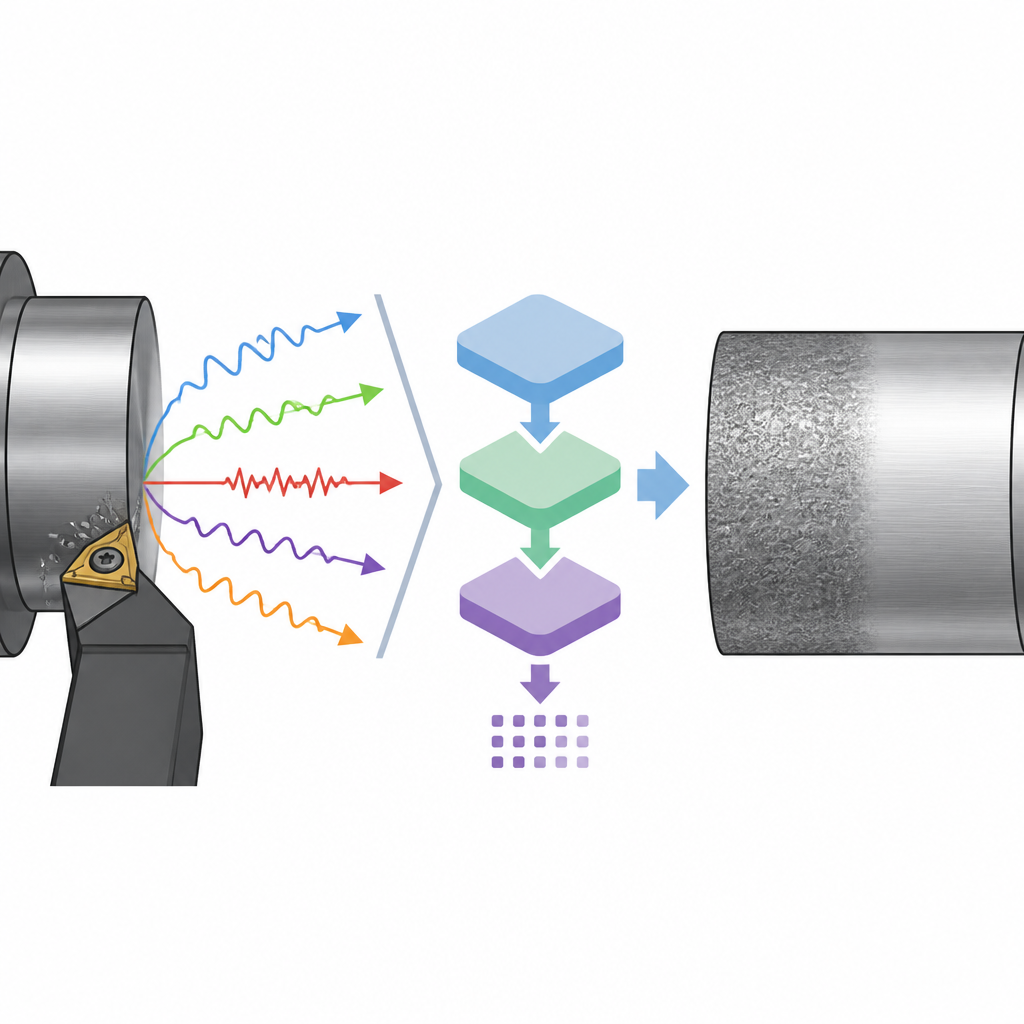
Because the experiments used an ordinary legacy lathe and off the shelf sensors, workshops that cannot afford modern computer controlled machines can still reproduce or extend this setup. The open dataset, together with example computer code to align and analyze the signals, gives researchers a solid foundation for training machine learning models that estimate surface roughness during cutting. In simple terms, the work shows how to turn raw vibrations and forces from a cutting tool into clues about how smooth the finished metal surface will be, helping move manufacturing toward smarter, less wasteful processes.
Citation: Sakthivel, N.R., Harigovind, H. & Nair, B.B. A Sensor based turning dataset for data-driven surface roughness estimation. Sci Data 13, 742 (2026). https://doi.org/10.1038/s41597-026-07061-1
Keywords: surface roughness, Inconel-625 turning, machining sensors, machine learning, intelligent manufacturing