Clear Sky Science · en
A repeat expansion in GOLGA8A is a major risk factor for atypical frontotemporal lobar degeneration with ubiquitin-positive inclusions
Why this discovery about early dementia matters
A small but devastating form of early-onset dementia strikes people in the prime of life, often in their 30s, 40s, or 50s, changing personality and behavior long before memory problems appear. Until now, doctors did not know why most of these cases seemed to arise out of the blue, with no clear family history or culprit gene. This study uncovers a major genetic risk factor for one such condition—called atypical frontotemporal lobar degeneration with ubiquitin-positive inclusions (aFTLD-U)—by pinpointing a strange stretch of DNA that is abnormally repeated in many patients. The work opens a new window into how hidden instabilities in our genome can quietly set the stage for severe brain disease.

A rare dementia that hits the frontal brain
Frontotemporal dementia (FTD) is one of the most common causes of dementia before age 65. Unlike Alzheimer’s disease, which mainly affects memory, FTD often begins with dramatic changes in personality, judgment, and social behavior. aFTLD-U is a rare pathological subtype within this group. People with aFTLD-U usually develop severe behavioral symptoms but relatively preserved language and movement. Brain scans reveal striking shrinkage of the frontal lobes and deep brain structures that help control motivation and habits. Under the microscope, affected brain cells accumulate abnormal clumps of certain RNA-binding proteins known collectively as FET proteins. Yet, in contrast to other FTD subtypes, no clear disease-causing gene had been identified for these patients, who mostly appeared to be “sporadic” cases.
Hunting for a hidden risk region in the genome
To track down genetic contributors, researchers formed an international consortium and gathered DNA and brain samples from people who had been definitively diagnosed with aFTLD-U at autopsy. They compared 59 such cases to more than 3,000 control individuals using a genome-wide association study, a scan that searches millions of DNA markers for differences between patients and controls. One region on chromosome 15 (called 15q14) lit up with an exceptionally strong signal, pointing to two related patterns of genetic variation, or haplotypes, that were far more common in patients than in healthy people. These risk haplotypes lie near a pair of nearly identical genes, GOLGA8A and GOLGA8B, in a part of the genome that is notoriously hard to analyze because it contains many duplicated and rearranged segments.
A long, unstable DNA repeat emerges as the key player
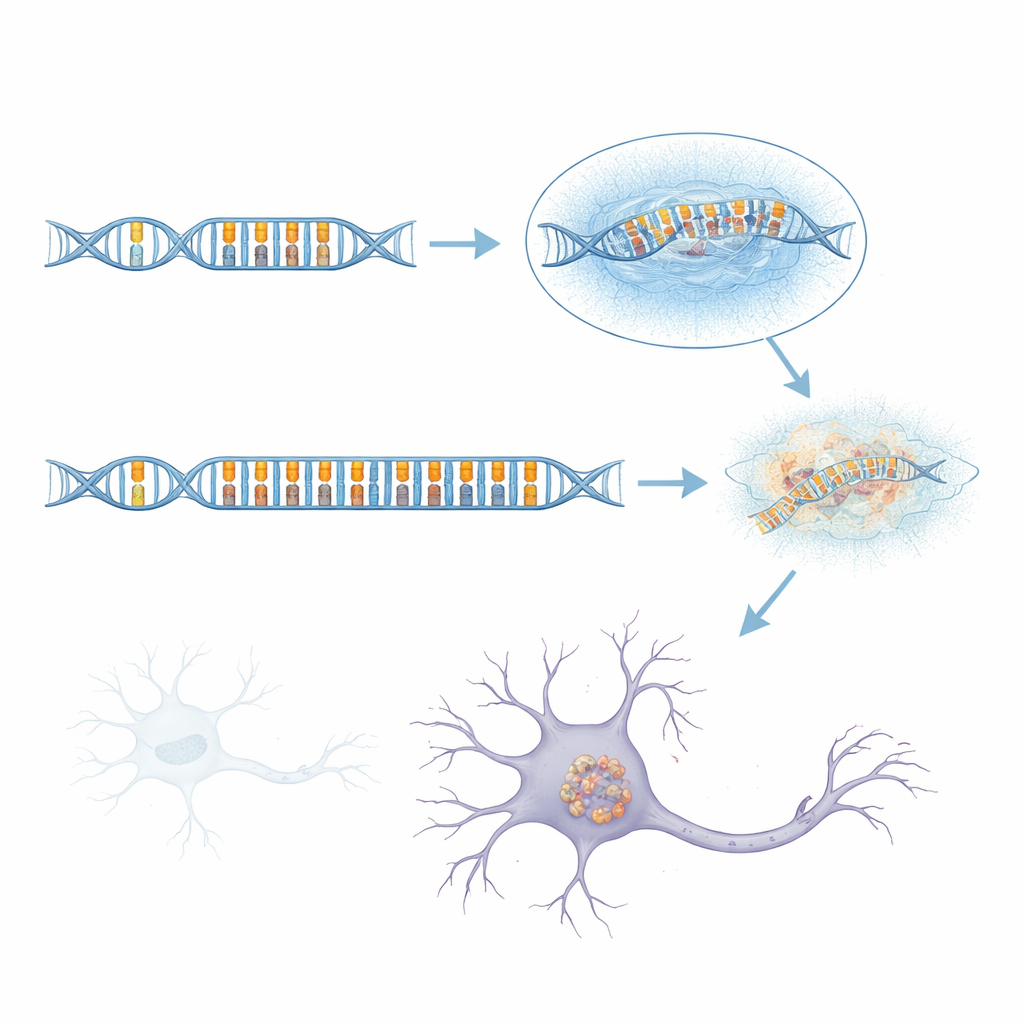
Because standard short-read sequencing struggles in this complex region, the team turned to long-read sequencing, which can read much larger chunks of DNA in a single pass. Examining more than 1,700 genomes, including many aFTLD-U cases and comparison groups with other brain diseases, they discovered that the risk haplotypes almost always carried an unusually long “tandem repeat” inside an intron of the GOLGA8A gene. Tandem repeats are like stutters in the DNA sequence, where small units of letters are copied over and over. In healthy people, this repeat is short; in many aFTLD-U patients, it was massively expanded, sometimes stretching over 2,000 DNA letters. These expanded versions were not all alike, but the ones most strongly linked to disease were dominated by a simple two-letter pattern based on the nucleotides C and T repeated in pairs. When the researchers classified carriers by repeat length and the percentage of CT content, long, CT-rich expansions predicted aFTLD-U much better than the original marker variants.
Variation, inheritance, and subtle risk
The story is not as simple as a single mutation that always causes disease. Some people in the general population, including relatives of aFTLD-U patients, carried large CT-heavy expansions in GOLGA8A yet had not developed dementia—at least not by the time they were studied. The expanded repeat also showed signs of instability: its length varied from cell to cell and from one tissue to another, suggesting that it can continue to grow or shrink over a person’s lifetime. Intriguingly, about 70% of aFTLD-U patients in the cohort were male, hinting that sex-related biological factors or environmental exposures may influence whether a carrier actually becomes ill. Moreover, roughly 40% of confirmed aFTLD-U cases did not show this particular expansion at all, implying that other, as-yet-undiscovered genetic or environmental triggers can produce the same brain pathology.
What this means for understanding and diagnosing disease
Although scientists do not yet know how this intronic GOLGA8A repeat harms brain cells, its location and composition suggest several possibilities. The expanded DNA might alter how nearby genes are switched on and off, produce unusual RNA molecules that trap vital proteins, or form toxic structures inside neurons. Whatever the precise mechanism, the presence of a very long CT-rich repeat in nearly 60% of aFTLD-U cases marks it as a major risk factor, on par with strong genetic influences in more familiar neurodegenerative diseases. In practical terms, testing for the chromosome 15 haplotypes and the GOLGA8A repeat could help identify people with early behavioral symptoms who are likely to have this specific subtype of FTD, aiding diagnosis and research. More broadly, this work highlights how cryptic repeat expansions—long stretches of repeated DNA hiding in difficult genomic terrain—can underlie apparently sporadic brain disorders, and it sets the stage for future studies to unravel their biology and, potentially, target them therapeutically.
Citation: De Coster, W., Van den Broeck, M., Baker, M. et al. A repeat expansion in GOLGA8A is a major risk factor for atypical frontotemporal lobar degeneration with ubiquitin-positive inclusions. Nat Genet 58, 726–736 (2026). https://doi.org/10.1038/s41588-026-02537-7
Keywords: frontotemporal dementia, repeat expansion, GOLGA8A, neurodegeneration, genetic risk