Clear Sky Science · en
A comprehensive dated phylogeny of China’s vascular plants reveals a hidden global biodiversity hotspot
Why This Hidden Garden Matters
China is home to an astonishing variety of plants, from ancient “living fossils” to species that evolved only recently. Yet until now, scientists lacked a complete picture of how this botanical wealth is arranged across the country and how it came to be. This study stitches together genetic data, fossil-based timelines, and huge maps of plant distributions to reveal not only when China’s plants evolved, but also where the most irreplaceable species live today. The work uncovers a surprising result: Central China, a region better known for dense cities and farmland than for wild nature, turns out to be a global treasure trove of unique plants that is rapidly disappearing.
Tracing Family Trees Through Deep Time
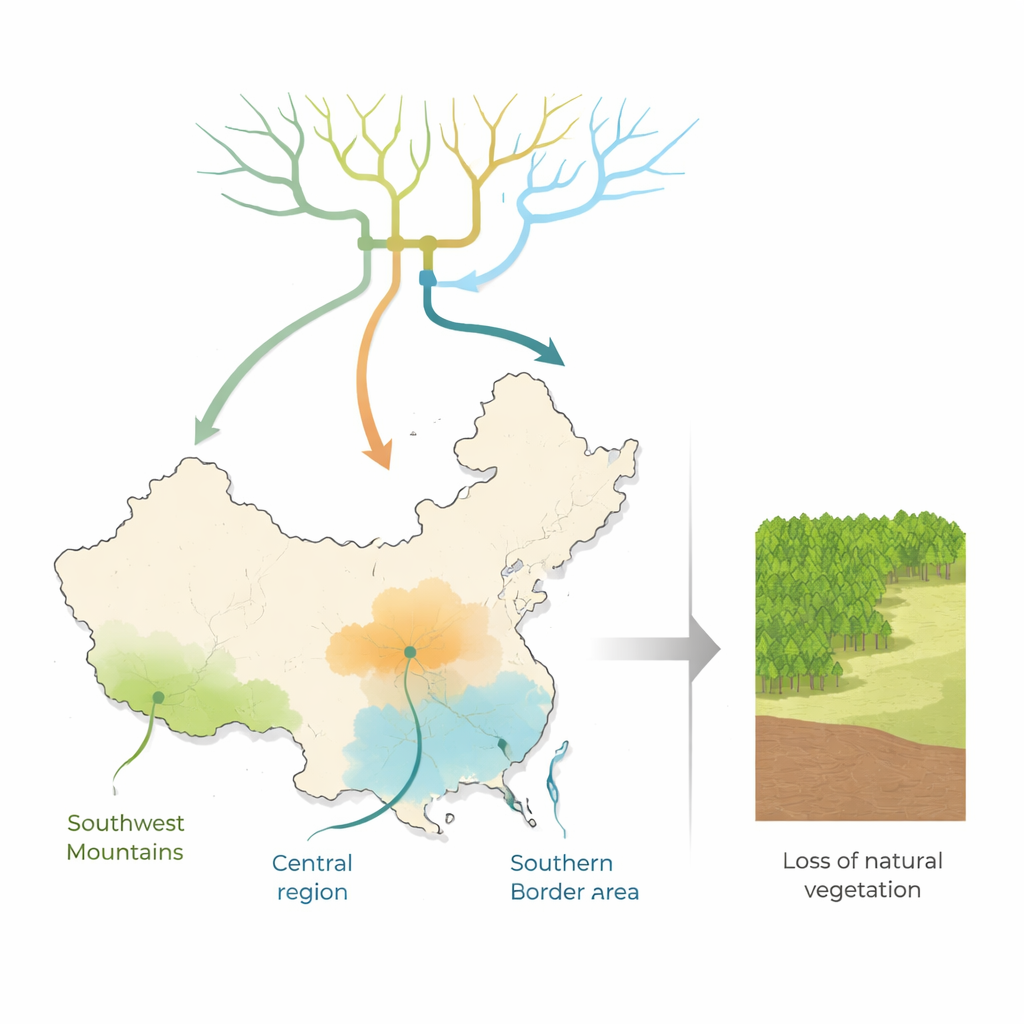
The researchers assembled the most comprehensive evolutionary “family tree” yet for China’s vascular plants—plants with specialized tissues to move water, such as trees, shrubs, and ferns. Using DNA from nearly 18,000 species and five genes, they built a time-calibrated tree that shows when each lineage branched off from its relatives. They then matched this tree to more than 1.4 million records of where plants actually grow across China. This allowed them to pinpoint which species occur only in China (endemics), how old those lineages are, and where on the map both ancient relicts and recently evolved species are concentrated.
How Ice Ages and Mountains Shaped Today’s Flora
The evolutionary timelines reveal that many plant genera in China arose during the Oligocene and Miocene, tens of millions of years ago, when tectonic uplift and shifting monsoon patterns reshaped Asian climates. A particularly important burst of diversification occurred about 19 million years ago, especially in the uplifted Hengduan Mountains of southwest China. More recently, during the Pleistocene ice ages over the past few million years, repeated cycles of cooling and warming pushed plant populations up and down mountains and north and south across the landscape. These climatic swings helped generate a wave of new species, especially in southern China, as isolated populations diverged and sometimes hybridized when conditions changed again.
Where Old Relics and Newcomers Now Live
By layering evolutionary ages onto geography, the team identified three major centers where China’s endemic plants are especially concentrated: the Hengduan Mountains, Central China, and the boundary region of Yunnan, Guizhou, and Guangxi. The Hengduan Mountains stand out for their many young, recently diversified lineages, making them a cradle of new species. In contrast, Central China and the Yunnan–Guizhou–Guangxi region host more ancient, long-surviving lineages, including iconic relict trees such as ginkgo and dawn redwood. Using a method that weights both how rare a lineage is and how much evolutionary history it represents, the authors also mapped “phylogenetic endemism” and showed that centers defined by sheer species counts and those defined by evolutionary uniqueness only partly overlap, highlighting different conservation values.
A Hidden Hotspot in a Human-Dominated Heartland
When the researchers compared these centers to existing protected areas and previously recognized global hotspots, a striking gap appeared. Western China’s mountain hotspots align well with large nature reserves and global priorities, but Central China does not. This region, spanning about 1.54 million square kilometers across provinces such as Hubei, Hunan, and Jiangxi, contains more than 14,000 vascular plant species, including at least 2,024 that occur nowhere else. Yet over 93% of its original subtropical evergreen broad-leaved forest has been lost to cities, agriculture, and infrastructure, and only about 7% of the region is formally protected. Despite housing both ancient relicts and younger species—and supporting rich animal life such as amphibians and flagship mammals—Central China has remained largely invisible in global conservation planning.
Steps Toward Saving a Living Museum
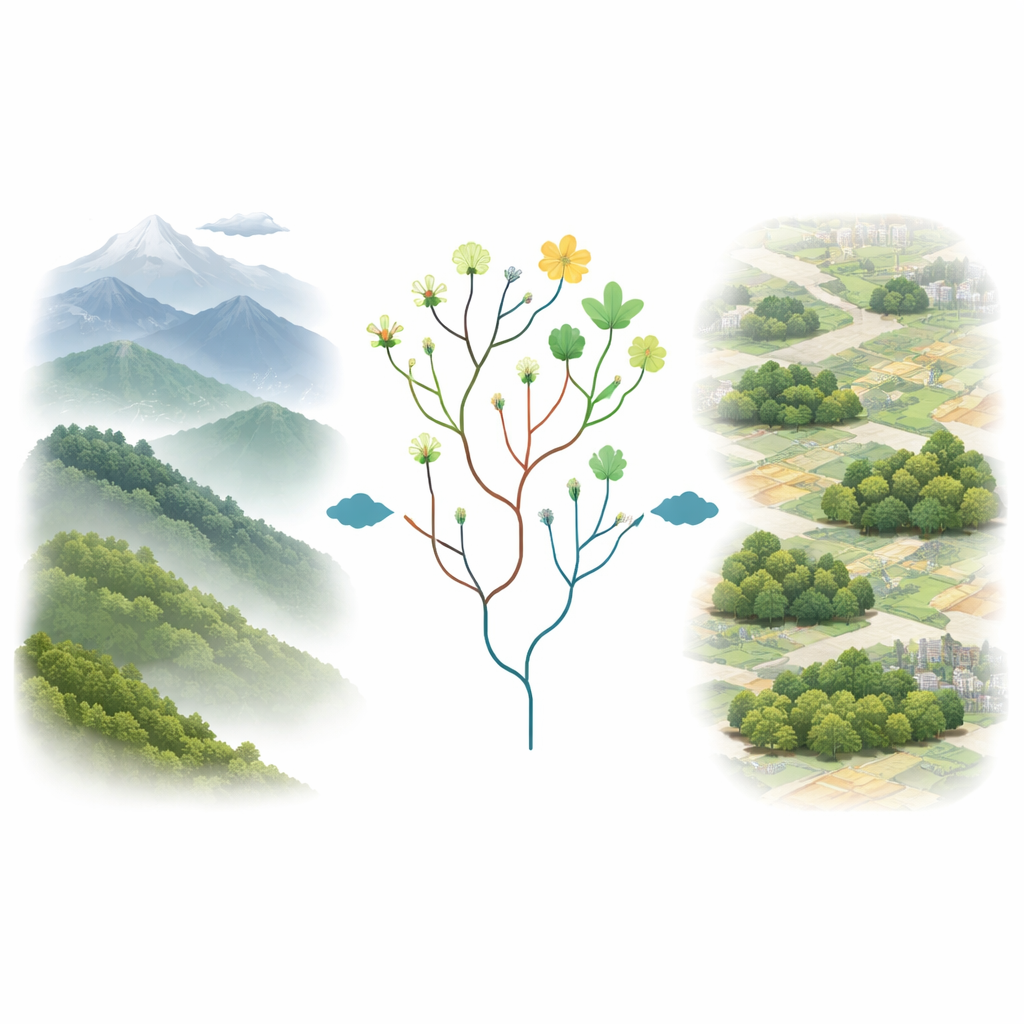
Based on strict international criteria, a region qualifies as a biodiversity hotspot if it combines exceptional numbers of unique plant species with extensive loss of natural habitat. Central China clearly meets these standards, yet it is not currently recognized alongside better-known hotspots like the Himalaya or Indo–Burma. The authors argue that officially designating Central China as a global biodiversity hotspot would raise its profile and attract much-needed effort to protect remaining forest patches, expand and connect national parks, and encourage locally led conservation in working landscapes. Their work shows that to safeguard life on Earth, conservation must consider not just how many species live in a place, but how much evolutionary history those species embody—and that some of the world’s most precious biological heritage can hide in plain sight within heavily populated regions.
Citation: Feng, YL., Hu, HH., Liu, B. et al. A comprehensive dated phylogeny of China’s vascular plants reveals a hidden global biodiversity hotspot. Nat Ecol Evol 10, 794–806 (2026). https://doi.org/10.1038/s41559-026-03025-1
Keywords: biodiversity hotspots, Chinese flora, endemism, plant evolution, conservation planning