Clear Sky Science · en
Scalable conflict-free bandit algorithm using a quantum optical setup
Light Helping Us Share Without Clashing
Many modern technologies, from Wi‑Fi networks to online advertising, must juggle multiple users who all want the best option at the same time. When two people or devices unknowingly make the same choice, they interfere with each other and everyone does worse. This paper shows how a carefully designed beam of quantum light can act as an impartial referee, quietly steering two independent decision makers toward good choices while preventing them from picking the same option—without any direct communication between them.
Choices, Rewards, and the Problem of Crowding
Engineers often model repeated decision making with the “multi‑armed bandit” framework, inspired by rows of slot machines. Each option gives a reward with some hidden probability, so a player must balance trying different options to learn about them against sticking with those that seem best. The challenge becomes far harder when several players face the same options and each wants the high‑payoff ones. If they pick the same option at the same time, they must share the reward. This situation, called the competitive multi‑armed bandit problem, captures real‑world tasks such as assigning radio frequencies to wireless devices or allocating servers to data traffic, where too many users piling onto the same channel harms everyone.
Using Twisted Light as a Shared Decision Engine
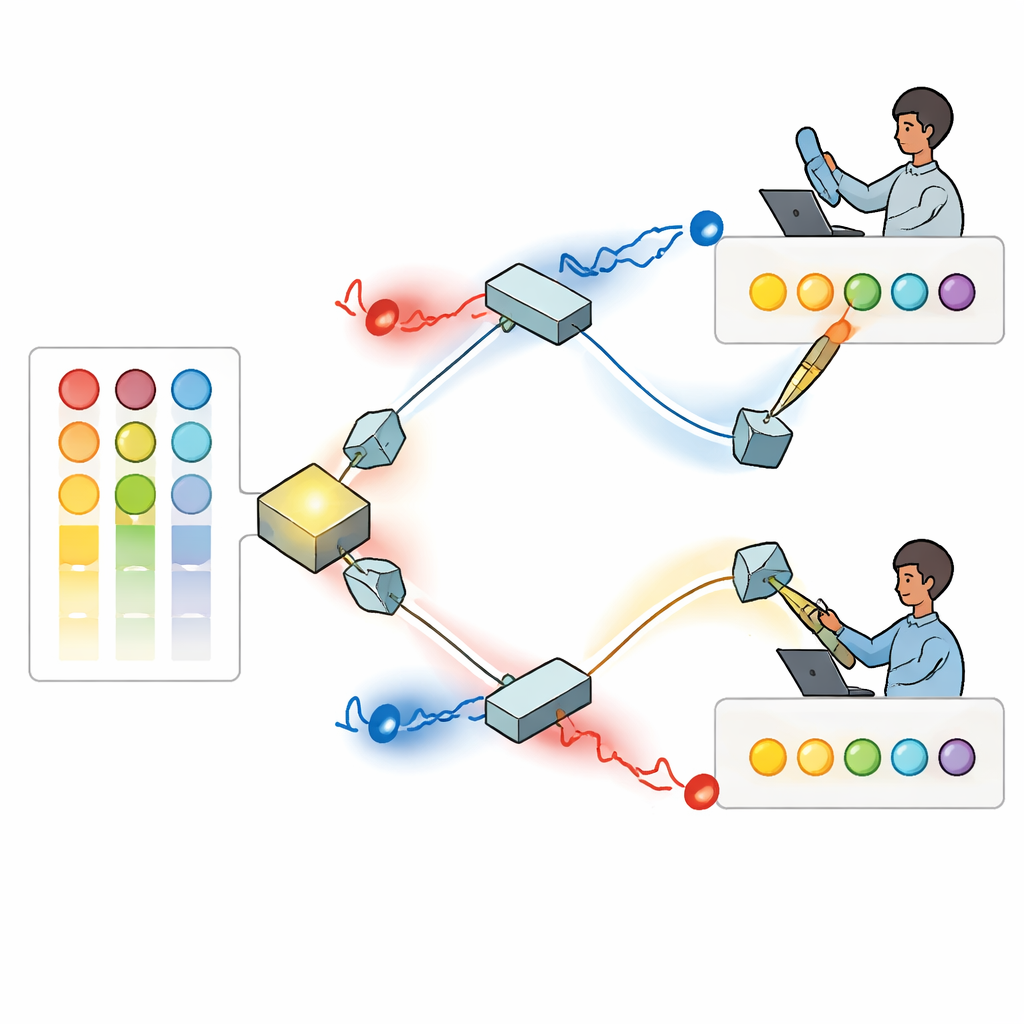
The authors build a solution using single photons—particles of light—whose wave patterns swirl like tiny corkscrews, a property known as orbital angular momentum. Because these twisted light patterns can be distinguished and, in principle, support many distinct “modes,” they provide a large menu of tags that can stand in for different choices. In the proposed setup, a source generates a pair of linked photons that are routed to two separate players through an arrangement of mirrors and beam splitters. Each player passes their photon through a programmable device that shapes its twisted pattern so that the brightness of each mode reflects how strongly that player currently prefers each option, based on their own past wins and losses.
Quantum Interference to Prevent Collisions
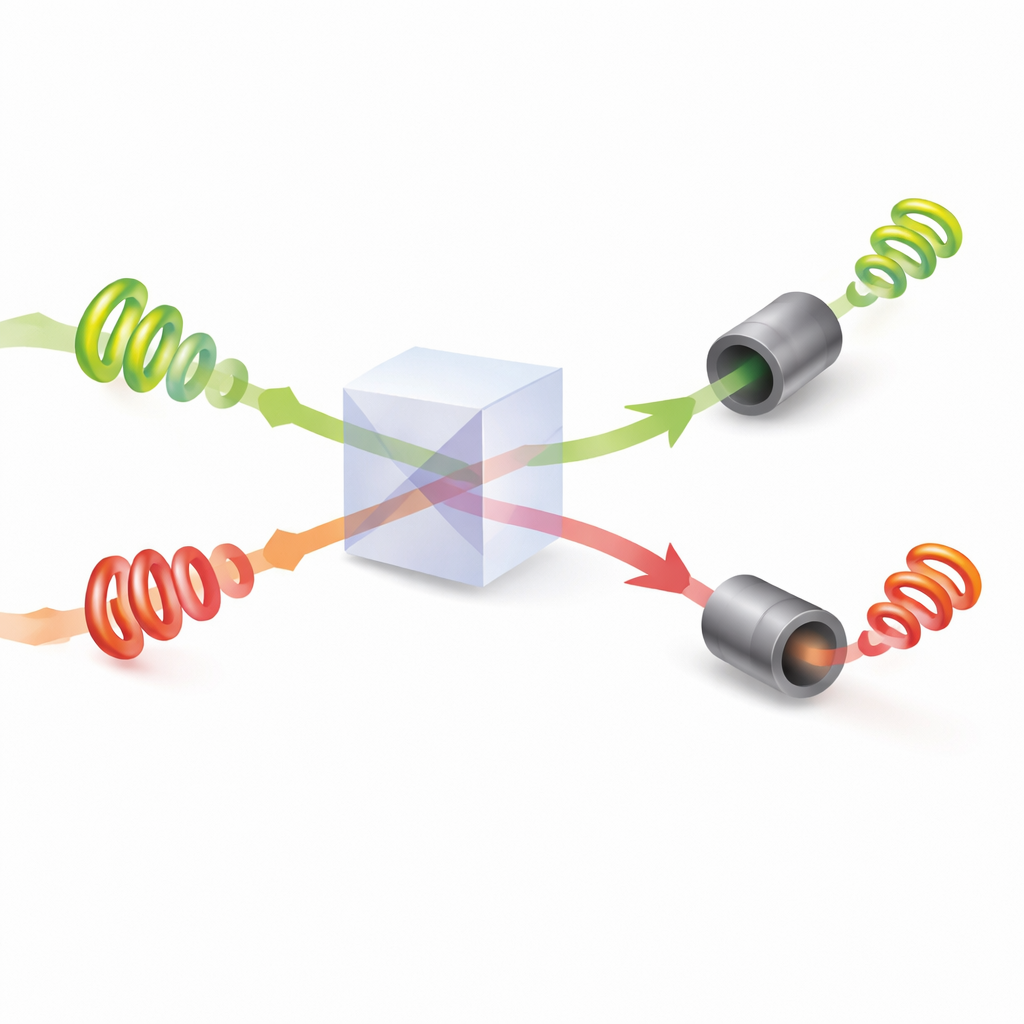
After their patterns are set, the photon pair meets at a beam splitter where quantum interference occurs: the combined light waves can reinforce or cancel each other depending on their relative twists and phases. The researchers show how to adjust the hidden phase angles of the light so that, whenever the two photons emerge from different output paths, they are guaranteed to carry different twist values. Each player then measures the absolute amount of twist on their photon and interprets that value as a specific option to choose. Because of the interference, they never receive the same instruction when both photons are successfully detected. In effect, the physics of light itself enforces a no‑collision rule, something that is impossible to reproduce with ordinary, classical light.
Learning While Scaling to Many Options
The optical system is coupled to a simple learning rule that gradually shifts each player from broad exploration toward favoring better‑paying options over many rounds. Crucially, unlike earlier optical schemes that relied on dimming the light to encode preferences—wasting more and more photons as the number of options grew—this design embeds the preferences directly in the twist pattern of each photon. The authors analyze how often the photons exit in separate paths, how closely the resulting choices match the players’ intended preference patterns, and how much “regret” accumulates, meaning lost reward compared with an ideal strategy. In large computer simulations with five and ten options, their method consistently achieved higher rewards, adapted more quickly, and was less sensitive to tuning knobs than the previous approach.
What This Means for Real‑World Systems
Beyond its mathematical performance, the approach hints at a new style of hardware where light does part of the thinking. Because the coordination happens physically through interference rather than through digital messages, two devices can avoid stepping on each other’s toes without revealing their internal priorities. The authors argue that such a conflict‑free, high‑throughput, and privacy‑preserving decision engine could one day be built into optical links in data centers or into radio systems that must rapidly grab idle channels with minimal chatter. Although the current work is demonstrated in simulation for two players, it showcases how the quirks of quantum optics can be harnessed to tackle complex learning and coordination tasks in ways that standard electronics cannot easily match.
Citation: Konaka, K., Röhm, A., Mihana, T. et al. Scalable conflict-free bandit algorithm using a quantum optical setup. npj Quantum Inf 12, 44 (2026). https://doi.org/10.1038/s41534-026-01201-6
Keywords: quantum optics, reinforcement learning, multi-armed bandit, orbital angular momentum, photonic decision-making