Clear Sky Science · en
Ice-sheet hydro-fracture not advanced inland by lower-elevation lake drainages in Kalaallit Nunaat
Why ice lakes on Greenland matter
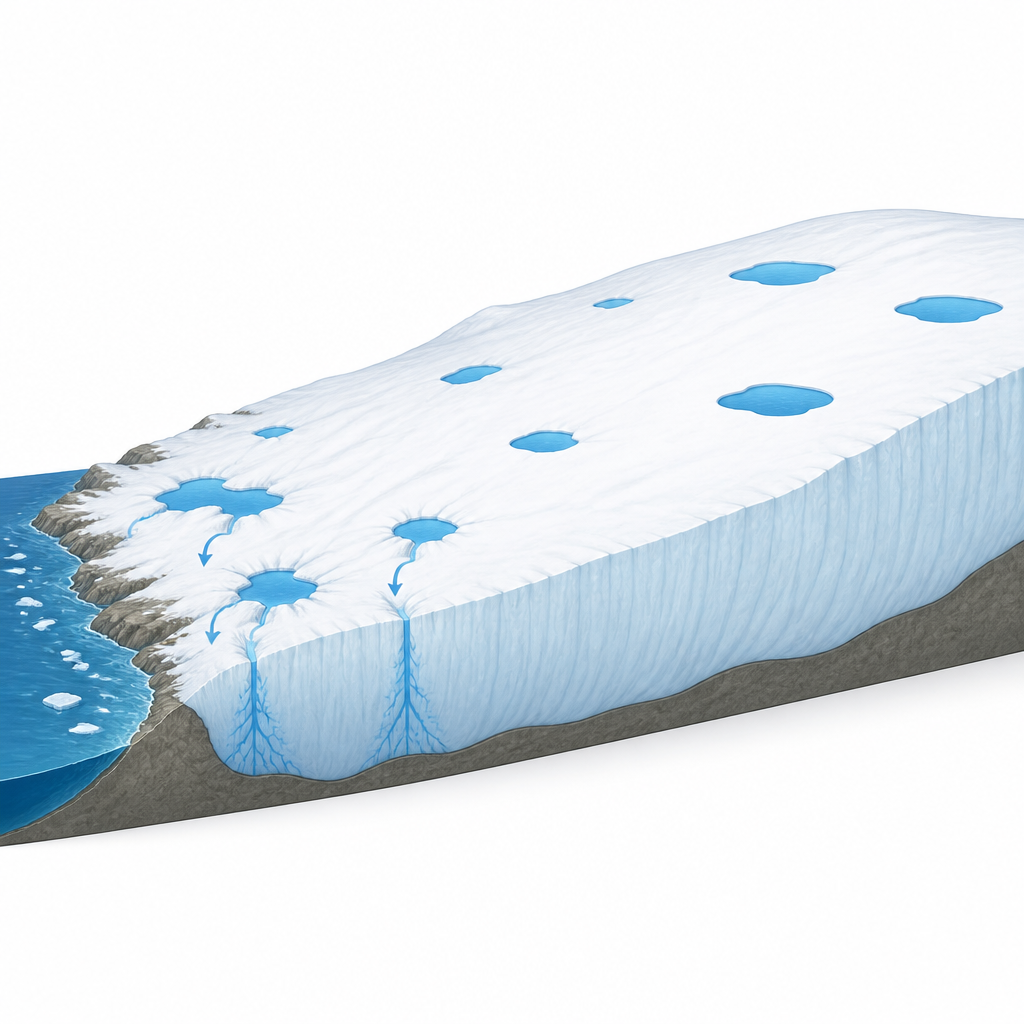
The surface of the Greenland ice sheet is dotted with bright blue lakes that appear each summer as snow and ice melt. Scientists worry that when these lakes suddenly drain, water can punch down through the ice, reach the bed, and briefly speed up ice flow toward the ocean. If this sort of cracking marched inland faster than climate warming itself, it could destabilize large parts of the ice sheet. This study asks a focused question: do lake drainages at lower elevations help trigger similar cracking far inland, or does inland change mostly track local warming?
How water can crack thick ice
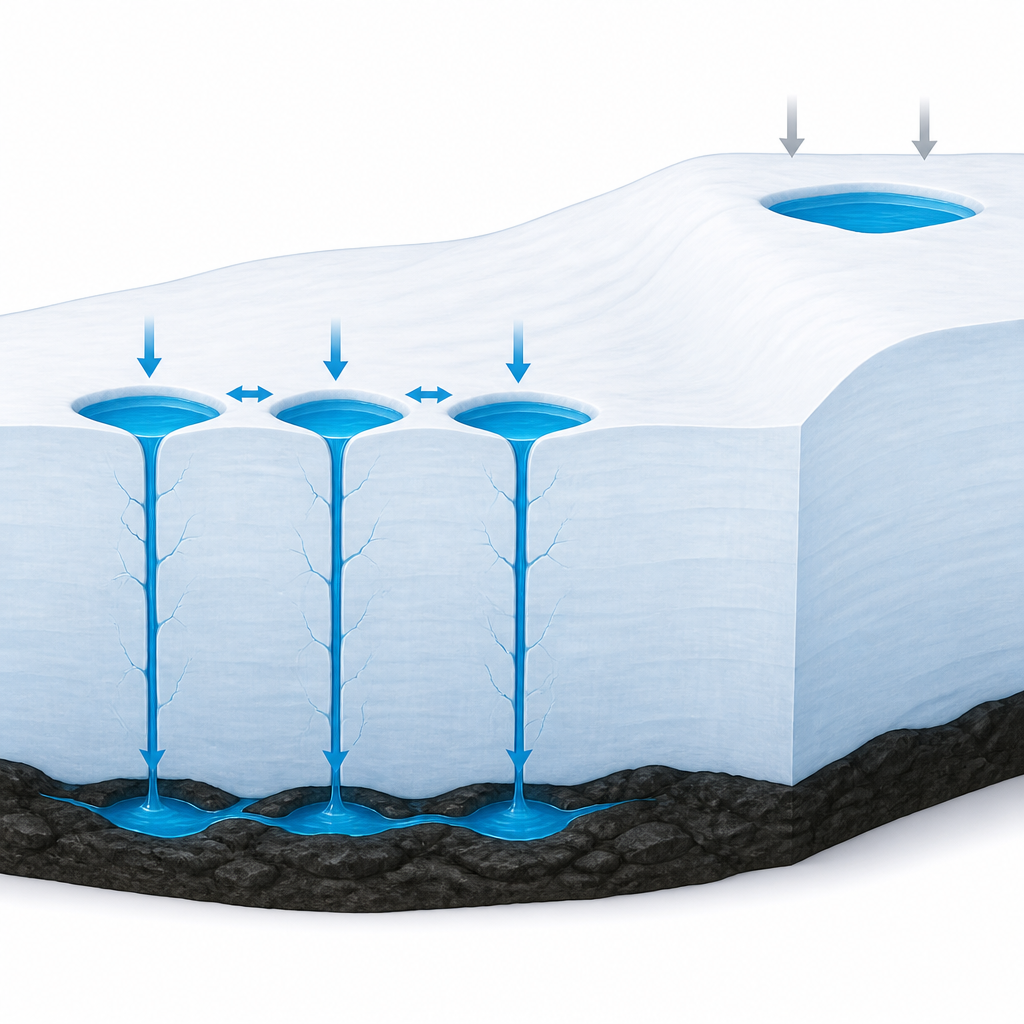
When a lake on the ice sheet drains in a few hours, water can force open a vertical fracture that reaches all the way to the base. This process, called hydro-fracture, briefly lifts and slides the ice as water rushes underneath. Earlier ideas suggested that such events could set off a chain reaction: one dramatic drainage would alter stresses in the ice and in the hidden water system below, nudging distant lakes toward their own sudden drainages. If true over tens of kilometers, this would give surface meltwater a shortcut inland, letting it reach deeper, thicker ice well ahead of where climate alone would place it.
Watching lakes and ice motion in detail
To test this chain-reaction idea, the researchers combined precise ground instruments with satellite images in western Greenland. They installed a network of 22 Global Navigation Satellite System stations around groups of lakes spanning about 55 kilometers from lower to higher elevations. These instruments recorded ice motion every 15 seconds, allowing the team to see tiny changes in stretching and squeezing of the ice. At the same time, they used high-resolution satellite images to track roughly 200 lakes each year and to classify how each one drained: by sudden cracking straight down, by feeding a vertical shaft called a moulin, by quietly spilling over into surface streams, or by simply freezing over without visible drainage.
What the lakes actually did
Only about one eighth of the lakes drained by cracking straight down through the full ice thickness. Most lakes simply overflowed into surface rivers, sometimes into another lake, and a smaller share drained into local moulins or froze in place. The team then looked for groups of fast-draining, crack-driven events that occurred close together in time and checked whether those groups were larger than would be expected by chance. They did find a few such clusters, usually involving neighboring lakes at similar elevations. In some cases, models and GPS data suggest that water entering at one lake could raise stresses or send a local flood under nearby lakes, plausibly triggering additional cracks. But these clusters always involved only a handful of lakes and covered short distances.
Inland ice stayed calm
The crucial test was whether dramatic drainage and flooding at lower elevations disturbed the ice farther inland. GPS stations straddling higher-elevation lake basins showed that as lower lakes cracked and sent water racing below the ice, the inland ice experienced no detectable change in stretching beyond very small, local wobbles. Many inland lakes had enough water volume to crack, yet they either overflowed gently or froze without draining. Statistical tests and physical models both indicate that any stress changes from distant lake drainages fade within a few ice thicknesses, and that apparent timing clusters often arise simply because lakes at similar heights tend to fill and drain during the same part of the melt season.
What this means for future sea level
For a non-specialist, the takeaway is that sudden drainages of lower lakes on Greenland do not appear to pull inland lakes into a rapid chain reaction. Instead, the ability of surface meltwater to punch through the ice and reach the bed seems to move inland step by step with the warming-driven advance of melt itself. Hydro-fracture remains an important local process that can briefly speed up ice flow, but this study finds no evidence that it is racing ahead of climate warming to open deep inland shortcuts for water at a regional scale.
Citation: Stevens, L.A., Nettles, M., Larochelle, S. et al. Ice-sheet hydro-fracture not advanced inland by lower-elevation lake drainages in Kalaallit Nunaat. Nat Commun 17, 4598 (2026). https://doi.org/10.1038/s41467-026-73033-z
Keywords: Greenland ice sheet, supraglacial lakes, hydrofracture, meltwater drainage, climate warming