Clear Sky Science · en
Trees halve urban heat island effect globally but unequal benefits only modestly mitigate climate-change warming
Why city trees matter for your summer heat
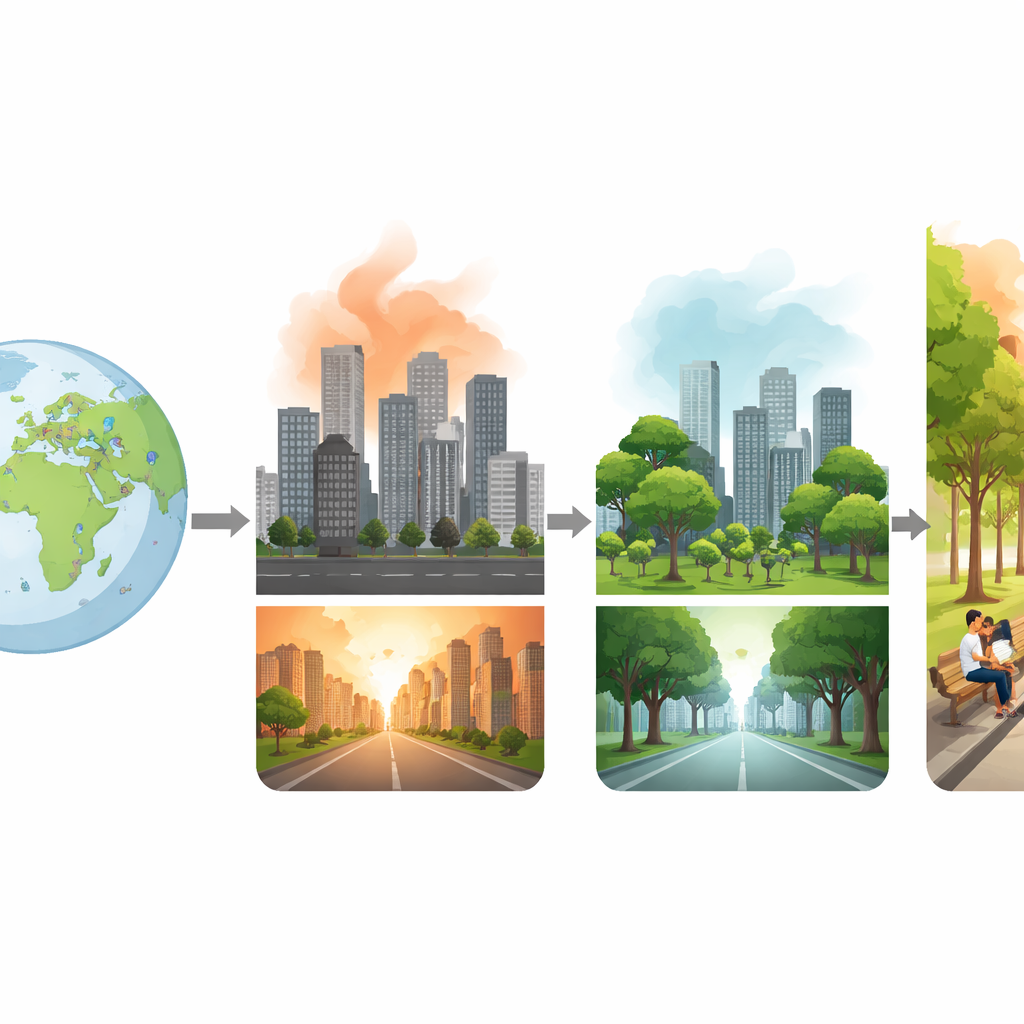
On hot summer days, city streets can feel like giant ovens. This extra heat, compared with nearby countryside, is called the urban heat island effect. Many people know that trees bring shade and beauty, but this study asks: how much do trees really cool cities worldwide, who benefits from that cooling, and can planting more trees keep up with climate change? The answers matter for anyone living in a town or city, especially as heat waves become more frequent and more dangerous.
How cities heat up and how trees fight back
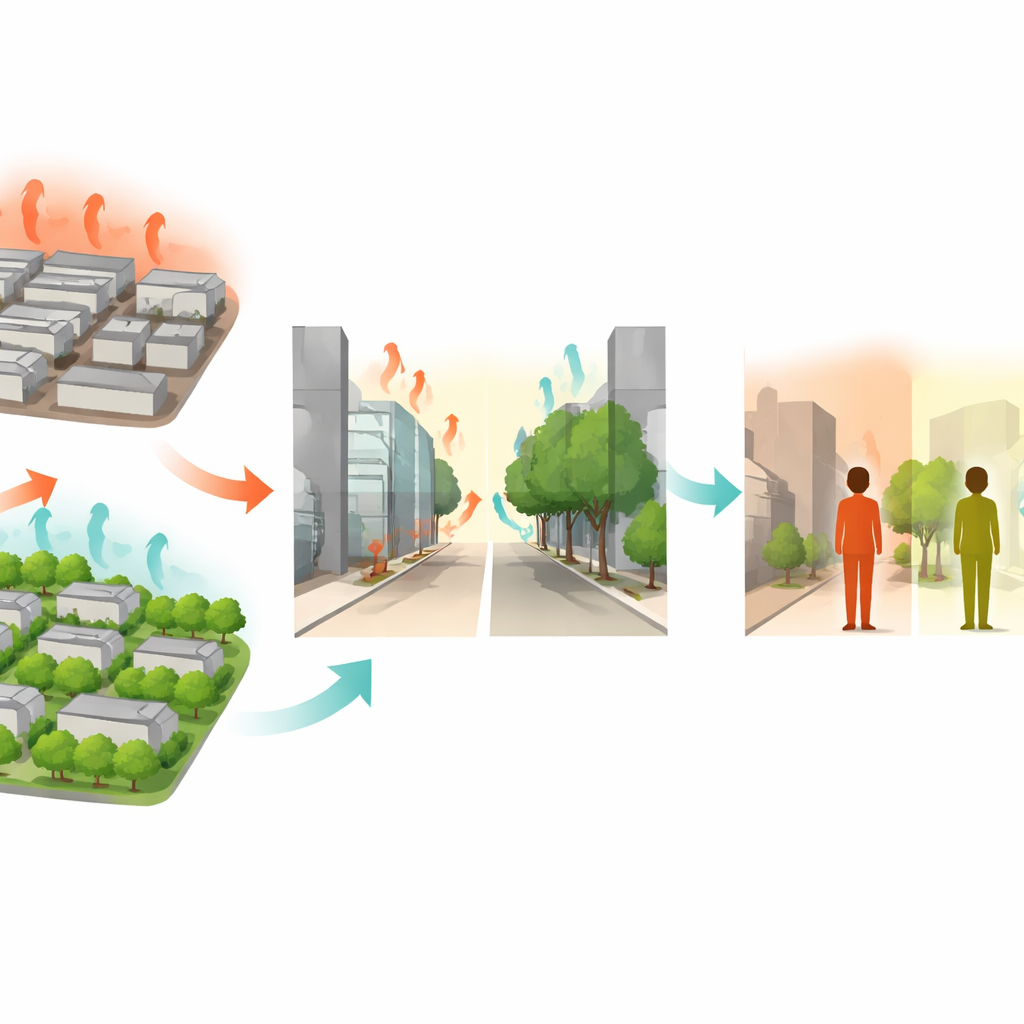
Cities are full of concrete, asphalt, and dark roofs that soak up sunlight during the day and then release that stored heat into the air. This makes urban air temperatures higher than in nearby rural areas, putting millions of people at greater risk of heat-related illness and death. Trees counter this in two main ways. Their leaves provide shade that keeps buildings and pavement from heating up as much, and they cool the air through evapotranspiration, a process similar to people sweating. Past local studies suggested trees can cool the air by one to two degrees Celsius right under their canopies, but until now, no one had measured how big this effect is across nearly all major cities on Earth.
A global check-up on city trees and heat
The researchers examined 8,919 large urban areas around the world, using satellite images, detailed maps of land cover, and high-resolution air temperature estimates. They built a statistical model to see how much local air temperature changes when tree cover, pavement, and other land types vary within each urban area. They also ran a detailed physical model for three cities in very different climates—arid Phoenix, semi-arid Lisbon, and humid Gothenburg—to zoom in on neighborhood-scale patterns and to look at a more complete heat-stress measure that combines temperature, humidity, sunlight, and wind.
What trees already do for city heat
The study finds that existing urban trees are already doing a lot. On average, trees cut about 41–49 percent of the maximum air-temperature urban heat island that would exist if there were no urban tree cover at all. Globally, current tree canopy lowers summer daytime air temperature by about 0.15 °C when weighted by where people actually live, with some places seeing local reductions up to 2.7 °C. Around 914 million people currently experience at least a quarter of a degree of cooling thanks to urban trees, and more than 200 million enjoy half a degree or more. However, the biggest cooling tends to occur in suburbs and in wealthier, cooler countries, where trees are more common. Densely packed, often poorer neighborhoods usually have fewer trees and less of this natural relief.
Why more trees alone cannot beat climate change
The team also asked how tree cooling stacks up against global warming. Using climate model projections for a mid-century world under a moderate emissions pathway, they estimate that average summer daytime air temperatures in cities will rise by about 1.5 °C by around 2050. Today’s tree cover cancels out only about one-tenth of that future warming. Even in a generous scenario where every neighborhood reaches a “maximum plausible” tree cover, global urban tree cooling would roughly double to about 0.30 °C—still only around one-fifth of the expected climate-driven temperature increase. In other words, even very ambitious urban tree planting, while helpful, cannot fully counteract rising heat from greenhouse gas emissions.
Who gets the shade, and who is left in the sun
The benefits of tree cooling are not shared equally. High-income countries tend to have more urban trees and therefore more cooling. Low-income countries, many of which are already in hotter and drier climates and have less access to air conditioning, have less tree cover and less relief from heat. Within cities, low-income residents often live in denser areas with more pavement and fewer trees. The study finds that only a small fraction of people in low-income countries receive even modest cooling from trees today, though that share could rise sharply if planting focused on crowded, treeless neighborhoods. Interestingly, in drier climates, each extra bit of tree cover cools the air more efficiently than in humid climates, especially when trees replace large expanses of bare pavement.
What this means for future city living
For a layperson, the key message is that trees are powerful but limited tools for cooling cities. They already cut the urban heat island roughly in half and protect hundreds of millions of people from even higher temperatures. Yet even a major global push to plant more trees in cities can only modestly soften the extra heat we expect from climate change. To keep city life bearable in the coming decades, communities will need both: aggressive cuts in greenhouse gas emissions to slow overall warming, and smart local action—especially planting and caring for trees in dense, low-income neighborhoods—to share cooling benefits more fairly and help people adapt to hotter summers.
Citation: McDonald, R.I., Chakraborty, T., Endreny, T.A. et al. Trees halve urban heat island effect globally but unequal benefits only modestly mitigate climate-change warming. Nat Commun 17, 3569 (2026). https://doi.org/10.1038/s41467-026-71825-x
Keywords: urban heat island, urban trees, heat inequality, climate change adaptation, city greening