Clear Sky Science · en
A snow-fire bridge mechanism for the 2025 Southern California winter wildfire
When Distant Snow Affects Winter Fires
Wildfires in Southern California are usually a summer or autumn menace, not a winter surprise. Yet in January 2025, a fast moving blaze became the costliest wildfire event in recorded history for the region. This study explains how a shortage of early winter snow thousands of miles away in western Eurasia can help set the stage for such an off season catastrophe, revealing a hidden climate link between far away snow fields and fire weather in California.
A Rare Winter Fire Disaster
California has long lived with fire, but warming temperatures have stretched its fire season later into the year and now, at times, into winter. The January 2025 Southern California fires killed dozens of people and caused hundreds of billions of dollars in damage, outstripping many better known summer blazes. Winter fires can be especially destructive because strong seasonal winds spread flames quickly while firefighting resources are often not positioned for large outbreaks. Understanding why this midwinter event was so severe is vital for public safety planning in a changing climate.
Clues from Fire Weather and Distant Snow
Instead of counting burned acres, the researchers relied on a fire weather index that combines heat, dryness, wind, and recent rain to estimate how easily fires can start and spread. They focused on conditions in December and January, around the time of the 2025 fires. When they compared years with especially high fire weather values in Southern California to different climate patterns around the globe, one signal stood out: low November–December snow cover over western Eurasia. Years with less snow in that region tended to be followed a month or two later by hotter, drier, windier conditions that favor fires in Southern California, even after accounting for well known influences such as the El Niño–La Niña cycle.
A Climate Bridge Across the Pacific
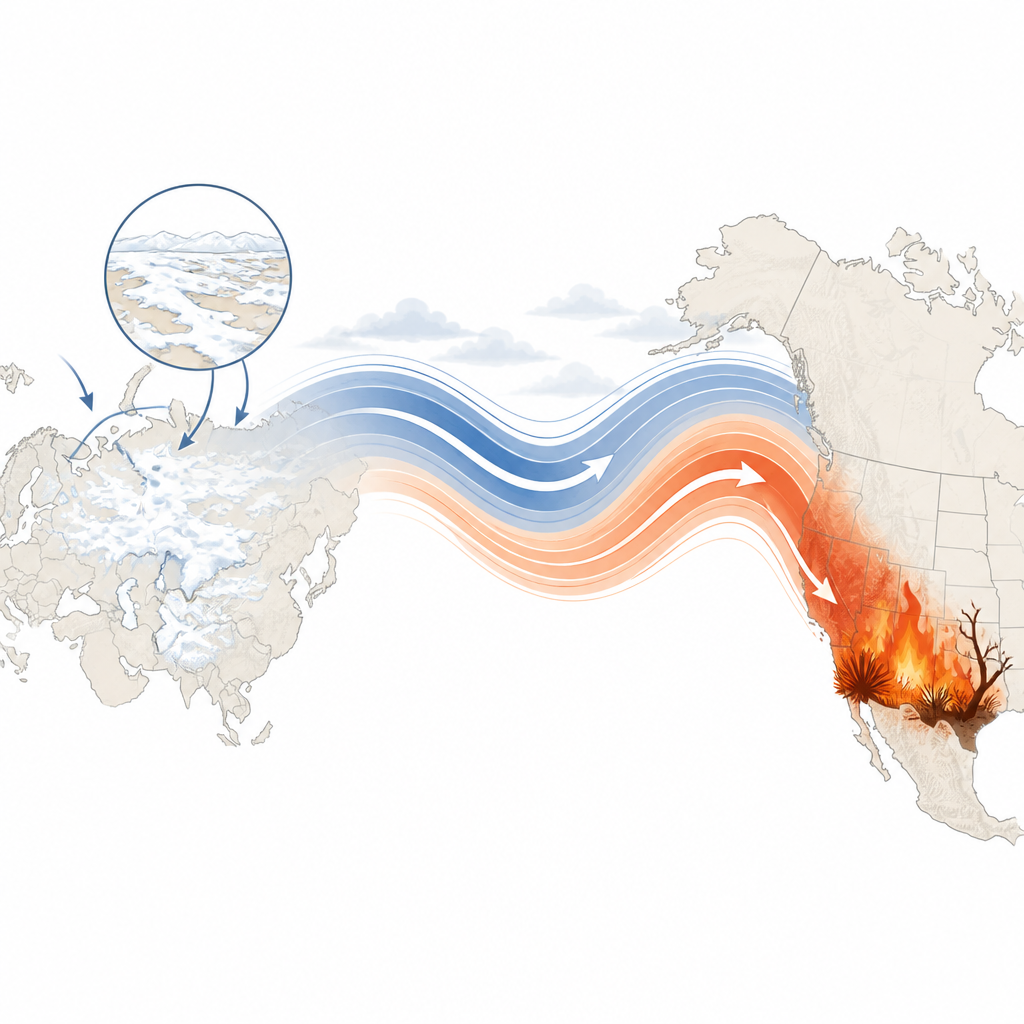
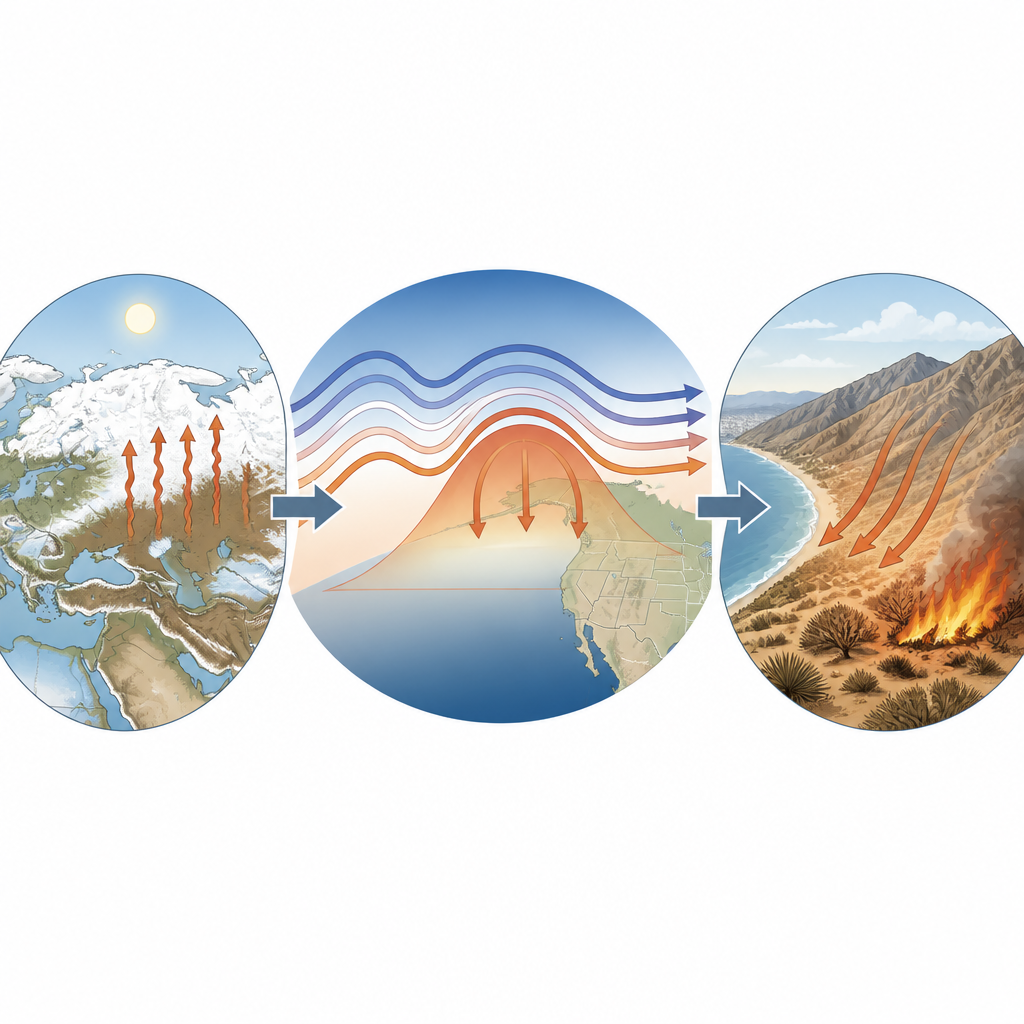
The team then asked how missing snow so far away could matter for California. Snow reflects sunlight and keeps the ground cool. When snow over western Eurasia is reduced, darker land absorbs more sunlight and the surface warms. That warming disturbs the overlying air and launches a train of large scale waves that ripple through the atmosphere across the North Pacific toward North America. Observations show that these waves encourage high pressure over the western United States in winter. High pressure brings clear skies, sinking air, and fewer clouds, which all help raise daytime temperatures and dry out the air and vegetation. In Southern California, this pattern also strengthens the region’s well known offshore winds that blow from inland mountains toward the coast, further boosting fire danger.
Testing the Link with Climate Simulations
To go beyond simple correlation, the researchers used a state of the art climate model. They ran two large sets of simulations that were identical except for one feature: the amount of snow prescribed over western Eurasia. One set used typical snow levels, while the other used the unusually low values observed in late 2024. Comparing the two revealed that reduced Eurasian snow reliably produced a high pressure system over the North Pacific and western North America, a warm west and cool east temperature pattern across the continent, and drier, hotter air over the western United States. In Southern California, these experiments generated higher vapor pressure deficit, a measure of the air’s drying power, and elevated fire weather index values, though not quite as extreme as those actually seen in 2025. The modeling suggests that the snow shortage contributed roughly one third of the drying linked to the winter fire event.
Wider Climate Patterns and Future Risk
Beyond fire, the same snow driven atmospheric waves help explain a familiar winter pattern in North America: warmer conditions in the west and colder ones in the east. The study shows that changes in western Eurasian snow cover are one piece of the puzzle behind this temperature contrast, alongside other shifting wind patterns and ocean temperatures. Looking ahead, the authors note that climate models often struggle to reproduce the observed strength of the snow–atmosphere connection, making it hard to predict how this pathway will evolve as the planet warms and snow seasons shorten. Still, the work indicates that snow cover in distant lands can be a useful ingredient in seasonal outlooks for winter fire danger in California.
What This Means for People in Fire Country
In plain terms, this research uncovers a surprising bridge between faraway winter snows and the risk of dangerous fires in Southern California. When early winter snow is scarce over western Eurasia, it can tilt the odds toward warmer, clearer, and drier conditions over the American West a month or two later, while also stiffening the winds that drive flames. This distant influence does not by itself cause a wildfire, but it helps load the dice for an unusually risky winter season. Tracking Eurasian snow cover, alongside better known climate signals, could therefore offer communities and decision makers an earlier heads up about heightened winter fire risk in the years to come.
Citation: Liu, S., Hu, S. & Seager, R. A snow-fire bridge mechanism for the 2025 Southern California winter wildfire. Nat Commun 17, 4169 (2026). https://doi.org/10.1038/s41467-026-70827-z
Keywords: winter wildfire, Eurasian snow cover, atmospheric teleconnection, Southern California climate, fire weather index