Clear Sky Science · en
Liquid metal universal grippers for gentle, adaptable, multiscale manipulation
A Soft Robot That Flows Like a Living Cell
Imagine a robotic hand that can gently pick up a dandelion seed, a live fish, a grain of dust, and a heavy piece of fruit, all with the same tiny device—and do it underwater, in acid, or in open air. This study introduces exactly that: a "universal gripper" made from liquid metal that flows and reshapes itself much like an amoeba, allowing machines to handle objects that are too fragile, too small, or too oddly shaped for today’s robots.
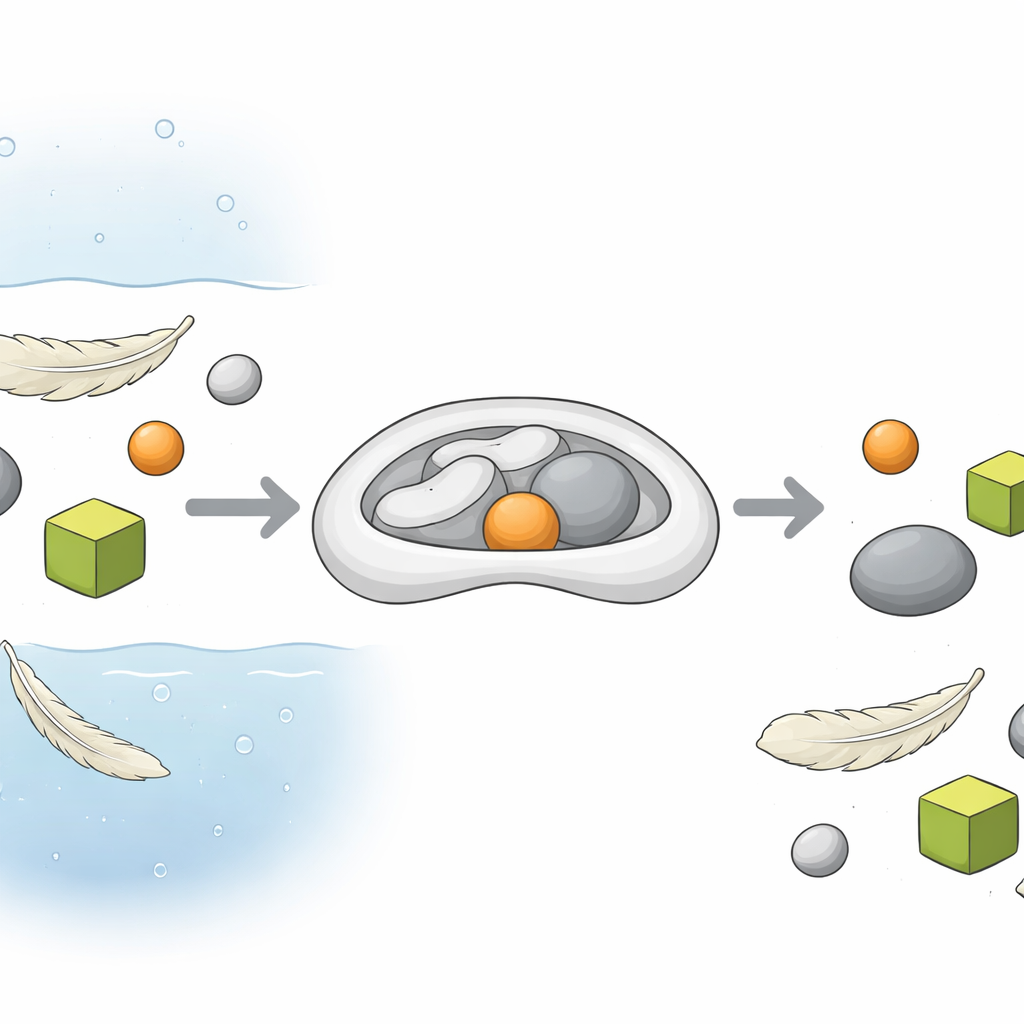
Why Gentle Gripping Is So Hard
Conventional robot hands are great at grabbing sturdy, regular items, such as boxes or tools, but they struggle with delicate, soft, or microscopic targets. Multi-fingered hands can crush fragile objects or miss tiny ones. Grippers that enclose items in soft bags or use grains that jam together can adapt to shape, but they often need bulky pumps or heaters and still cannot hold fast-moving creatures or very tiny parts securely. Adhesive-based tools can pick up microscopic chips or fibers, yet they have trouble letting go on command. Across factories, labs, and biological research, this leaves a major gap: how to grasp and then cleanly release everything from living organisms to microdevices, over an enormous range of sizes and in very different environments.
Borrowing a Trick From Amoebas
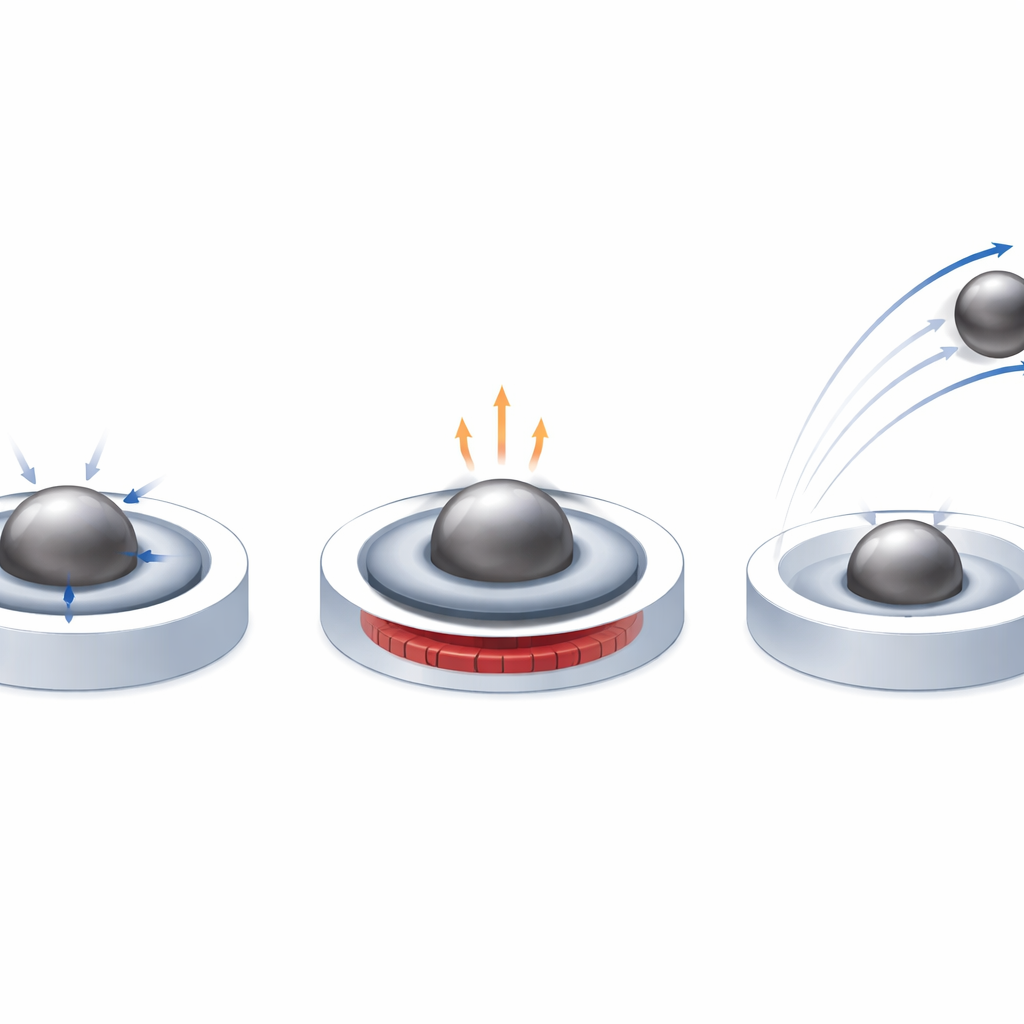
Amoebas, single-celled organisms, solve this problem with a body that behaves like a very soft fluid. They flow around prey, envelop it, and later squeeze it out. The researchers mimic this strategy using droplets of gallium-based liquid metal mixed with tiny iron particles. At room temperature these metals stay liquid, yet they can dramatically change how tightly their surface pulls together when a small voltage is applied. In the new liquid metal universal gripper, a droplet sits inside a soft 3D-printed cavity, in contact with a thin layer of salty liquid. When the team applies an electric signal, the metal’s surface tension nearly vanishes and it spreads, wrapping around whatever object is nearby—whether a glass bead, a twisted shell, or a live worm—both in liquids and in air.
From Soft Flow to Strong Hold
To turn this flowing droplet into a firm hand, the device uses magnetism. Because the metal contains iron particles, turning on an electromagnetic coil under the cavity makes the fluid behave more like a soft solid. The wrapped metal then interlocks with the object’s surface, giving it surprising strength. The gripper can hold objects weighing up to about 200 grams—such as peppers, oranges, or broccoli—while still working at millimeter scales. Smaller versions are especially efficient, supporting payloads more than a thousand times the mass of the liquid metal they contain. At the same time, the contact pressure can be kept as low as about 10 pascals, far below what would damage tofu, jellylike algae, or many small animals, making it exceptionally gentle.
Letting Go at Lightning Speed
Releasing tiny objects is often harder than grabbing them, because invisible forces like adhesion and surface tension make them stick. Here, the same liquid metal offers a built‑in solution. By switching the electric signal, the metal’s surface tension snaps back to a very high value. The droplet retracts, much like a stretched rubber band that suddenly lets go, flinging away whatever it was holding. Experiments show that a human hair or microscopic particles can be launched in just a few thousandths of a second, reaching accelerations up to about 42 times Earth’s gravity—faster than any other reported gripper. Importantly, the researchers can tune this release speed by adjusting the voltage, trading power for safety when handling especially fragile samples.
Handling Life Without Harm
To test whether such dramatic actions are safe for living tissues, the team used the gripper to move early zebrafish embryos—tiny, sensitive spheres often used in biology labs. Compared with a standard pipette, the liquid metal tool worked much faster and with a higher success rate, yet the embryos showed no extra signs of stress, deformities, or impaired movement as they developed. The gripper also caught fast-moving cockroaches, wriggling earthworms, and slippery baby fish without apparent harm, hinting at future uses in ecology, aquaculture, and biomedical research where precise yet gentle handling is essential.
A New Kind of Universal Robotic Touch
The study shows that by controlling how a liquid metal droplet flows, stiffens, and snaps back, one device can grasp and actively release objects spanning roughly 14 orders of magnitude in weight, from microscopic beads to everyday produce, and do so in air, seawater, alkaline, or acidic solutions. For non-specialists, the key message is that robots no longer need different hands for every task: a single, amoeba-like liquid metal gripper could someday let machines interact safely with everything from living cells to fragile electronics, bringing a more adaptable, gentle, and precise touch to both industry and medicine.
Citation: Chen, X., Zhang, M., Cao, L. et al. Liquid metal universal grippers for gentle, adaptable, multiscale manipulation. Nat Commun 17, 3548 (2026). https://doi.org/10.1038/s41467-026-70313-6
Keywords: soft robotics, liquid metal, universal gripper, microscale manipulation, biomedical handling