Clear Sky Science · en
The psychoactive cannabinoid THC inhibits peripheral nociceptors by targeting NaV1.7 and NaV1.8 nociceptive sodium channels
How a Famous Cannabis Compound May Numb Pain at Its Source
Many people know that cannabis can ease pain, often assuming it works mainly by changing how the brain senses discomfort. This study reveals another, less familiar side of the story: the main psychoactive ingredient in cannabis, THC, can also act directly on the tiny pain-sensing nerves in our skin and tissues. By showing that THC quiets these nerve endings through a mechanism similar to local anesthetics, the work hints at new ways to design pain medicines that tap into cannabis chemistry without relying only on its mind-altering effects.
From Whole-Body High to Local Pain Control
THC is best known for binding to cannabinoid receptors in the brain and spinal cord, which produces both the “high” and some of its pain relief. But pain signals actually start far from the brain, in specialized nerve cells called nociceptors that detect harmful heat, pressure, or chemicals. These cells use tiny molecular gates, called sodium channels, to fire electrical impulses toward the spinal cord. Earlier research showed that non-psychoactive cannabis compounds like CBD and CBG can dampen these sodium channels, especially two forms known as NaV1.7 and NaV1.8, which are strongly linked to pain. Until now, it was unclear whether THC itself could act on these same gates in peripheral nerves. 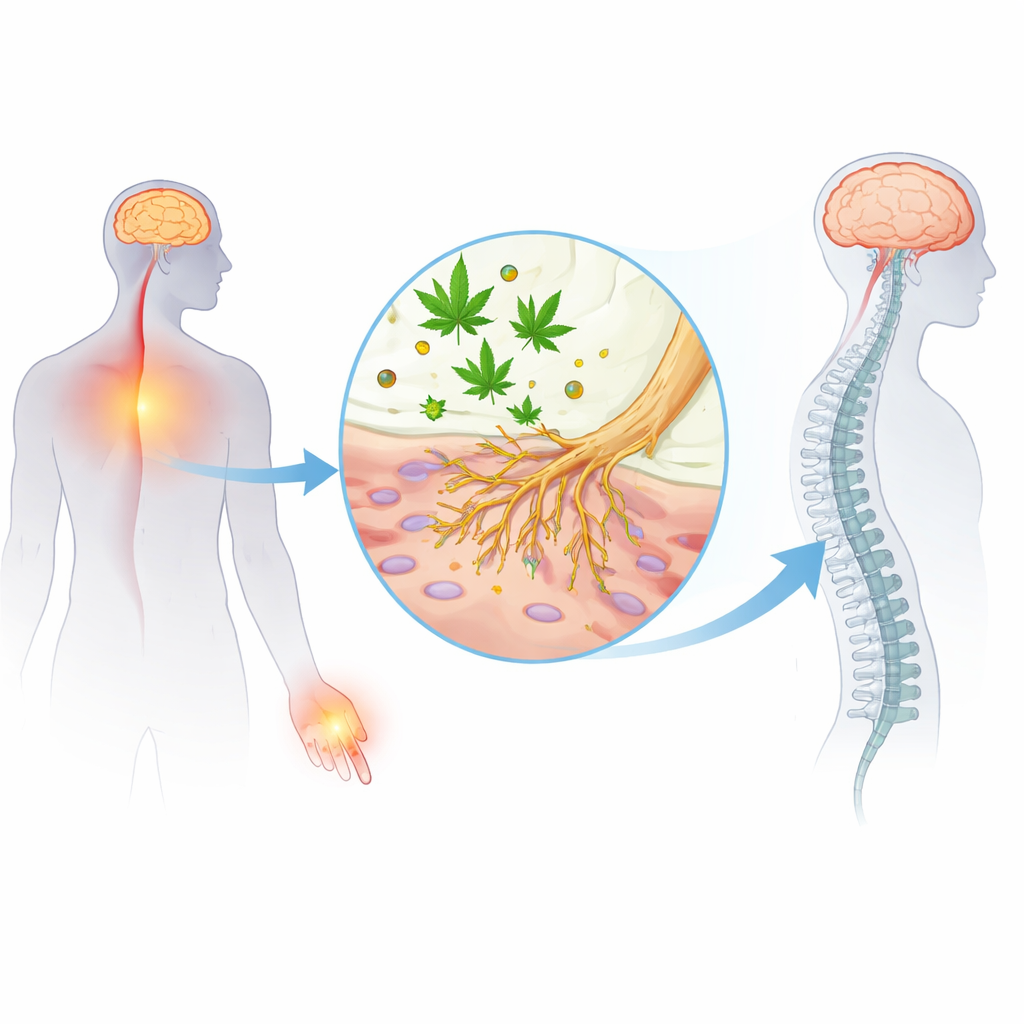
Testing THC on Pain-Sensing Nerves
To answer this, the researchers isolated pain-sensing neurons from rat trigeminal ganglia, a cluster of nerve cells that transmit facial and head pain. Using fine glass electrodes, they recorded how easily these neurons fired electrical spikes—action potentials—when stimulated. Even when a classic sodium-channel blocker (tetrodotoxin) was present, adding THC sharply reduced the neurons’ firing, and did so at micromolar concentrations that are realistic for tissues after cannabis use. This showed that THC can directly calm nociceptors, and that its effect is especially strong on a subset of sodium channels that resist tetrodotoxin, which are key for repetitive firing during ongoing pain.
Zeroing In on Two Critical Sodium Gates
The team then expressed individual human sodium channel types in cultured cells so they could see exactly which ones THC affects. They found that THC potently inhibited NaV1.7 and NaV1.8—the forms heavily involved in pain—while leaving other major sodium channel types essentially untouched. THC made these channels more likely to sit in an “inactivated” non-conducting state, a behavior characteristic of drugs that act like local anesthetics. When the researchers altered specific amino acids that form the classic binding pocket for local anesthetic drugs, THC became much less effective and lost its state-dependent behavior. This pinpointed the same pocket as a key docking site for THC on NaV1.8, strongly suggesting that THC acts as a local anesthetic–like blocker at these pain-related channels. 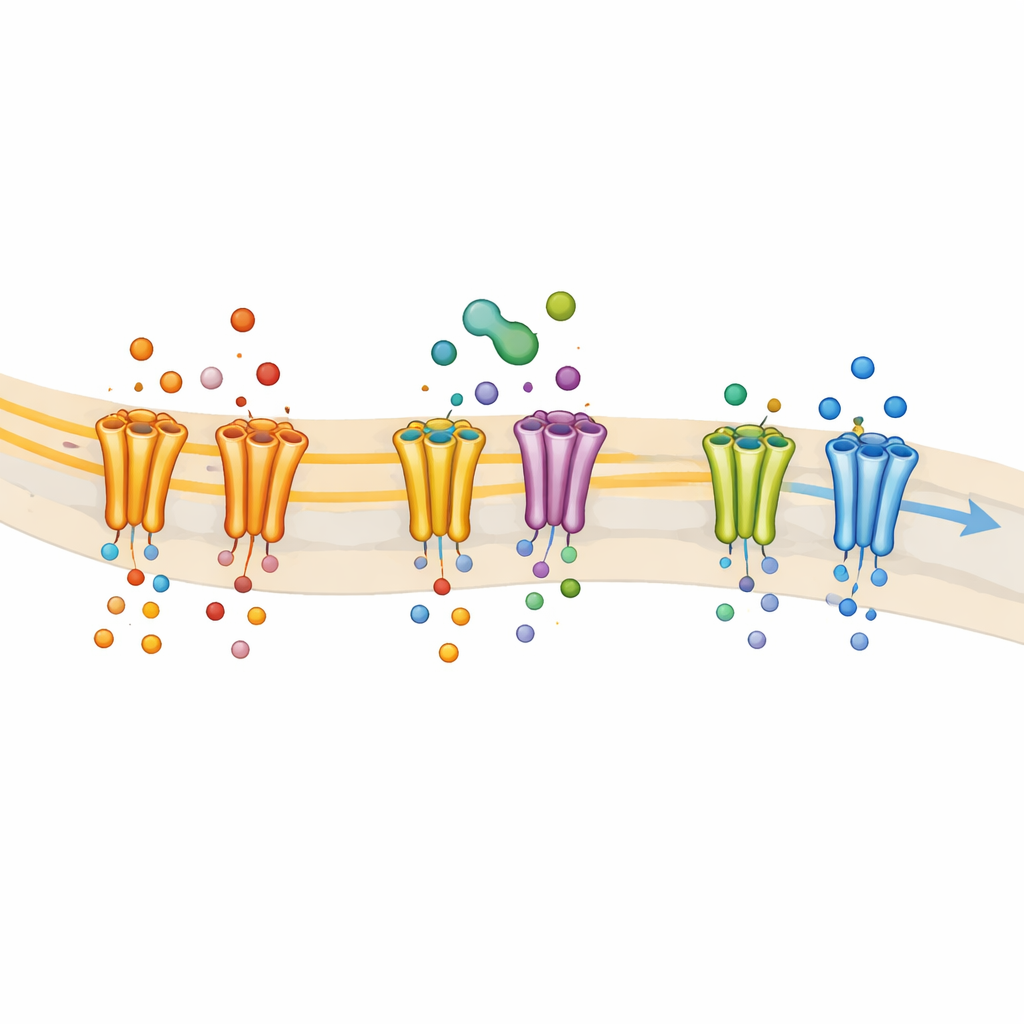
Comparing THC to Its Non-Psychoactive Cousins
The scientists also compared THC with several other plant cannabinoids. All of them, including CBD, CBG, and cannabichromene (CBC), could inhibit NaV1.7 to a similar degree. NaV1.8, however, was more selective: it was strongly blocked by CBD and CBG but less so by THC and CBC. These differences likely arise from subtle structural features in each molecule and how well they fit into the local anesthetic pocket. Because NaV1.8 plays a major role in sustaining repetitive firing in nociceptors, this selectivity helps explain why non-psychoactive cannabinoids can sometimes appear more potent than THC in dampening pain-signal traffic, even though they share related chemical backbones.
What This Means for Future Pain Treatments
Altogether, the study shows that THC is not only a brain-acting drug; it can also directly silence pain-sensing nerve endings by plugging key sodium channels much like a local anesthetic. By targeting NaV1.7 and NaV1.8 in the periphery while sparing other sodium channels, THC helps reduce the intensity of pain signals before they even reach the spinal cord. This insight clarifies part of how cannabis eases pain and suggests a promising path forward: designing THC-inspired compounds that stay largely outside the brain yet home in on peripheral nociceptors. Such drugs could offer meaningful pain relief with fewer psychoactive side effects, blending the precision of modern ion-channel pharmacology with the long history of cannabis-based medicine.
Citation: Maatuf, Y., Iskimov, A., Binshtok, A.M. et al. The psychoactive cannabinoid THC inhibits peripheral nociceptors by targeting NaV1.7 and NaV1.8 nociceptive sodium channels. Neuropsychopharmacol. 51, 1091–1099 (2026). https://doi.org/10.1038/s41386-026-02355-9
Keywords: THC, pain signaling, sodium channels, peripheral nerves, cannabinoid analgesia