Clear Sky Science · en
Ritual ceramics from Early Iron Age funerary contexts at Domasław, Lower Silesia, Poland
Ancient graves and the secrets in their pots
Imagine trying to reconstruct a long-vanished funeral ceremony when all that remains are broken pots and a scattering of bones. This study looks at just such traces from an Early Iron Age cemetery in Domasław, in today’s southwest Poland, to find out not only how people buried their dead, but what kinds of oils, fats, resins, and perhaps even mind‑altering mixtures they used in the process. By combining archaeology with chemical detective work, the authors show that some vessels really were “special” ritual tools, not just everyday dishes reused for the grave.
Life and death around a vast burial ground
The Domasław cemetery, used roughly in the 8th–6th centuries BC, is one of the largest prehistoric burial grounds in the region, with more than 2000 graves and about 9000 ceramic vessels. Most graves contain coordinated sets of large vases and pots for storing and pouring, plus bowls and cups for serving and drinking—equipment for feasting with and for the dead. Mixed in with these are unusual pieces: animal‑shaped spouted vessels, incense burners, miniature flasks, plate‑like discs and small idols, and containers placed in odd locations such as grave roofs, ditches, or separate pits. Archaeologists suspected these oddities played special ceremonial roles, but their exact function remained uncertain.
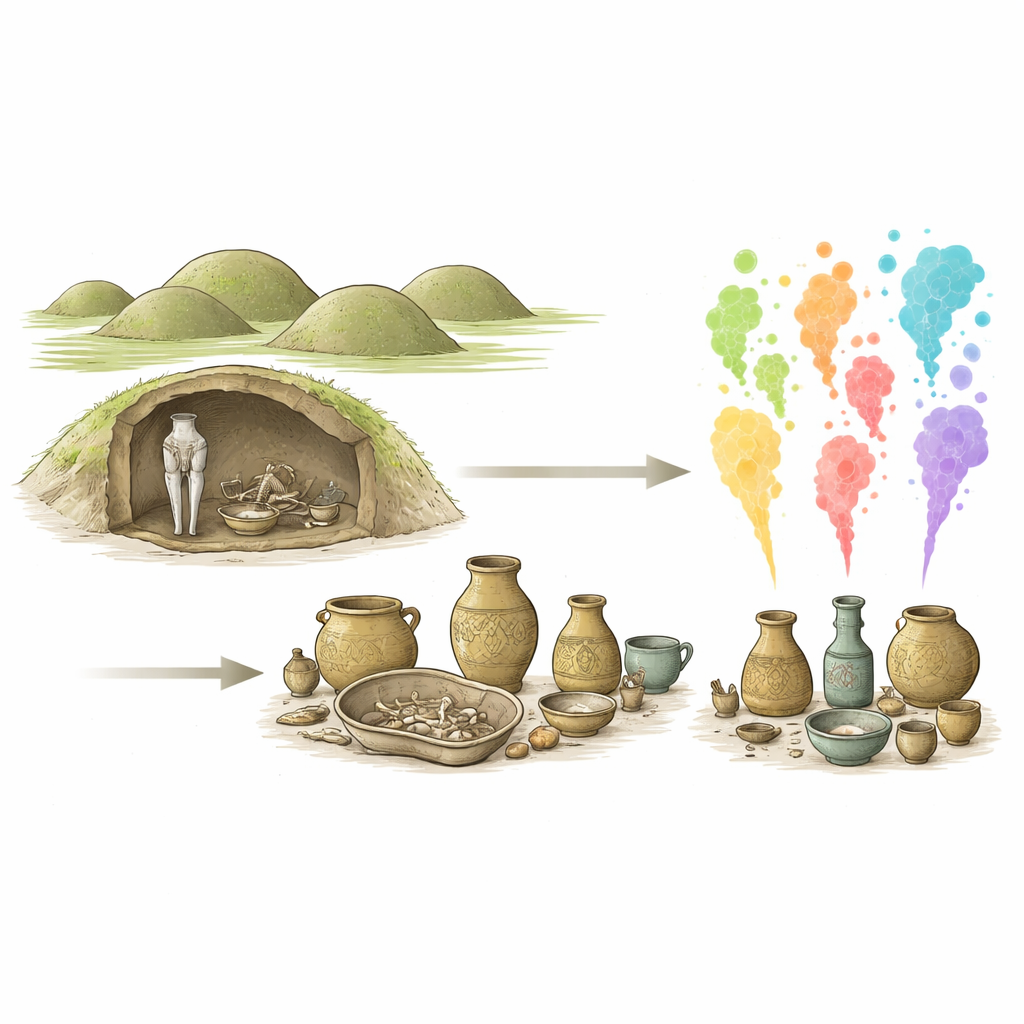
Turning pots into chemical witnesses
To test whether “ritual” vessels were really used differently from the standard grave set, the team sampled 40 such special pieces and compared them with 34 more ordinary vases, pots, bowls, and cups. Using gas chromatography–mass spectrometry, they extracted traces of ancient fats and other molecules that had soaked into the ceramic walls. Instead of hunting for single “smoking gun” ingredients, they looked for broader patterns: the presence or absence of groups of compounds and the overall mix of fatty acids. Statistical tools then checked whether certain vessel types clustered together chemically or blended into the cemetery average.
What was inside the ritual ceramics?
Several recurring chemical suites emerged. Many special vessels carried signs of plant oils, animal fats, and conifer products—suggesting mixtures of oily, resinous, and sometimes aromatic substances. Added or offering vessels placed outside chambers or in grave roofs often showed oxidized plant or animal lipids and conifer markers, hinting at libations, anointing, or burning of scented mixtures rather than everyday cooking. Miniature rhyta—tiny flasks and vases found near urns or disc‑plates—contained combinations consistent with seeds, nuts, berries, plant oils, and animal fats, much like small containers for perfumes or balms. Unusual forms such as zoomorphic rhyta, kernoi, and censers also pointed to plant oils, resins, and possibly grain‑based products, again matching roles in pouring, warming, or burning offerings during ceremonies.
Ordinary urns, extraordinary uses
The containers that held cremated bones were not chemically dull. Urns shared many of the same oily and resinous signatures as the ritual group, including markers compatible with conifer resins and aromatic plants. One urn‑like vessel in a symbolic grave contained a particularly rich mix of compounds associated with fragrances and possibly medicinal or psychoactive plants. Across the cemetery, a few pots and bowls—not all in the “special” category—yielded tentative traces of stimulant and hallucinogenic substances such as ephedrine‑like and DMT‑like molecules, though the authors stress that these identifications remain cautious and require further testing.
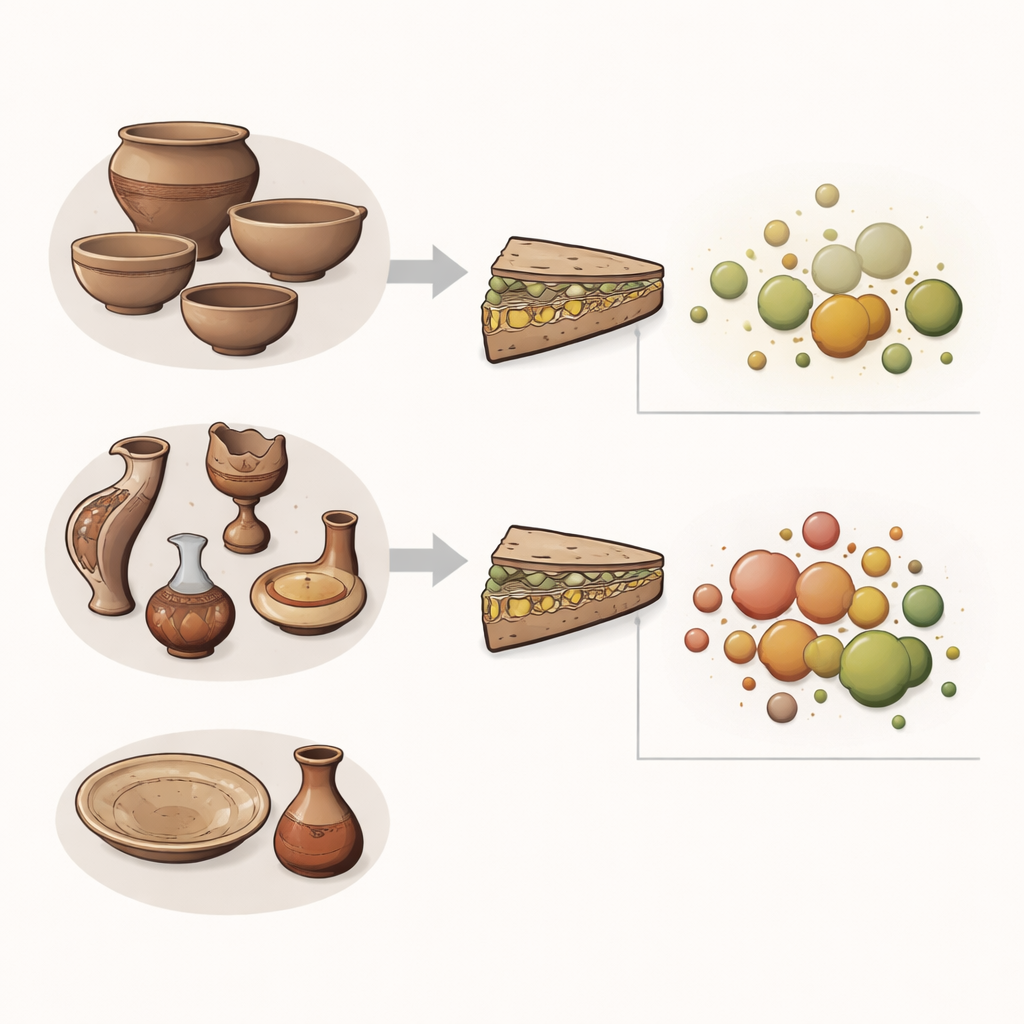
Seeing patterns in invisible traces
When the researchers compared the chemical fingerprints as simple yes/no patterns rather than exact quantities, clear differences emerged. Added or offering vessels and formally special shapes formed distinct groups compared with the cemetery baseline; urns and miniature rhyta, in contrast, overlapped more with ordinary containers. Certain compounds, such as azelaic acid and tiglic acid, stood out as strong statistical markers for particular ritual categories, often appearing together with conifer‑derived molecules. This suggests that a limited repertoire of oily and resinous mixtures was used repeatedly across different ceremonial tools, following shared rules rather than random improvisation.
Ritual pots as tools of scent, touch, and transformation
To a non‑specialist, the key message is that these were not just random old pots. By reading the faint chemical ghosts trapped in their walls, the study shows that Early Iron Age mourners at Domasław routinely handled combinations of plant oils, animal fats, resins, and aromatics during funerals—anointing bodies and objects, pouring offerings, and perhaps occasionally working with psychoactive brews. Certain vessel types and placements really were “special,” marked by distinct chemical histories that matched their unusual shapes and positions in the grave. Together, the pattern reveals a carefully choreographed ritual world in which scent, taste, and touch helped guide the dead—and the living—through the drama of burial.
Citation: Józefowska, A., Sekulska-Jaworska, J., Gocławski, J. et al. Ritual ceramics from Early Iron Age funerary contexts at Domasław, Lower Silesia, Poland. npj Herit. Sci. 14, 262 (2026). https://doi.org/10.1038/s40494-026-02517-4
Keywords: archaeology, funerary rituals, organic residue analysis, Iron Age Europe, ritual ceramics