Clear Sky Science · en
Can Chinese negative structures distinguish between children with developmental language disorder and children with autism spectrum disorder plus language impairment?
Why this matters for everyday communication
Parents, teachers, and clinicians often meet children who struggle to express themselves, and it can be hard to know whether those challenges stem from a language disorder, autism, or both. This study looks at a very specific—but everyday—piece of language in Mandarin Chinese: saying that something did not or cannot happen. By zooming in on how children form these common negative sentences, the researchers show that two groups of children who sound similarly delayed on the surface are actually having difficulty for different underlying reasons. That distinction can change how we assess and support them.
Two ways to say “no” in Chinese
Mandarin uses two main patterns to express negative meanings in the situations studied here. One pattern, called Structure B, is used to say that someone is not able to do something—like “cannot erase the cat.” The other, Structure M, is used to say that an event has not been completed—like “has not erased the cat yet.” Although both patterns contain a verb, a negative word, and a result word, they differ in where the negative word goes and in what exactly is being denied: ability versus actual outcome. Mastering these patterns requires children not only to know the words, but also to understand which part of the sentence the “not” should cover—its “scope”—and how that matches what they see in the world.

Game versus video: two ways to ask the same question
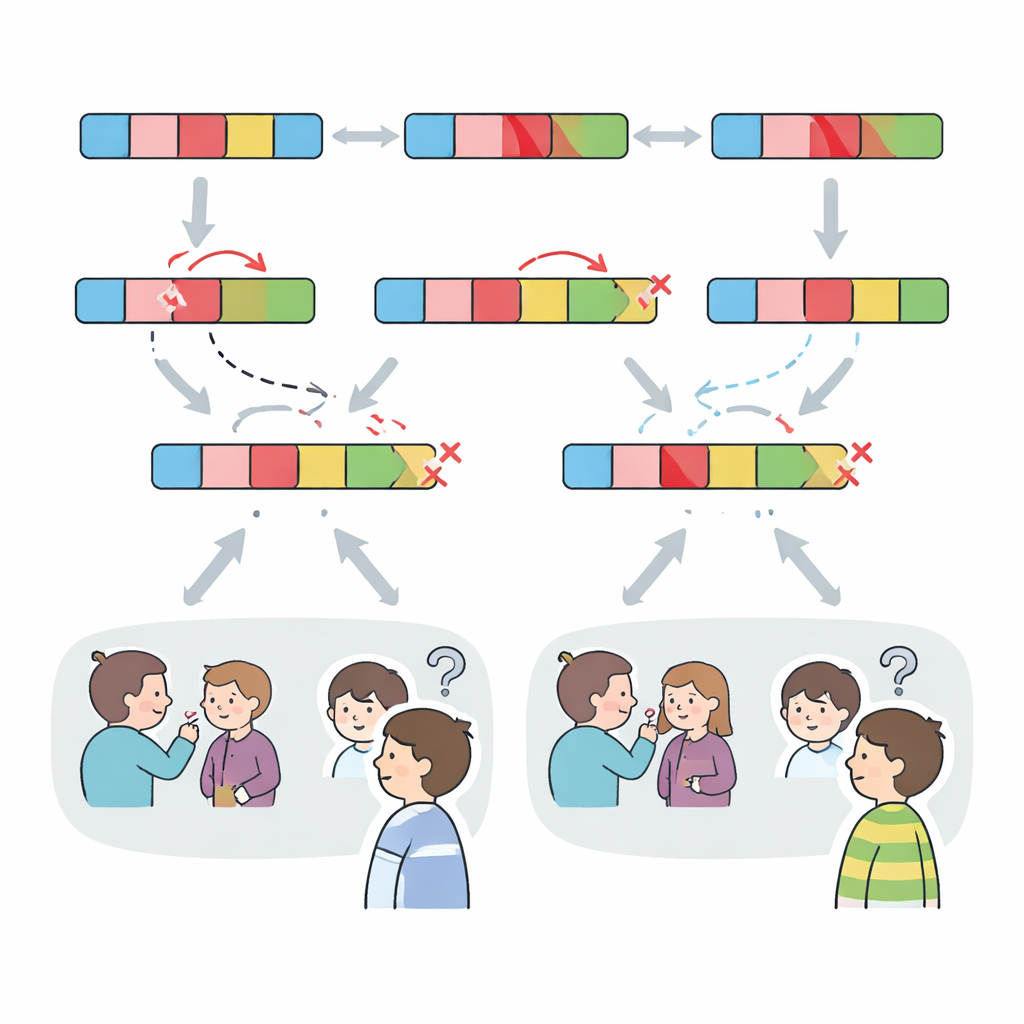
To explore how children use these negative patterns, the researchers worked with three groups of Mandarin-speaking children around five years old: those with developmental language disorder (DLD), those with autism plus language impairment (ALI), and typically developing age-matched peers. Children completed two kinds of tasks. In a video task, they watched short clips of an adult trying, sometimes failing, to complete actions such as erasing a drawing, opening a door, or tearing paper. They then answered questions that prompted either ability-style negatives (Structure B) or outcome-style negatives (Structure M). In a game task, children themselves attempted to do similar actions—for example, erasing a pencil drawing but not a printed picture—and answered nearly identical questions about their own performance. This clever design let the team compare how children talk about another person’s attempts versus their own.
What children got right and wrong
Typically developing children almost always produced the expected sentences for both patterns in both tasks. Children with DLD and those with ALI looked similar at first glance: they both struggled with the outcome-style pattern, Structure M, often mixing it up with the ability-style pattern. But important contrasts emerged. For Structure B, children with DLD performed about as well as typical children, whereas children with ALI did noticeably worse, especially in the video task where they had to judge another person’s ability by reading facial expressions and body language. In the game task, where they only had to judge their own success, the ALI group improved. The researchers also examined the exact “wrong” sentences. Children with DLD produced more responses that were ungrammatical or structurally odd, suggesting trouble deciding exactly how far the negative meaning should extend within the sentence. Children with ALI, in contrast, mainly produced sentences that were grammatical but did not quite answer the question asked, such as denying that something was finished when the question was really about ability, or vice versa.
Hidden causes beneath similar symptoms
By looking closely at both correct and incorrect answers, the study argues that the two groups’ difficulties come from different places. For children with DLD, the pattern of errors points to a problem with managing the internal mechanics of sentences—specifically, assigning the correct “scope” to negative words so that the right part of the action is being denied. Their performance did not really change between the video and game tasks, which suggests that reading social cues was not their main obstacle. For children with ALI, the opposite pattern emerged: they seemed capable of building well-formed sentences, but had trouble keeping track of what, exactly, the question was about and how the sentence should fit the situation. Their performance improved when the task relied less on inferring someone else’s intentions and more on talking about their own actions, pointing to broader challenges with social understanding and pragmatic use of language.
What this means for labels and support
To a casual listener, children with DLD and children with autism plus language impairment may sound similarly “behind” in language, but this study shows that they can struggle for very different reasons—one more rooted in sentence structure, the other more in social use of language and inference. That insight matters for diagnosis and for help: it suggests that professionals should not rely on broad labels or overall test scores alone, but should analyze how children respond, which tasks are harder or easier for them, and what types of mistakes they make. Tailoring assessment and intervention to these deeper differences—using playful, child-friendly settings like the game task—can lead to more precise support for children’s everyday communication.
Citation: Dai, H., He, X. & Yin, C. Can Chinese negative structures distinguish between children with developmental language disorder and children with autism spectrum disorder plus language impairment?. Humanit Soc Sci Commun 13, 583 (2026). https://doi.org/10.1057/s41599-026-06873-1
Keywords: developmental language disorder, autism spectrum disorder, Chinese negation, child language, pragmatics