Clear Sky Science · en
Deep differences: expanding the marine social sciences and humanities into the deep ocean
Why the deep ocean matters to all of us
Far below the waves, in cold and lightless waters, the deep ocean quietly helps regulate our climate, supports unique life, and now faces rising human pressure. This article explains why these hidden depths are closely linked to our economies, cultures, and rights, and why experts in history, law, economics, and other social fields are urgently needed alongside biologists and geologists to understand and guide our relationship with this vast part of the planet.
A hidden world with special rules
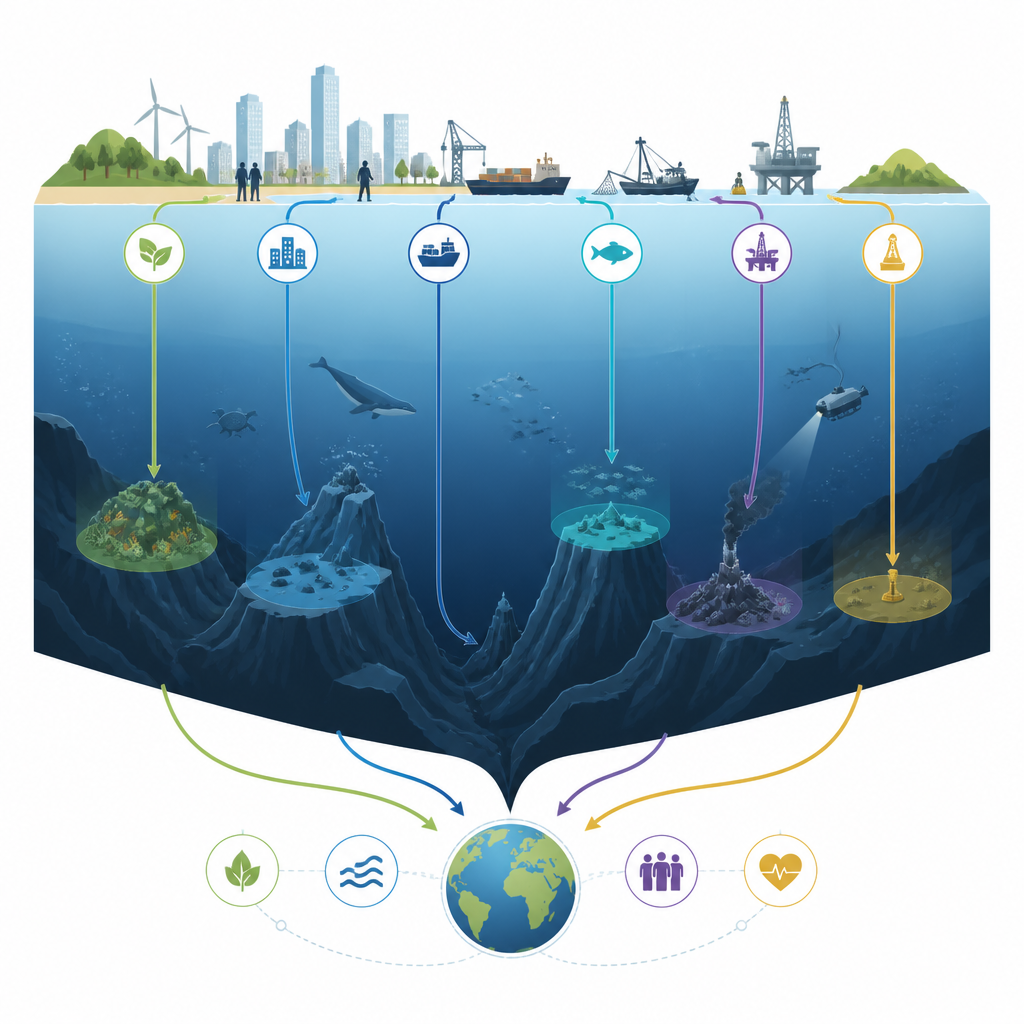
The deep ocean, generally deeper than 200 meters, makes up most of the ocean by volume and much of the seafloor beneath both national and international waters. It is a mosaic of environments, from underwater mountains and canyons to hot vents and cold seeps, shaped by darkness, high pressure, and low temperatures. These conditions produce slow growing, long lived species and tightly linked ecosystems that recover extremely slowly from damage, if at all. At the same time, deep waters store large amounts of human made carbon and absorb much of the excess heat trapped by greenhouse gases, tying deep sea processes directly to the global climate and to life on land.
How people already shape the depths
For a long time, many assumed the deep ocean was nearly empty and beyond human reach, which helped justify waste dumping and plans to mine metal rich nodules with little thought for ecology. New technology has overturned that view, revealing rich communities living on the seafloor and in the deep water column, as well as far reaching climate roles. Yet only a tiny fraction of this realm has been observed. This limited knowledge creates what the authors call epistemic challenges: big gaps in data, high research costs, and unequal access to ships and tools. These gaps influence global climate and biodiversity assessments, the way risks are judged, and whose voices count in decisions, from Indigenous knowledge holders to scientists in countries with few resources.
Growing demands and old patterns of inequality
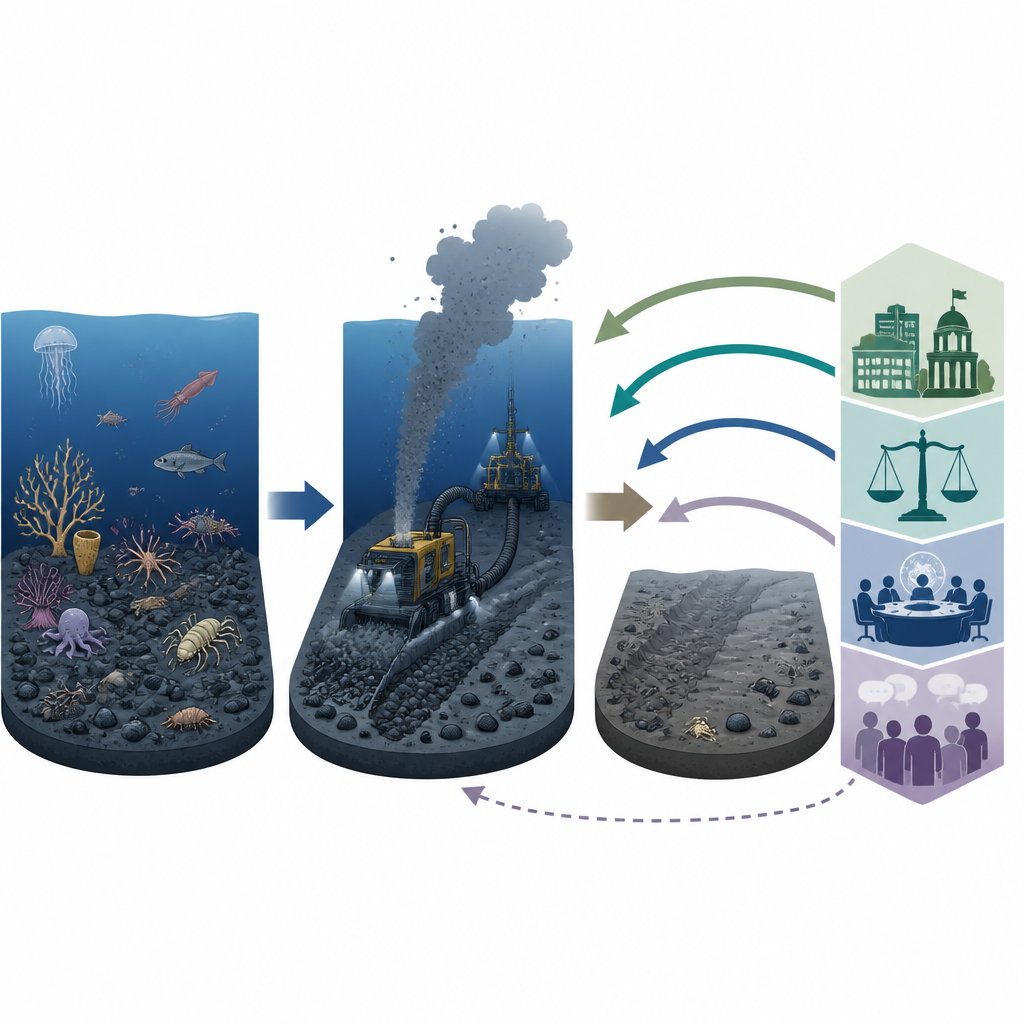
Advances in technology have opened the deep ocean to many forms of extraction, including deep sea fishing, oil and gas drilling, possible mineral mining, and proposals to store carbon in the deep sea. These activities are often wrapped in the language of a “blue economy” that promises both growth and sustainability. But deep sea fish tend to be slow to reproduce, making some catches more like mining than farming, and trawling or mining can leave long lasting scars on the seafloor. Economic tools used to place a price on deep sea damage struggle with both scientific uncertainty and low public awareness, so harm may be underestimated. Wealthy states and companies dominate exploration and extraction, while the environmental costs and social risks can fall on poorer nations and coastal or island communities, echoing older patterns of colonialism and uneven power.
Stories, memories, and rights in the deep
The deep ocean also holds human stories that standard maps and laws often miss. Ship routes used in the transatlantic slave trade, for example, turned parts of the Atlantic seabed into mass graves, a form of underwater cultural heritage that has barely entered legal debates. For many Indigenous peoples, deep waters and seafloor features are home to guardian beings and are woven into spiritual and legal traditions that do not fit neatly into ideas of private ownership or resource frontiers. The article argues that recognizing such histories and worldviews can reshape how decisions are made about deep activities like mining or carbon storage. New human rights language, including the right to a clean, healthy, and sustainable environment, now explicitly extends to the whole ocean and could support closer work between deep sea scientists, lawyers, and affected communities.
Rethinking how we govern the depths
Current ocean rules were built mainly around horizontal lines on a map, separating territorial seas, exclusive economic zones, and the high seas. The three dimensional nature of the deep ocean cuts across these zones and across different agencies that manage mining, fishing, conservation, and new climate related activities. This leads to fragmented oversight, gaps in impact assessment, and weak coordination between institutions that may pursue conflicting goals. The authors see promise in tools such as broader environmental and social impact assessments, three dimensional marine planning, and area based protections, but note that these all must account for deep uncertainty, limited data, and hard to monitor activities far from shore.
What this means for our shared future
In plain terms, the deep ocean is no longer a distant backdrop; it is becoming central to climate stability, resource debates, cultural identity, and human rights. The article concludes that social sciences and humanities need to “go deep” just as natural sciences have, treating the deep ocean as a distinct category with its own histories, values, and power struggles. Doing so can support fairer and better informed decisions about who benefits from the deep, who bears the risks, and how societies can act as responsible stewards of a realm on which we depend but barely know.
Citation: Lidström, S., Craik, N., Alfaro-Lucas, J.M. et al. Deep differences: expanding the marine social sciences and humanities into the deep ocean. npj Ocean Sustain 5, 24 (2026). https://doi.org/10.1038/s44183-026-00200-6
Keywords: deep ocean, marine social science, deep seabed mining, ocean governance, Anthropocene