Clear Sky Science · en
Assessing the status and challenges of vulnerability to viability transitions: small-scale fisheries in the transboundary Sundarbans mangrove forest
Why this mangrove story matters to you
The Sundarbans, the world’s largest mangrove forest straddling India and Bangladesh, feeds and shelters millions of people. Yet the small boats working these tangled waterways are caught in a web of poverty, dangerous weather, wildlife attacks, and clashing rules at the national border. This study looks closely at how those pressures make fishing families vulnerable, and what it would take for their work to become secure and sustainable instead.
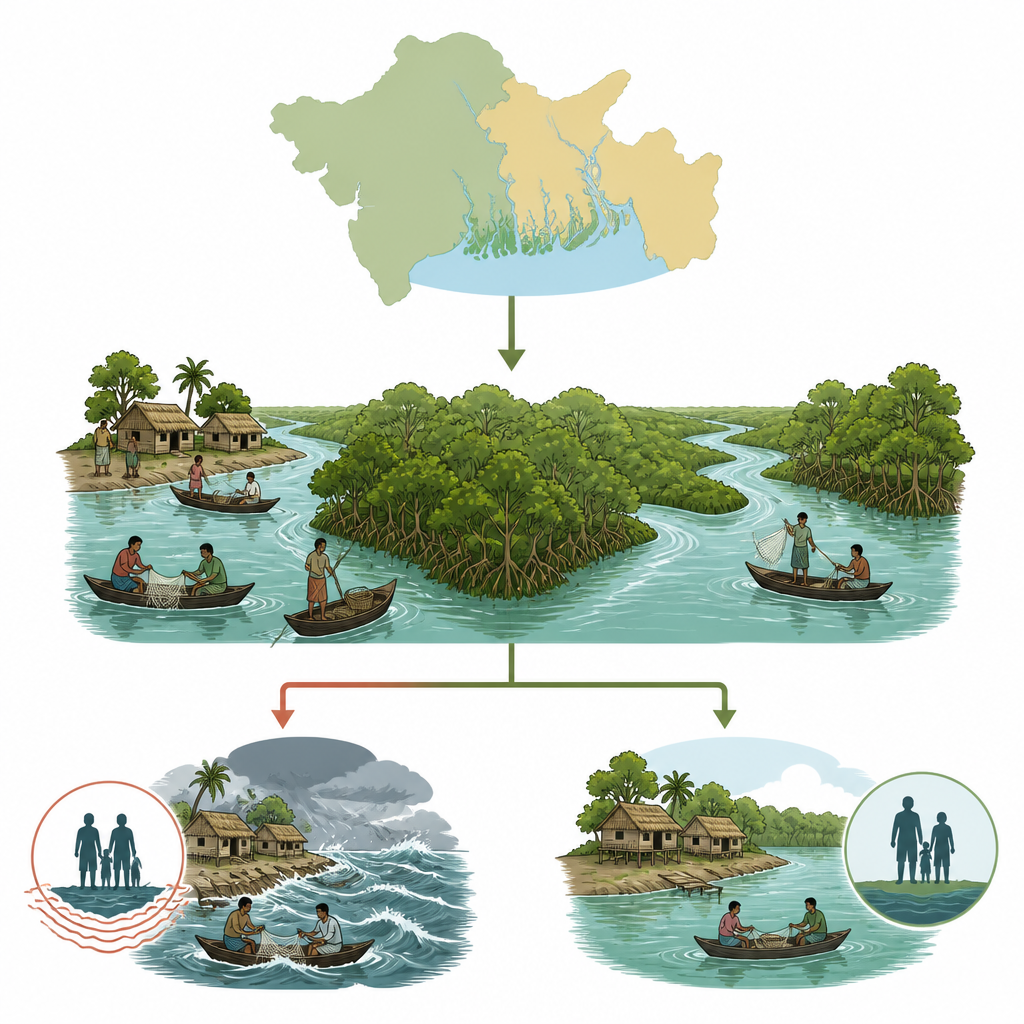
Life and work in a shared water world
The Sundarbans cover about ten thousand square kilometers of swampy islands and tidal creeks in the Bay of Bengal. Fish, crabs, shrimp, honey, and forest products from this maze of roots support more than twelve million people. Most fishers use small boats, simple nets and traps, and work in groups of just a few people. Women collect shrimp larvae for fish farms, help harvest crabs, and form much of the workforce in processing plants, although they still usually depend on men for money and decisions. Younger people are turning away from fishing because catches are falling, seasons are short, and income is low, leaving mainly older workers to brave the forest.
Everyday hardship beyond the catch
Household surveys and community meetings reveal that hardship reaches far beyond what fishers bring home in their nets. Many families in both countries report poor health care, long and risky trips to clinics, and trouble providing enough nutritious food for children. When money runs short, families often cut back from three meals a day to two. Most households must buy all of their food, yet alternative jobs are scarce, usually limited to day labor on farms or in aquaculture ponds. As a result, fishers are highly dependent on the forest even as it becomes less reliable.
Storms, tigers, and the power of middlemen
On the water, fishers face a dangerous mix of cyclones, flooding, and saltier rivers, alongside attacks by tigers, crocodiles, wild boars, and snakes. Many also report confrontations with law enforcement and border patrols as they follow fish across invisible lines in the water or seek refuge during storms. A sharp decline in fish stocks, noted by most respondents, leaves them chasing fewer fish in shrinking safe areas. At the same time, many fishers must borrow boats, nets, and cash from middlemen, who demand that catches be sold back to them or that profits be shared. This debt trap encourages fishers to catch more and take greater risks just to stay afloat, while keeping a large share of the value away from the people doing the work.
Rules that do not fit the water
Although India and Bangladesh share the Sundarbans, they largely manage it as two separate spaces. Both use bans, permits, and protected zones to safeguard the forest and its wildlife. In Bangladesh, co-management committees are meant to give local people a voice, and in India, village-level forest groups exist on paper, but most fishers say they are rarely informed or asked to participate in decisions. Joint plans between the two countries have stalled, and many communities see governance as top-down and distant. This split system does not match the way fish or fishers move, turning long-standing travel and trade into border violations, fines, or jail time. As a result, people respond with quiet resistance and rule-breaking rather than cooperation.
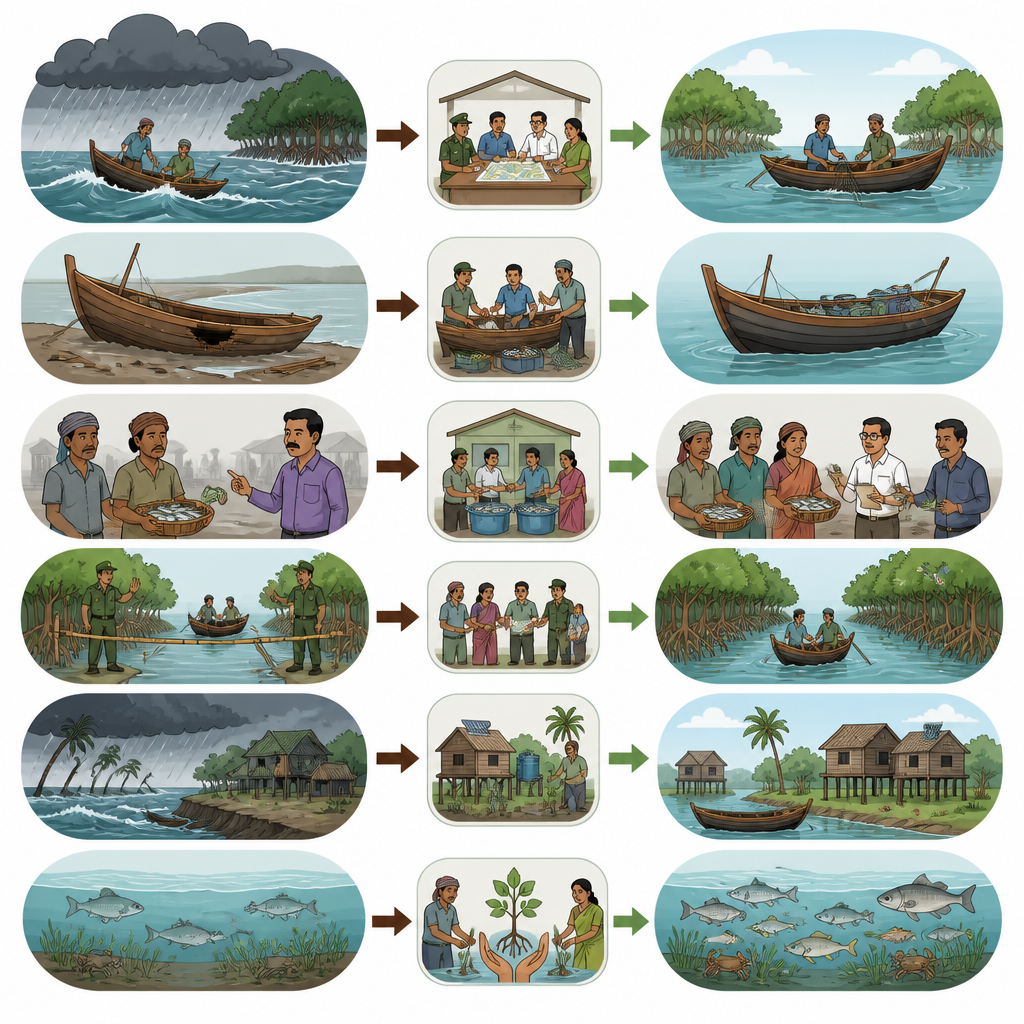
Pathways from risk to a safer future
The authors argue that these many problems are not just about bad weather or fewer fish, but about how the forest and its users are governed. They propose treating the Sundarbans as a single living system shared by two nations, with a common access scheme that respects how fish and people actually move. They call for real power-sharing with fishers and especially with women, better oversight of credit and markets to weaken exploitative middlemen, and regular checks on whether rules are helping communities as well as nature. In simple terms, the study shows that small-scale fisheries can only move from vulnerability to viability when decisions are made with fishing families, not just about them, and when their well-being is seen as a core part of protecting the mangrove forest.
Citation: Miah, M.R., Nayak, P.K., Pittman, J. et al. Assessing the status and challenges of vulnerability to viability transitions: small-scale fisheries in the transboundary Sundarbans mangrove forest. npj Ocean Sustain 5, 27 (2026). https://doi.org/10.1038/s44183-026-00189-y
Keywords: small-scale fisheries, Sundarbans mangroves, transboundary governance, fisher livelihoods, vulnerability and viability